Hardware
ISE Theatres a resounding success

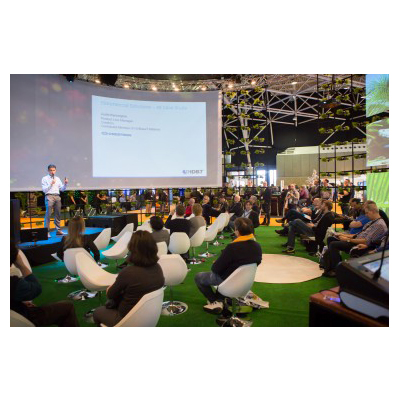
AMSTERDAM: New for ISE 2014, the Residential Solutions Theatre and Commercial Solutions Theatre have proven to be a big draw for visitors. Covering a range of topics, including audio connectivity, collaborative technology and home automation, the free-to-attend sessions have been well received throughout the show.
Lighting design was a hot topic in the Residential Solutions Theatre with independent lighting designer Tad Trylski declaring: “There is a lighting design-shaped hole in current AV systems training.

“There is a lot of expertise in controlling the light, but the gap exists in the lighting design skills themselves and/or how to work with lighting designers,” he added, during ‘The Science of Lighting Designers’.
Trylski is currently working with CEDIA on potential courses, and advises that to best use light, and make huge efficiency gains: “The qualitative design must come first. Where and when do you want the light, and what do you want to use it for?”
The biggest mistake engineers make is to work to the plan (rather than a section), and simply place lots of downlighters lighting the floor. Instead, they should light the walls (giving more perceived light with fewer lights) and specific tasks.
He gave an example of a typical developers one-bedroom apartment, where using lots of 50W downlighters used 1,200W (with other lights adding more than 600W), whereas a using a lot of linear LEDs, floor mounted wall washers, and by putting lighting close to the task, cut the total energy use to just 632W. “It’s slightly more difficult to install, but the savings are phenomenal and it looks a lot better,” he told visitors.
Over in the Commercial Solutions Theatre, InfoComm sustainability officer Allen Weidman stated that Smart Buildings are a market waiting to happen. They will be a great opportunity for integrators “to add value and claim the space. It’s there for the taking” as no one else has made it their own, he added.
The biggest problem is the lack of standards or best practice for Smart Buildings Technology (SBT). “We don’t even have an accepted definition for SBT,” he said. “We really need open source in this area,” pointing to the Raspberry Pi-based Ninja Blocks project for home automation.
The market could be huge. China has just started replacing 76 million analogue electricity meters with smart meters, while the US already has 46 million smart meters (40% of households) installed, and it is calculated that SBT could save $20-25 billion in the US alone each year.
Google just spent $3.2 billion on Nest, which makes smart thermostats, smoke detectors and door openers, showing that “data will be the business driver,” he said. “Sensors are the key to the future for everything, to which smartphones will be connected.”
Sessions continue in the theatres today, opening at 11:00 with Keith Yates discussing ‘Using science to solve the low frequency problem in media rooms and home theatres’ in the Residential Solutions Theatre, and ‘DreamHack: the technology behind a major eSports tournament’ with Jonas Bengston of DreamHack in the Commercial Solutions Theatre.







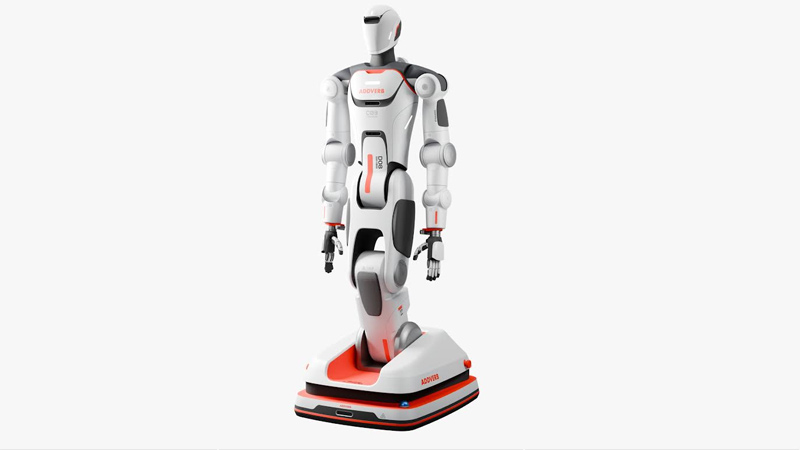
MUMBAI: Addverb has taken a decisive turn on the road to humanoid automation, unveiling its first wheeled humanoid robot, Elixis-W, at LogiMAT India 2026 in Mumbai. Built and manufactured in India, the robot signals the company’s push to make so-called physical AI a practical presence on the factory floor rather than a futuristic concept.
Unlike traditional fixed automation, Elixis-W is designed to move, think and work alongside people in dynamic industrial settings. The robot combines adaptive wheeled mobility with dual arms, each fitted with five-fingered dexterous hands, allowing it to handle tasks that demand precision as well as flexibility.
At its core sits a Physical AI-ready architecture, supported by dual Nvidia Jetson Orin and Thor computing units. This setup is intended to give the robot the ability to perceive, plan and adapt to changing environments, rather than simply follow pre-programmed routines.
According to Addverb CEO and co-founder Sangeet Kumar, the humanoid reflects the company’s long-standing belief in human-robot collaboration. He said the robot is designed to take on repetitive, risky or physically demanding tasks, freeing human workers to focus on higher-value decision-making roles.
Alongside the humanoid, Addverb also showcased two new intralogistics solutions. The Cruiser 360, a four-way pallet shuttle, is aimed at high-density storage environments where space and speed matter. The FlowT, an autonomous forklift, is designed to move materials safely in busy warehouses and factory spaces.
Visitors also saw Trakr, the company’s quadruped robot, navigating the exhibition floor, offering a glimpse of how legged machines could assist in future warehouse and industrial operations.
Addverb, which began as a warehouse automation specialist, has steadily expanded its global footprint across the United States, Europe, Australia and Asia. Its client list includes Reliance, HUL, PepsiCo, Maersk, Mondial Relay and DHL.
With the launch of Elixis-W, the company is steering towards a future where robots are not just bolted to the floor, but rolling, reasoning and working shoulder to shoulder with people on the shopfloor.








