Hardware
Interra Systems Simplifies Video Caption Creation With Machine Learning-Based QC Solution


CUPERTINO: Interra Systems, a leading global provider of software products and solutions to the digital media industry, today announced BATON Captions, a new addition to its BATON platform. Leveraging cutting-edge machine learning (ML) and automatic speech recognition technology, BATON Captions brings simplicity and cost savings to the creation, management, and delivery of captions for traditional TV and video streaming. BATON Captions allows broadcasters and other media professionals to address all of their captioning needs, from caption generation to QC, auto corrections, review, and editing.
Keeping in mind the high volumes of content being generated and distributed today, a defining feature of BATON Captions is that it offers industry-leading performance. Utilizing the high-performance solution, media companies can dramatically expedite the caption creation and verification processes for both live and VOD content.
"Captions have long been mandated by all major broadcasters, and now with the rise in global consumption of online content, captions and subtitles represent an amazing opportunity for television viewers to watch and comprehend foreign-language content with ease. However, captions can be tedious and expensive to produce. Also, when transitional issues happen throughout the file-based workflow, the delivery of captions becomes more complex," said Anupama Anantharaman, vice president, product management at Interra Systems. "BATON Captions leverages our industry-proven expertise in captions and subtitles QC to simplify this process and improve workflow efficiency. Using this solution, broadcasters and media companies can ensure that when content is delivered in multiple video quality levels within OTT video streams, the captions maintain a high quality."

BATON Captions reports on any drop or inaccuracy in captions and audio, as well as compliance issues, providing broadcasters with automated options for correcting alignment, text, and spelling mistakes. Captions can be checked against actual audio essence, corrected, and exported to any industry-supported caption format. Through auto time stamping with state-of-the-art speech recognition technology, BATON Captions adds accurate time to dialogs in scripts, resulting in faster, more efficient caption generation.
Through web-services-based API support, BATON Captions can easily be integrated with third-party tools. Broadcasters have the option of deploying the captioning solution on premises or in the cloud for added flexibility. The application comes with a feature-rich review and editing platform with frame-accurate playback options. Offering support for a host of subtitle and closed caption formats, BATON Captions helps drive globalization of content for broadcasters and other media professionals.
Interra Systems will demonstrate its new BATON Captions solution at the 2020 NAB Show, April 19-22 in Las Vegas, booth SU5510. More information about Interra Systems solutions can be found at www.interrasystems.com.






Hardware
India clears Rs 1.6 lakh crore semiconductor projects under Semicon India
Ten projects cleared as production begins and design ecosystem gathers pace
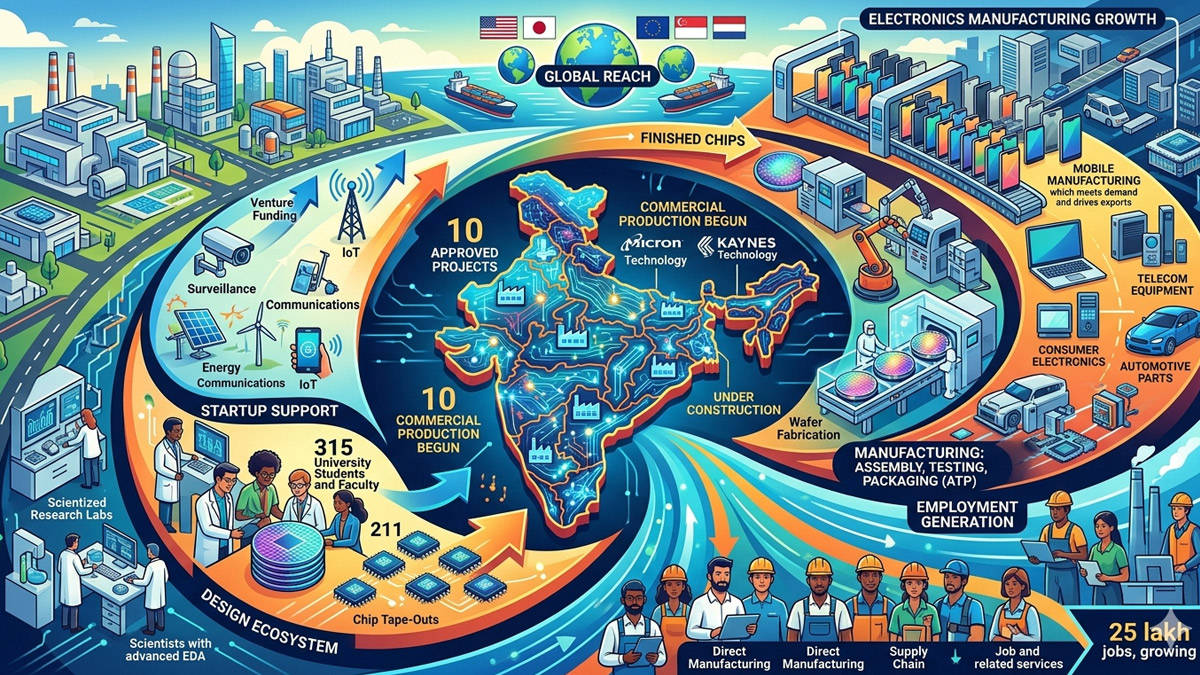
NEW DELHI: India’s push to become a global electronics powerhouse is gaining momentum, with the Semicon India Programme driving the creation of a full-fledged semiconductor ecosystem from design to manufacturing.
Launched in 2022, the programme aims to build capabilities across the entire value chain, including chip design, fabrication, assembly, testing and packaging. In just four years, the government has approved 10 semiconductor projects with a combined investment commitment of around Rs 1.6 lakh crore.
Two of these facilities have already begun commercial production, including units led by Micron Technology Inc. and Kaynes Technology India Limited. Two more plants are expected to go live later this year, signalling that India’s chip ambitions are moving from blueprint to factory floor.
The broader electronics manufacturing story has also seen sharp growth over the past decade. Production has jumped from roughly Rs 1.9 lakh crore in 2014-15 to about Rs 12 lakh crore in 2024-25, while exports have surged nearly eightfold. Mobile phone manufacturing, once heavily import-dependent, now meets almost all domestic demand and has become a major export driver.
Alongside manufacturing, the government is investing heavily in design capabilities. Through access to advanced chip design tools provided free to 315 universities, students and researchers have clocked over 200 lakh hours of usage. This effort has already resulted in 211 chip tape-outs from 75 institutions.
Support for startups is also picking up pace. Twenty-four chip design projects have been approved, targeting sectors such as surveillance, energy, communications and IoT. Of these, 14 companies have collectively raised over Rs 650 crore in venture funding, while several designs have progressed to fabrication, including at advanced nodes.
To strengthen supply chains, India has also signed semiconductor cooperation agreements with countries including the United States, Japan, the European Union, Singapore and the Netherlands. These partnerships aim to reduce global dependencies while boosting domestic capabilities.
The employment impact is equally significant. The electronics sector now supports an estimated 25 lakh jobs, with mobile manufacturing alone accounting for nearly half. As more semiconductor units come online under the India Semiconductor Mission, indirect job creation across supply chains is expected to rise further.
Sharing these updates in Parliament, Ministry of Electronics and Information Technology minister of state Jitin Prasada underscored the government’s focus on building a resilient, end-to-end semiconductor ecosystem.
With factories taking shape, designs moving to silicon and investments flowing in, India’s semiconductor story is steadily shifting gears from ambition to execution.






