News Broadcasting
Indias Economic Confidence Uncomfortably Uncertain: Ipsos Study

MUMBAI: India’s economic confidence recovered marginally but it remains uncomfortably uncertain as food inflation remains sky high and economic growth dwindling, according to a report by global research firm Ipsos.
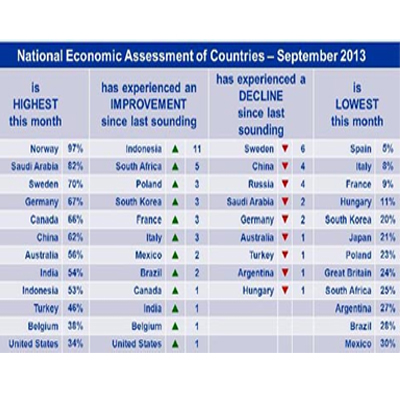
According to the “Ipsos Economic Pulse of the World” survey, India’s economic confidence increased by only 1 points to 54 percent in the month of September compared to the month of August 2013, however its rating further got pulled down to eighth most economically confident country in the world, as sentiments in G8 and other developed countries improve.

Thirty four percent Indian Citizen believe a further decline of 2 points. However, what is alarming is generally optimist Indians have turned pessimist, with only 40 per cent people expecting that the economy in their local area will be stronger in next six months, a drop of further 3 points.
Mick Gordon, CEO, Ipsos in India said, “India’s sizable current-account deficit compared to its economic output, nearly double-digit inflation in consumer prices and dwindling economic growth is making India’s economic sentiments uncomfortably uncertain.”
“Perhaps the crucial general election next year is limiting governments’ ability to make politically unappetizing economic decisions to implement drastic reforms to revive economic growth and to boost the weakening rupee,” added Gordon.
The online Ipsos Economic Pulse of the World survey was conducted in August 2013 among 18,503 people in 25 countries.
After a stagnant June/July, the average global economic assessment of national economies surveyed in 25 countries takes a turn for the better this month as 39% of global citizen’s rate their national economies to be ‘good.’ This shift largely reflects the inclusion of Norway in the global aggregate. Without Norway, the average is 37%, up one point from last sounding.
Source: Ipsos
A substantial margin continues to exist at the top of the global ratings between global leader Norway (97%), and runners-up Saudi Arabia (82%), Sweden (70%), Germany (67%), Canada (66%), China (63%), Australia (56%) and India (54%). Only a handful of those in Spain (5%) rate their national economies as ‘good’, followed by Italy (8%), France (9%), and Hungary (11%)
Countries with the greatest improvements in this wave: Indonesia (53%, 11pts), South Africa (25%, 5pts), Poland (23%, 3pts), South Korea (20%, 3pts), France (9%, 3pts) and Italy (8%, 3pts).
A strong majority of Brazilians (64%) continue to indicate they predict their local economies will be stronger in the next six months. A gap persists in between Brazilian ratings and the rest of the highest-ranking countries: Saudi Arabia (51%), Argentina (41%), India (40%), Indonesia (37%) and China (35%).







News Broadcasting
Network18 channels lead YouTube news viewership in March 2026
CNN-News18, News18 India and CNBC channels top categories with record views

MUMBAI: When the world hit refresh on breaking news, Network18’s channels were already streaming ahead. As geopolitical tensions and war-driven headlines fuelled a surge in global news consumption, the network’s digital playbook delivered big clocking record Youtube viewership across English, Hindi and business news categories in March 2026.
At the forefront was CNN-News18, which emerged as the clear leader in the English news segment with 130 million live and video-on-demand views. The channel edged past competitors such as Times of India (126.5 million), Times Now (101.1 million), India Today (88.2 million) and NDTV (77.5 million), according to Databeings data for March.
In the Hindi news arena, News18 India delivered a commanding performance, racking up a staggering 3,297 million views on YouTube. The channel comfortably outpaced NDTV India, which recorded 3,119 million views, underlining its deep reach and consistent engagement with mass audiences, as per Playboard data.
The network’s dominance wasn’t confined to general news. In the Hindi business segment, CNBC Awaaz topped the charts with 92 million views, narrowly ahead of Zee Business (90 million) and well ahead of ET Now Swadesh (57 million). Meanwhile, its English counterpart CNBC-TV18 posted a strong 58 million views, reinforcing the network’s cross-category strength.
The spike in viewership reflects a broader shift in audience behaviour, with viewers increasingly turning to digital platforms particularly Youtube for real-time updates and in-depth coverage during high-intensity news cycles. For Network18, the numbers signal more than just scale; they underline the effectiveness of a multi-platform strategy that blends speed, credibility and continuous coverage.
In a month where the news never paused, it seems viewers chose to stay tuned where the stream never stopped.






