Components
HAL Robotics ropes in Navanit Samaiyar as board member and advisor


MUMBAI: HAL Robotics has roped in Navanit Samaiyar as its board member and advisor. Samaiyar has a record of setting up, scaling and transforming businesses across a very wide cross section of industries spanning from IT/ ITeS to steel, telecom, engineering goods, earthmoving machinery, logistics and warehousing, agribusiness and healthcare.
Samaiyar brings 25+ years of leadership experience to HAL Robotics with experiences from IBM, GE, Reliance and Clove Dental.
HAL Robotics is a Gurgaon-based technology start-up, which helps enterprises to improve their operating business matrices by deploying its “home-grown AI-powered IoT data platform, which is interwoven with custom-designed special purpose hardware sensors”.

Samaiyar has the unique ability to drive/ setup systems and processes drawn from large corporation’s experiences coupled with nimbleness of startups is key to business ‘sustainability’ while driving exponential growth through relentless employees, customers and market focus aided by a measured risk-taking and innovative culture. Samaiyar’s work experience has spanned across top-notch global MNCs and Indian blue chip enterprises apart from various startups/ self-promoted ventures. Having managed diverse operations domestically and across the globe, Samaiyar has a special knack for production planning, supply chain and logistics, product management and development, marketing/ sales & brand management.
Commenting on this development, HAL Robotics MD Prabhakar Chaudhary said, “It gives me immense pleasure to welcome Navanit Samaiyar as our board member. His previous experience and grasp of a wide cross section of industries are going to help us better structure and scale-up the venture. We are further looking forward to collaborating amongst the vast talent pool at HAL Robotics and growing together.”
On his current undertaking, Navanit Samaiyar said, “I am excited to be part of the HAL Robotics. The promising start-up endeavours to solve certain crucial challenges faced by the industry today, especially the lack of visibility, logistics and the resulting operational inefficiencies. Furthermore, emerging technologies like artificial intelligence, big data, IoT and more are going to define the future of our generation and I can’t wait to begin my work, collaborate and strategise with the team in order for the venture to scale up, expand and achieve its business objectives. It is particularly energising to work alongside some of the smartest young minds both in IoT hardware and software and a wide range of AI and machine learning technologies”

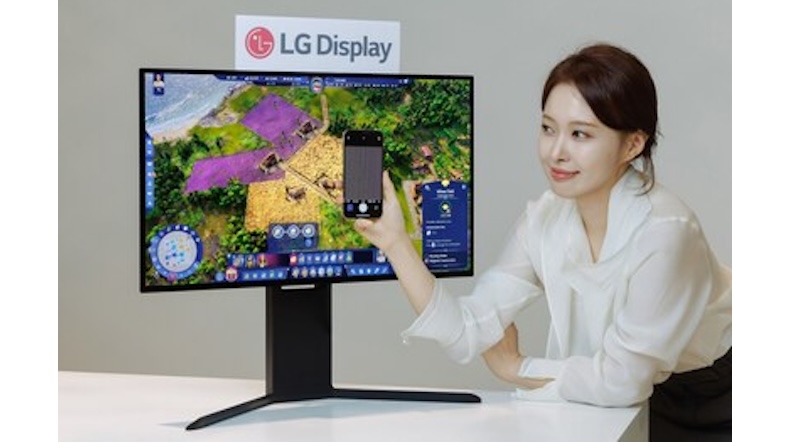
SEOUL: In the eternal battle between gamers demanding lightning-fast refresh rates and professionals craving pixel-perfect clarity, LG Display reckons it has found détente. The South Korean display titan is unveiling the world’s first 27-inch 4K OLED monitor panel that marries an RGB stripe structure with a blistering 240Hz refresh rate—a combination previously thought incompatible, like oil and water or fashion and function.
The breakthrough lies in how the pixels are arranged. RGB stripe structure lines up red, green and blue subpixels in neat rows, banishing the colour bleeding and fringing that plague lesser screens when you park your nose close to the display. It is the difference between reading crisp text and squinting at a rainbow-tinged mess. OLED panels using this method existed before, but they topped out at a sluggish 60Hz—fine for spreadsheets, useless for fragging opponents in first-person shooters.
LG Display’s engineering wizardry changes the game. By cranking the refresh rate to 240Hz whilst maintaining that pristine RGB stripe layout, the company has produced a panel that works equally well for colour-critical design work and twitchy gaming sessions. Better still, the panel incorporates Dynamic Frequency & Resolution technology, letting users toggle between ultra-high-definition at 240Hz and full-HD at a frankly ludicrous 480Hz. That is fast enough to make your eyeballs sweat.
The specs are suitably impressive: 160 pixels per inch for exceptional detail, optimised performance for Windows and font-rendering engines, and colour accuracy that should please the Photoshop brigade. LG Display achieved this by boosting the aperture ratio—the percentage of each pixel that actually emits light—and applying what it coyly describes as “various new technologies.” Translation: years of R&D and probably some sleepless nights.
Existing high-end gaming OLED monitors have relied on RGWB structures (which add a white subpixel) or triangular RGB arrangements. Both work, but neither delivers the sharpness that professionals demand. LG Display’s new stripe pattern is tailored specifically for monitor use, a recognition that staring at a screen from two feet away demands different engineering than watching telly from across the room.
The company is betting big on this technology, targeting the high-end monitor market where it already commands roughly 30 per cent of global OLED panel production. Among gaming OLED panels in mass production, LG Display claims world-leading specs across refresh rate, response time and resolution—a trifecta that sounds like marketing bluster until you check the numbers.
“Technology is the foundation of leadership in the rapidly growing OLED monitor market,” says LG Display head of the large display business unit Lee Hyun-woo. He promises to keep pushing “differentiated technologies compared to competitors”—corporate-speak for staying ahead of Chinese rivals snapping at LG’s heels.
The new panel will debut at CES 2026 in Las Vegas, where LG Display plans to woo customers and expand its lineup. Initial rollout targets high-end gaming and professional monitors, the sweet spot where people actually pay premiums for superior screens rather than settling for whatever came with their laptop.
Whether this technology reshapes the monitor market or remains a niche luxury depends on two things: pricing and production scale. But for now, LG Display has pulled off something rare—a genuine technical leap that solves a real problem. Gamers get their speed, designers get their clarity, and LG gets bragging rights. In the cutthroat world of display tech, that counts as a win.