News Broadcasting
Expanding the Film and Television Industry’s Horizon, 23 years and counting


MUMBAI: Saicom Trade Fairs & Exhibitions Pvt Ltd is pleased to announce that the 23rd chapter of the Broadcast India 2013 will be held from October 9 -11, 2013 at the Bombay Exhibition Centre, Goregaon (East), Mumbai. A 2 day Conference will be held on October 9 and 10, 2013 at the same venue.
As an added attraction, this year, Broadcast India along with RED bring you REDucation a workshop focused on hands-on learning with RED Digital Cinema camera packages (DRAGON, EPIC, SCARLET). Learn, shoot and review 4K footage on the big screen each day in the large 200+ sq mt. REDucation theatre.
Broadcast India 2013 is the country’s biggest and the most comprehensive platform for the broadcast, film and entertainment industry which promises to bring to you the very best for all there is to do with Broadcast, Film, Audio, Radio from its content creation to its management and delivery.

The show will be host to 35 participating countries and to over 550 companies, 30 of them exhibiting at the show for the first time. Panasonic, Sony, Blackmagic Design, Harris, GoPro, Grass Valley, ARRI, AJA Video Systems, Autodesk, Adobe, Canon, Datavideo, Wasp3D, Ross Video, Yamaha, Harman, RCS, Carl Zeiss and Shure, to name a few, will showcase their state-of-the-art equipment and cutting-edge technology. The other attractions are the new Pavilions of Korea and UK apart from the Bavarian Pavilion, all representing their respective countries.
As promises go, at the very least we will be introduced to an enlightened environment that will challenge the very way we look at broadcast and entertainment.
For more information, please visit www.broadcastindiashow.com







News Broadcasting
News18 India launches Command Centre war explainer with Arya
New show shifts from debates to decoding global conflicts and impacts
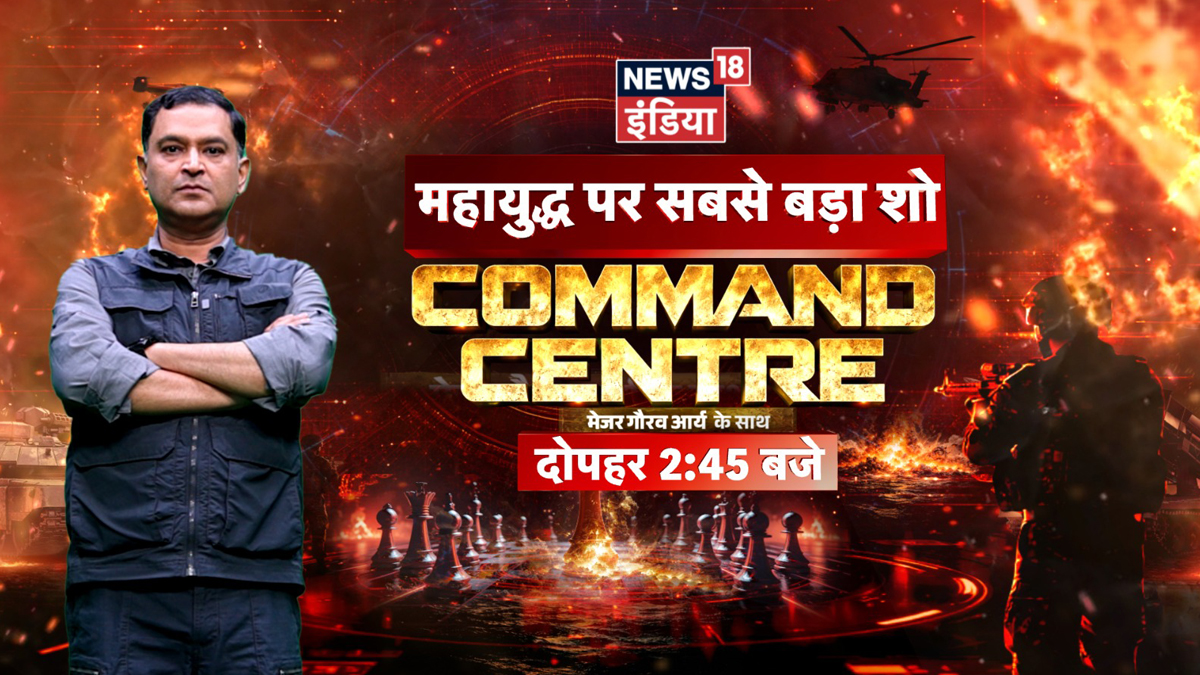
MUMBAI: News18 India has rolled out a new war-focused programme, Command Centre, featuring Gaurav Arya, as it looks to offer viewers a sharper, more grounded take on global conflicts amid rising tensions in West Asia.
Positioned as an “insider war room”, the show moves away from conventional panel debates and instead focuses on explaining military developments, decoding strategy and connecting global events to their everyday impact, from fuel prices to economic shifts.
The format leans heavily on visuals and data. The studio has been designed like a command hub, complete with large LED war maps, real-time graphics and an alert system to track developments as they unfold.
At the centre of it all is Arya, who brings his military background to simplify complex war strategies for viewers. His signature line, “Seedhi baat samjhiye”, anchors the show’s promise of clarity over noise.
News18 India managing editor Jyoti Kamal said, “Command Centre, featuring Major Gaurav Arya is designed to deliver accurate insights and a clear perspective on how evolving conflicts impact everyday life, from household budgets to national security. With expert voices analysing every development in real time, the show goes beyond headlines to decode what’s happening now, what it means, and what could come next.”
Echoing the intent, Gaurav Arya added, “In times of war, confusion is the biggest threat. With News18 India’s Command Centre, we are bringing viewers inside the war room, decoding strategies, tracking every escalation, and explaining, in the simplest terms, what it means for India and for every household. Seedhi baat samjhiye, this is where you understand not just what is happening, but what happens next.”
The weekday show will air in the afternoon slot and will also feature Gaurav Shukla, adding to its editorial depth.
With its mix of analysis, visuals and a clear focus on impact, the show reflects a broader shift in news consumption. Viewers are no longer just watching events unfold, they are looking to understand what those events mean for them.






