News Broadcasting
Counting Day: CNN-IBN & IBN7 present ‘The Verdict’


MUMBAI: After months of exhaustive campaigning and nine long phases of polling, India is all set for the verdict in the world’s biggest democratic exercise. As the nation inches closer to the Counting Day, CNN-IBN & IBN7 present an extensive day-long programming, ‘A Billion Votes – The Verdict’ & ‘Mera Vote Meri Sarkar – Aap ka Faisla’ respectively, that will bring to the viewers the most credible minute-by-minute coverage of the results of General Elections 2014.
Commencing at 6am in the morning, this special coverage will include the latest trends, seat tally and extensive live coverage from across the country. The programming will also closely keep a track of results and analyse the implications of the same in detail. IBN Network’s formidable team of journalists led by country’s most trusted news anchor Padma Shri Rajdeep Sardesai, Editor-in-Chief CNN-IBN, IBN7 and IBN-Lokmat, along with India’s best political experts will discuss the verdict and provide the most definitive and incisive analysis of the results.

The eminent panel of experts on IBN Network comprises of Swapan Dasgupta, Dr. Ramachandra Guha, Dr. Surjit Bhalla, Manini Chatterjee, Dr. Sandeep Shastri, Kumar Ketkar, Dipankar Gupta, T R Ramachandran, Aakar Patel, Sharat Pradhan, Dr. Shaibal Gupta, Paranjoy Guha Thakurta, Dr. Sanjaya Baru, Prof. Rajeeva Karandikar, Sanjay Kumar, Hilal Ahmed, Ajay Singh, Nilanjan Mukhopadhyay and Purushottam Agrawal.
Commenting on this, Rajdeep Sardesai, Editor-in-Chief, CNN-IBN, IBN7 and IBN-Lokmat, said, “Considered to be the most critical elections in recent times, General Elections 2014 has witnessed voter participation in record numbers. Every Indian is now looking forward to the final results. At IBN Network, our aim is to keep our viewers abreast of the latest and provide them with the most definitive Counting Day coverage – for indeed these results will determine the future of India.”
Do not miss this special programming on CNN-IBN & IBN7 on May 16, 2014, all day, 6 am onwards.





News Broadcasting
UDF poised to return to power in Kerala, says Manorama-CVoter survey
Massive opinion poll projects shift in Kerala politics ahead of 2026 Assembly elections.
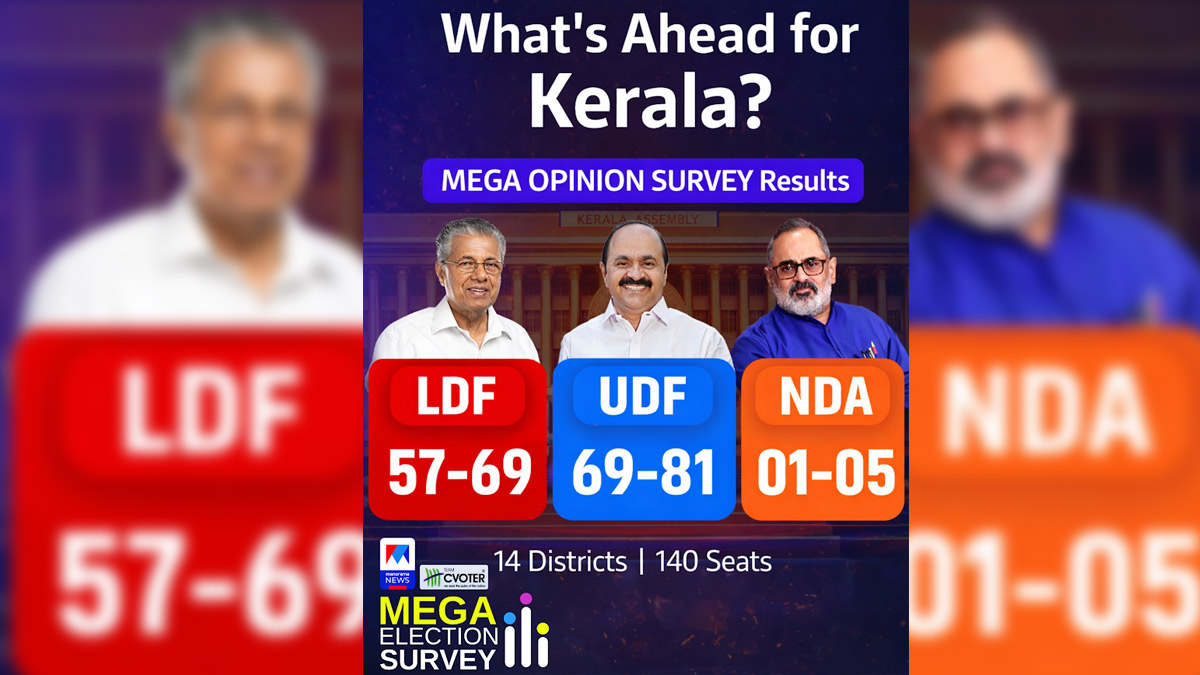
MUMBAI: The winds of change appear to be blowing through Kerala’s political landscape and this time, they seem to favour the United Democratic Front. A comprehensive mega opinion survey conducted by Manorama News in partnership with CVoter projects a potential comeback for the UDF in the upcoming Kerala Legislative Assembly Elections 2026. The survey, covering all 140 constituencies with a massive sample size of nearly 90,000 respondents, predicts the UDF could win between 69 and 81 seats.
The ruling Left Democratic Front (LDF) is expected to secure 57 to 69 seats, a significant drop from the 99 seats it won in the 2021 elections. This would mean the LDF losing 30 to 42 of its sitting seats. Meanwhile, the National Democratic Alliance (NDA), which drew a blank in 2021, is projected to open its account with 1 to 5 seats.
Region-wise, the UDF is expected to make strong gains in Malabar, winning 25 to 34 out of 48 seats, and in Central Kerala, where it could bag 29 to 33 out of 53 seats. In South Kerala, the LDF is likely to retain an edge with 21 to 25 seats, while the UDF may improve to 12 to 16 seats. The NDA could pick up 1 to 3 seats in the southern region.
The survey was conducted between 14 and 26 March 2026, with additional tracker and snap polls carried out from December 2025 to March 2026. A total of 89,693 respondents participated, ensuring representation across all demographics and social segments.
Manorama News has a strong track record of accuracy, with its previous projections closely matching the actual results of the 2019 and 2024 Lok Sabha elections as well as the 2021 Kerala Assembly polls.
In Kerala’s famously fierce political battles, this survey suggests the pendulum may be swinging back. Whether the final verdict matches these numbers or throws up another surprise, one thing is clear, the 2026 Assembly elections are shaping up to be one of the most keenly watched contests in the state’s history.






