News Broadcasting
CNBC-TV18 & ING Vysya Mutual Fund host CFO Brainstorm

Mumbai, August 24, 2005: CNBC-TV18, the country’s premier business channel and ING Vysya Mutual Fund, the world’s fourth largest integrated Financial Services provider jointly presented the CFO Brainstorm on ‘Treasury Management in India: Scope for Aggression’ today in Mumbai.
The discussion brought together financial experts, top influencers and luminaries, as well as renowned experts from the banking and related fields like Deepak Sogani, CFO, Patni Computers, Ajay Mahajan, CFO, YES Bank, Seshagiri Rao, Director Finance- Jindal Iron & Steel Co, B Jaju, CFO of Crompton Greaves, Kaushik Chatterjee, VP – Finance, Tata Steel , R. Venkatachalam, Director of Finance & CFO, Leela Hotels, Mike Ferrer, Regional General Manager, ING Asia Pacific who discussed whether monetary reserves of banks and other financial institutions are being put to effective use.
Indian banks and companies have between them, a considerable amount of monetary reserves accumulated owing to the rising levels of personal wealth and increased profitability of corporate entities. A surplus of investment opportunities still exists in the market for investors. This is despite the fact that new mutual fund offerings like floaters, dividend yield funds or even real estate funds are flooding the market.

The CFO Brainstorm on ‘Treasury Management in India: Scope for Aggression’ attempted to understand whether CFOs and treasury heads have been truly successful in making the most of the funds accumulated by the financial institutions. This highly interactive discussion delved into whether corporate India and the nation’s 300+ banks are doing justice to their shareholders and the Indian economy by exploring newer investment alternatives, the opportunities that this environment presents and the challenges faced by treasury managers and CFOs at these times.
Speaking at the forum, Kaushik Chatterjee, VP – Finance, Tata Steel said “In the challenging global scenario, the timing for raising funds for a company is as important a challenge for a CFO as managing the surplus funds and protecting the capital.” Seshgiri Rao, Director Finance- Jindal Iron & Steel Co added that the role of a CFO has changed from just minimizing risk to maximizing opportunities.
Summing up the entire scenario, Ajay Mahajan, CFO – YES BANK said, “The accent has been increasingly on risk management and awareness on the same has improved over the years among several company boards. In an increasingly growing economy, with global influences Indian companies need to improve their understanding about risk management in addition to being aware of the international financial markets that they would be exposed to.”
About CNBC-TV18:
CNBC-TVI8 is India’s No.1 business medium. CNBC Asia Pacific holds a strategic equity stake in the Indian registered broadcaster; Television 18. CNBC-TV18 is the undisputed leader in the business. The channel’s benchmark coverage extends from corporate news, financial markets coverage, expert perspective on investing and management to industry verticals and beyond. CNBC-TV18 has been constantly innovating with new genres of programming that helps make business more relevant to different constituencies across India. CNBC-TV18 is currently available in over 26 million households in India.
For further information contact:
Glen D’Souza/Janice Goveas/ Lorraine Correa Hanmer & Partners
98214 14845/ 98193 16878/ 98198 900935




News Broadcasting
WITT Summit 2026 concludes in New Delhi
Babar Azam’s comical diving attempt goes viral as league introduces anti-dew measures.
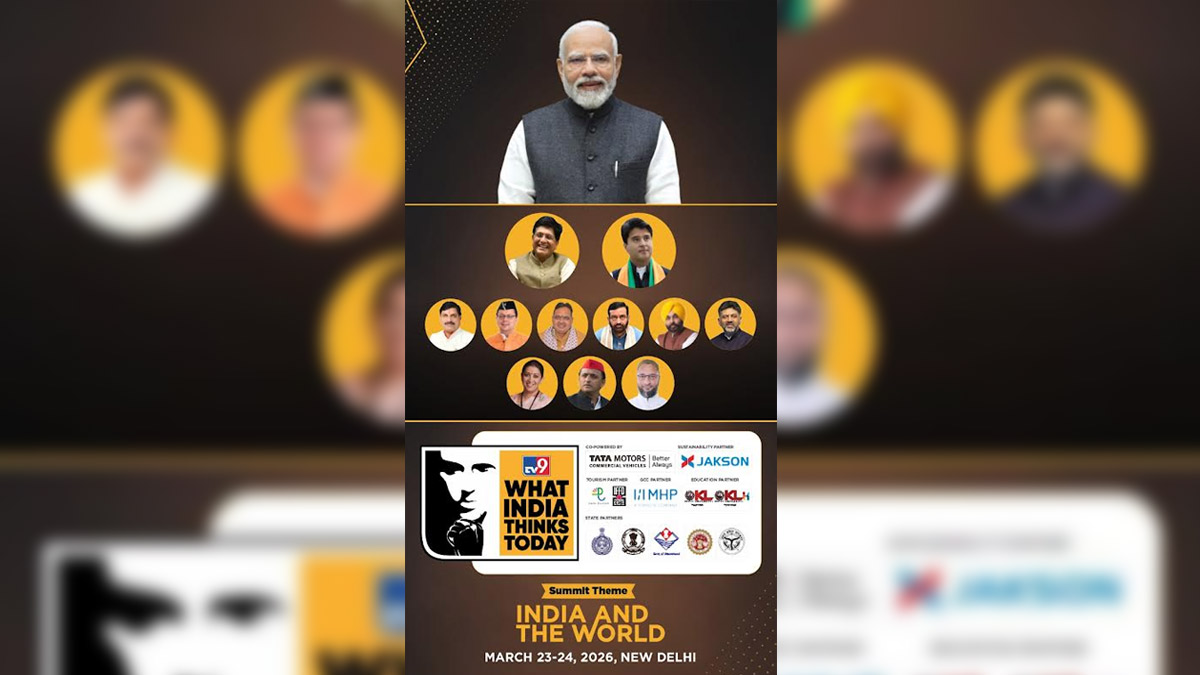
MUMBAI: The WITT Summit just wrapped up with enough big ideas to fill a policy playbook because when India’s leaders, thinkers and icons gather under one roof, even the conversations hit sixes. The eighth edition of TV9 Network’s flagship What India Thinks Today (WITT) Summit 2026 concluded on Saturday after two days of dynamic discussions at its New Delhi venue. India’s largest multi-domain public policy and culture summit brought together political leaders, policymakers, sports icons, artists and technology innovators to examine the forces shaping contemporary India and its global standing.
Prime minister Narendra Modi delivered the keynote address on the theme “India and the World” for the third consecutive year. In a wide-ranging speech, he addressed the ongoing conflict in West Asia, calling for restraint and compassion while highlighting India’s continued development trajectory despite global turmoil.
The summit featured candid conversations with state leaders. Telangana Chief Minister A. Revanth Reddy articulated a people-first governance model and contrasted it with other development approaches. Madhya Pradesh Chief Minister Mohan Yadav declared that Left-wing extremism had been effectively eliminated in his state and highlighted preparations for the upcoming Kumbh Mela. Punjab Chief Minister Bhagwant Mann defended his government’s record, citing the closure of 19 toll plazas and creation of the Sadak Suraksha Force. Karnataka Deputy Chief Minister D.K. Shivakumar expressed confidence in Congress prospects in Assam and addressed recent allegations against him.
On geopolitics and national security, Union Minister Jyotiraditya Scindia outlined India’s ambition to become a builder of trusted digital infrastructure for the world, citing the rapid 5G rollout and village-level 4G connectivity.
Cricket received significant attention. Former India captain Sourav Ganguly praised player freedom and trust as hallmarks of great leadership and named MS Dhoni as the greatest captain due to his World Cup successes. India women’s team bowling coach Aavishkar Salvi credited the BCCI and Women’s Premier League for building a pipeline of world-class talent behind the team’s recent ODI World Cup triumph.
The summit also hosted the inaugural AI² Awards 2026, celebrating the convergence of human creativity and machine intelligence in storytelling and content creation. Poet and kathavachak Kumar Vishwas delivered a nuanced take on India’s concept of Dharma and criticised the recent arrest of an 80-year-old Shankaracharya. Veteran lyricist Sameer Anjaan and storyteller Neelesh Misra reflected on changing music trends and artistic responsibility in the wake of a recent controversy involving Nora Fatehi.
In a country where conversations often run as deep as the Ganges, the WITT Summit proved once again that when leaders, thinkers and storytellers come together, the real winner is public discourse lively, layered and refreshingly unafraid to tackle the big questions shaping India’s tomorrow.








