News Broadcasting
CNBC-TV18 celebrates the business stalwarts of India

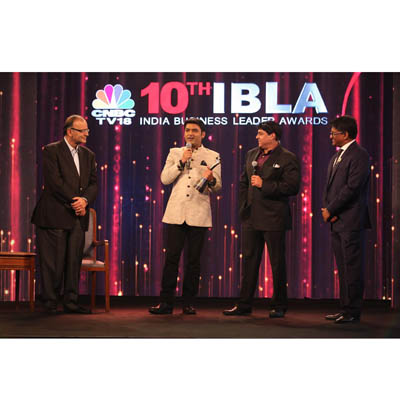
MUMBAI: “We Will Lead the Way, the Way We Have Led, Triumphs Behind, Triumphs Ahead” was the slogan that resonated at the 10th chapter of the flagship India Business Leaders Awards (IBLA) – Asia’s most renowned awards for Excellence in Leadership hosted by CNBC-TV18, India’s leading business television. The IBLA witnessed some of the biggest and eminent members of the business fraternity and recognize and honour the visionaries who have strived hard to change the face of India Inc and place it on the global pedestal. The 10th IBLA was presided by Hon’ble Finance Minister of India, Shri. Arun Jaitley, and was adjudged by stellar jury of reputed members at the Regal Room at Trident hotel, Mumbai on January 09th, 2015.
In an aim to celebrate the spirit of leadership and excellence in the business arena of India, the India Business Leader Awards credits individuals and organizations that have symbolized corporate excellence and have taken Indian Business to a new stratum of fame. The ‘India Business Leader Awards’, CNBC-TV18’s flagship awards for leadership in business and the economy, recognized the leaders who ingeniously piloted their organizations in these times of economic turmoil.
The singular idea for IBLA this year was to honor those poised to champion it. IBLA emphasized on the selection of winners across categories that have showcased men and women who have shown the ability, shared the vision, and have the capacity to rise above the current volatility and see the long term goal of putting India on the world map

In what would be an interactive and a first of its kind session with Hon’ble Finance Minister Shri. Arun Jaitley aimed to get a glimpse on what could be expected in terms of economic policies and Budget 2015 in the months to come from the the Finance himself. In response to the type of budget expected this year, Shri. Arun Jaitley said, “A budget is a very important occasion. It should indicate the direction of policies and major announcements should be made every week or fortnight regarding budget decisions in the same direction”. On fixing the fiscal gap, the Finance Minister continued to say that “a higher fiscal deficit is unfavourable to the economy as it hits the credibility of the country to curtail its spending. Also, rating agencies tend to alter their ratings based on this important parameter which, in turn, makes borrowing. Major disinvestment decisions will be taken before the 31st of March 2015”.
The IBLA jury consisted of distinguished names such as Mr. N. R. Narayana Murthy- Founder – Infosys Limited, Mr. Deepak Parekh – Chairman – HDFC ltd, Mr. D Shivakumar – Chairman and CEO, PepsiCo India Holdings Pvt. Ltd., Mr. Cyril Shroff- Managing Partner of Amarchand & Mangaldas & Suresh A. Shroff & Co., Mr. Harish Manwani- Non Executive Chairman- Hindustan UniLever.
Speaking about the awards, Anil Uniyal, CEO of CNBC-TV18 and CNBC AWAAZ said, “For years, we have recognized leadership and applauded India’s outstanding leaders with the CNBC-TV18 India Business Leader Awards. And now as we celebrate two very special milestones – 15 years of CNBC-TV18 and 10 years of CNBC-TV18 India Business Leader Awards – the occasion is twice as momentous. With the Hon’ble Finance Minister gracing this edition of the awards, and all key business leaders joining us on the evening of the 9th it was truly a celebration of our success”
The Young Turk of the Year was Hector Beverages – maker of Paperboat. Co-Founders Neeraj Kakkar and Neeraj Biyani accepted the award on behalf of the organisation. Speaking on the recognition, Neeraj Kakkar said, “We would like to thank IBLA for recognizing our dream and hard work. In our pursuit to walk down the memory lane and bring back childhood memories alive, we have bottled the traditional Indian drink in the form of Paperboat”. Neeraj Biyani who spoke on the growth prospects of Hector Beverages, said, “We believe that we can co-exist with the bigger players while creating our own space in the packaged beverage segment. We would like build on our product portfolio in India which by itself is a huge market while we would want to go global in a few years from now”.
Google India won the trophy for the Brand of the Year for their famous commercial on reunion. CNBC-TV18 raised an interesting point on Google India’s, decision for an ad that speaks about the past, despite being a company that redefines future. The Vice President and Managing Director of Google India, Rajan Anandan, who summarized the rationale behind the ad said, “The Internet is all about transforming lives and our lives are about the past as much as it is about the future and Google India believes that the internet truly changes these lives. We are touched to see how India and the world reacted to this ad and this award resonates that we are headed in the right direction. I would like to thank our creative partners, Ogilvy India and IBLA for this honour”.
The most deserved Lifetime Achievement winner, S. Ramadorai, erstwhile CEO and MD of Tata Consultancy Services and Chairman, National Council on skill development, congratulated CNBC-TV18 on completing 15 years in the industry and on the 10th year of Indian Business Leader Awards (IBLA). He thanked the Hon’ble Finance Minister, Shri Arun Jaitley and the respectable jury members on conferring him with the honour and credited the success to the employees of TCS.
The 10th India Business Leaders Awards once again stood as a truly defining moment for the leaders and the companies that won the award. Every year, the IBLA sets new standards for excellence to become a trend-setter in recognizing and awarding the best in the industry, and this year, it left no stone unturned to celebrate the spirit of excellence in business leadership in India.
The winners of the India Business Leadership Awards 2015 are listed below:






News Broadcasting
Induction cooktop demand spikes 30× amid LPG supply concerns
Supply worries linked to West Asia tensions push households and restaurants to turn to electric cooking alternatives
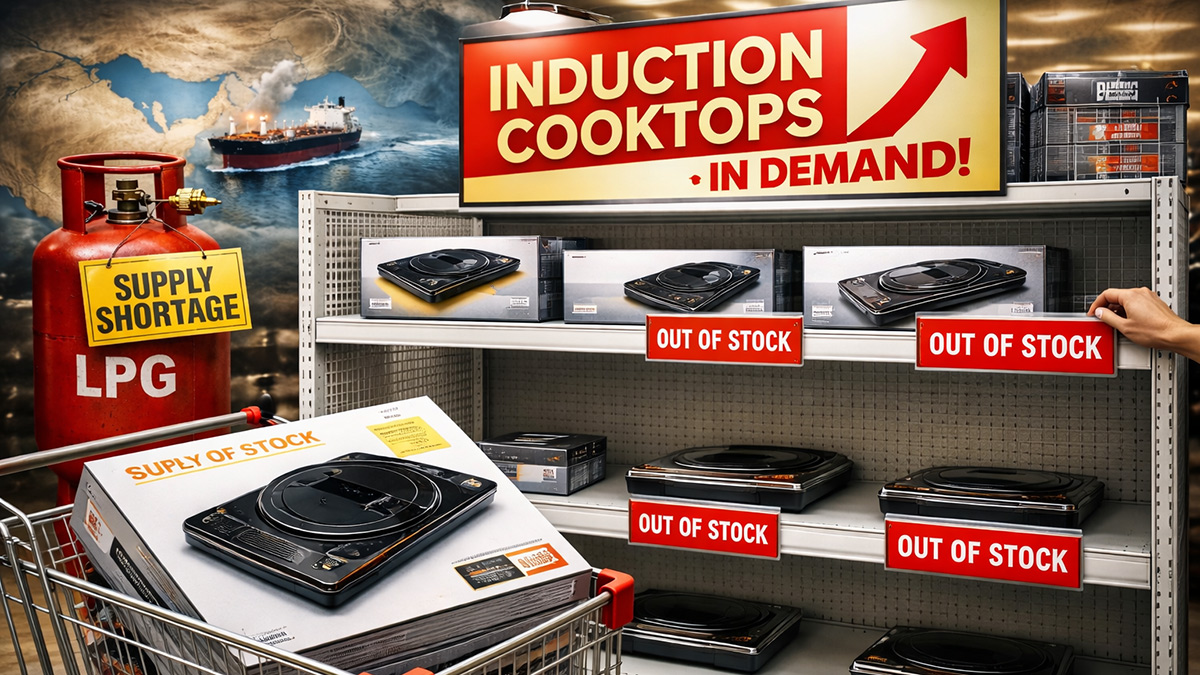
MUMBAI: As geopolitical tensions in West Asia ripple through global energy supply chains, the familiar blue flame in Indian kitchens is facing an unexpected challenger: electricity.
What began as concerns over the availability of liquefied petroleum gas (LPG) has quickly evolved into a technology-driven shift in cooking habits. Households across India are increasingly turning to induction cooktops and other electric appliances, initially as a backup but now, for many, a necessity.
A sudden surge in demand
Recent data from quick-commerce and grocery platform BigBasket highlights the scale of the shift. According to Seshu Kumar Tirumala, the company’s chief buying and merchandising officer, demand for induction cooktops has risen dramatically.
“Induction cooktops have seen a significant surge in demand, recording a fivefold jump on 10 March and a thirtyfold spike on 11 March,” Tirumala said.
The increase stands out sharply when compared with broader kitchen appliance trends. Most appliance categories are growing within 10 per cent of their typical demand levels, while induction cooktops have witnessed explosive growth as households rush to secure an alternative cooking option.
Major e-commerce platforms including Amazon and Flipkart have reported rising searches and orders for induction stoves. Quick-commerce apps such as Blinkit and Zepto have also witnessed stock shortages in major metropolitan areas including Delhi, Mumbai and Bengaluru.
What was once considered a convenient appliance for hostels, small kitchens or occasional use has suddenly become an essential addition in many homes.
A crisis thousands of miles away
The trigger for this shift lies far beyond India’s kitchens.
Escalating conflict in the Middle East has disrupted shipping routes through the Strait of Hormuz, one of the world’s most critical energy corridors. Nearly 85 to 90 per cent of India’s LPG imports pass through this narrow waterway, making the country particularly vulnerable to supply disruptions.
The ripple effects have been swift.
India currently meets roughly 60 per cent of its LPG demand through imports, and tightening global supply has already begun to affect domestic availability and prices.
Earlier this month, the price of domestic LPG cylinders increased by Rs 60, while commercial cylinders rose by more than Rs 114.
To discourage panic buying and hoarding, the government has also extended the mandatory waiting period between domestic refill bookings from 21 days to 25 days.
Restaurants feel the pressure
The strain is not limited to households. Restaurants, hotels and roadside eateries are also grappling with supply constraints as commercial LPG availability tightens under restrictions imposed through the Essential Commodities Act.
In cities such as Bengaluru and Chennai, restaurant associations report that commercial LPG availability has dropped by as much as 75 per cent, forcing many establishments to rethink their kitchen operations.
Some restaurants have reduced menu offerings, while others are rapidly installing high-efficiency induction systems, creating hybrid kitchens where electricity now shares the workload with gas.
For smaller eateries and roadside dhabas, the shift is less about sustainability and more about survival.
A potential structural shift
The government has maintained that there is no nationwide LPG crisis and has directed refineries to increase production to stabilise supply.
Nevertheless, the developments of March 2026 may already be triggering a longer-term behavioural shift.
For decades, LPG has been the backbone of cooking in Indian households. However, recent disruptions have highlighted the risks of relying on a single fuel source.
Increasingly, households appear to be hedging against uncertainty by adopting electric cooking options to guard against price volatility and delivery delays.
If the current trend continues, the induction cooktop, once viewed as a niche appliance, could emerge as a quiet symbol of India’s evolving kitchen economy.