News Broadcasting
‘Budget of Hope’ on CNN-IBN

MUMBAI: After achieving a historic mandate in General Elections 2014, the biggest challenge now for the newly elected Government is to present a growth oriented Budget for the people of India. As the nation eagerly awaits Union Budget 2014, CNN-IBN, brings to its viewers an extensive line-up of budget programming – ‘Budget of Hope.’
The channel has already kick started its programming with a segment ‘If I were FM’ which captures suggestions from common citizens for the Finance Minister. This will be followed by ‘Budget Yatra’ – a special show led by CNN-IBN Business Editor, Karma Paljor, wherein the issues and challenges facing the economy will be analysed on ground from key locations across the country. Additionally, we will also capture the expectation of and suggestions from corporates and policymakers in our segment ‘Budget Expectations.’ Of course on the day of the Rail Budget, Economic Survey and the Union Budget will bring together the most extensive and incisive rolling coverage of the key policy announcements and developments analysed by our unmatched panel of anchors and experts. Special shows such as Budget and You – detailing the impact of the budget on the common man/woman, Rate The Budget, the Finance Minister’s Interview and CNN-IBN’s award-winning initiative ‘Axe the Tax’ – which lists out specific recommendations for the FM to rationalize the tax regime – will also form an integral part of the unmatched array of shows on Budget 2014 that will be aired on CNN-IBN.
Speaking on the special programming, Rajdeep Sardesai, Editor-in-Chief, IBN Network, said “Expectations from Budget 2014 are very high. There are several economic challenges that the country is currently facing and the Budget is expected to address these. CNN-IBN will closely track these key issues in the run up to the Budget. Our focus will be on ensuring that the common Indian gets to participate in the discourse on the Budget, and on deconstructing and simplifying the impact that the Budget will have on them.”

Don’t forget to watch “Budget Yatra” starting from Friday, June 20th @ 10 PM & Saturday @ 5.30 PM only on CNN-IBN.




News Broadcasting
UDF poised to return to power in Kerala, says Manorama-CVoter survey
Massive opinion poll projects shift in Kerala politics ahead of 2026 Assembly elections.
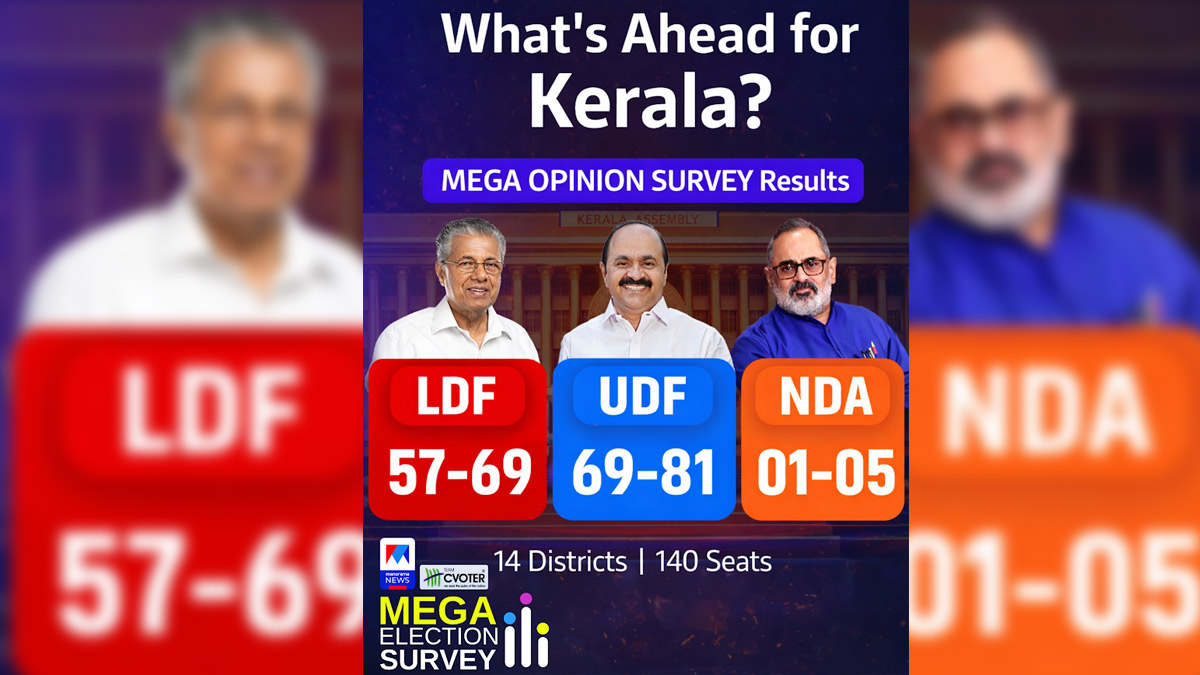
MUMBAI: The winds of change appear to be blowing through Kerala’s political landscape and this time, they seem to favour the United Democratic Front. A comprehensive mega opinion survey conducted by Manorama News in partnership with CVoter projects a potential comeback for the UDF in the upcoming Kerala Legislative Assembly Elections 2026. The survey, covering all 140 constituencies with a massive sample size of nearly 90,000 respondents, predicts the UDF could win between 69 and 81 seats.
The ruling Left Democratic Front (LDF) is expected to secure 57 to 69 seats, a significant drop from the 99 seats it won in the 2021 elections. This would mean the LDF losing 30 to 42 of its sitting seats. Meanwhile, the National Democratic Alliance (NDA), which drew a blank in 2021, is projected to open its account with 1 to 5 seats.
Region-wise, the UDF is expected to make strong gains in Malabar, winning 25 to 34 out of 48 seats, and in Central Kerala, where it could bag 29 to 33 out of 53 seats. In South Kerala, the LDF is likely to retain an edge with 21 to 25 seats, while the UDF may improve to 12 to 16 seats. The NDA could pick up 1 to 3 seats in the southern region.
The survey was conducted between 14 and 26 March 2026, with additional tracker and snap polls carried out from December 2025 to March 2026. A total of 89,693 respondents participated, ensuring representation across all demographics and social segments.
Manorama News has a strong track record of accuracy, with its previous projections closely matching the actual results of the 2019 and 2024 Lok Sabha elections as well as the 2021 Kerala Assembly polls.
In Kerala’s famously fierce political battles, this survey suggests the pendulum may be swinging back. Whether the final verdict matches these numbers or throws up another surprise, one thing is clear, the 2026 Assembly elections are shaping up to be one of the most keenly watched contests in the state’s history.






