News Broadcasting
Big Picture at India Today Conclave

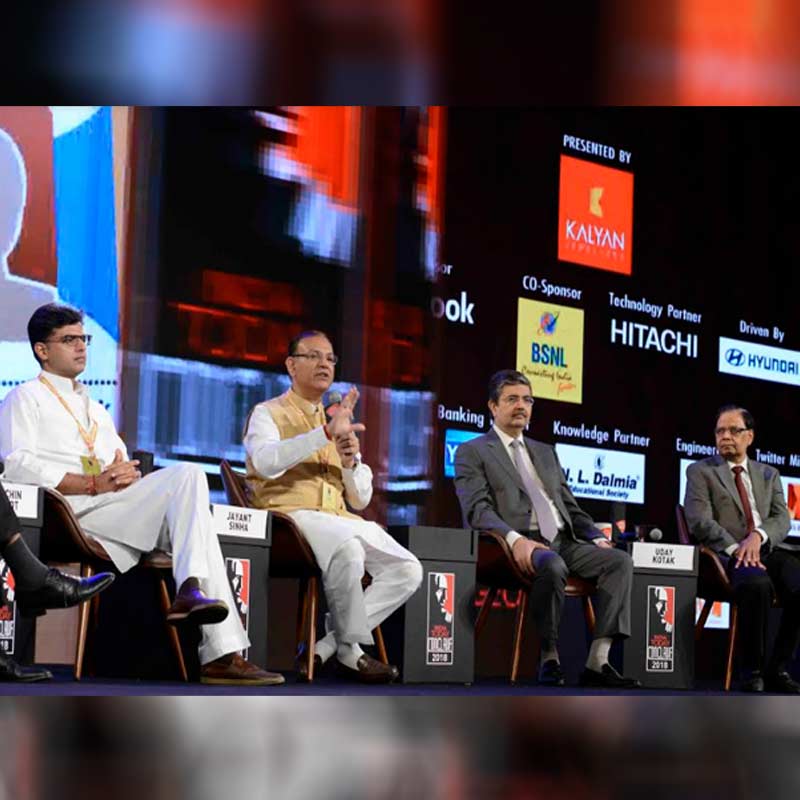
MUMBAI: The second session of the India Today Conclave 2018, The Big Picture, saw politicians Jayant Sinha and Sachin Pilot, economists Mohan Guruswamy and Arvind Panagariya and industrialist Uday Kotak debate the case of the missing jobs. While the politicians countered each other on job creation, Kotak discussed suggestions on how to create new jobs with a focus on the service sector. They stressed on the need to focus on education and link academics with education for imparting skills that make people employable. The debate threw up some startling figures—that demonetisation killed 20 million jobs in the construction industry, 57 per cent of the rural youth cannot do mathematical division.“We need a refocus to look at services. Manufacturing is a game that was played well in earlier times,” Kotak said. Some of the jobs of the future would be in leisure and wellness industry such as physical trainers and dentists.
The panel also debated on the role of the government and the private sector in job creation. Sinha was of the view the issue to be debated was not about missing jobs, but about missing data. He cited a recent report that suggested 6 to 7 million jobs are being created every year, if one goes by data mined from the EPFO. A number of jobs are being created in the informal sector, which is sometimes not captured in mainstream data.
Panagariya stressed that while jobs were there, the main problem was of people not being employed at full productivity and potential. “Talking of jobless growth is nonsense,” he said. The economy cannot grow at a robust 7.3 per cent if not for the contribution of new employment. The real problem is underemployment, and not unemployment, he added. While Pilot insisted that a government must create an environment that is conducive and positive where industry believes that its investments are safe, Kotak offered suggestions on how to transform the system to create more employment—a “deep rooted correction” in the education system, transforming the banking system to have a more efficient financial system and refocusing the approach to look at the services industry. Guruswamy agreed that skilling is key to creating more employment. An important sector, he said, was construction which employed around 55 million but was hit because of demonetisation. A unanimous point was on the need to skill the youth to make them more employable.





News Broadcasting
Network18 channels lead YouTube news viewership in March 2026
CNN-News18, News18 India and CNBC channels top categories with record views
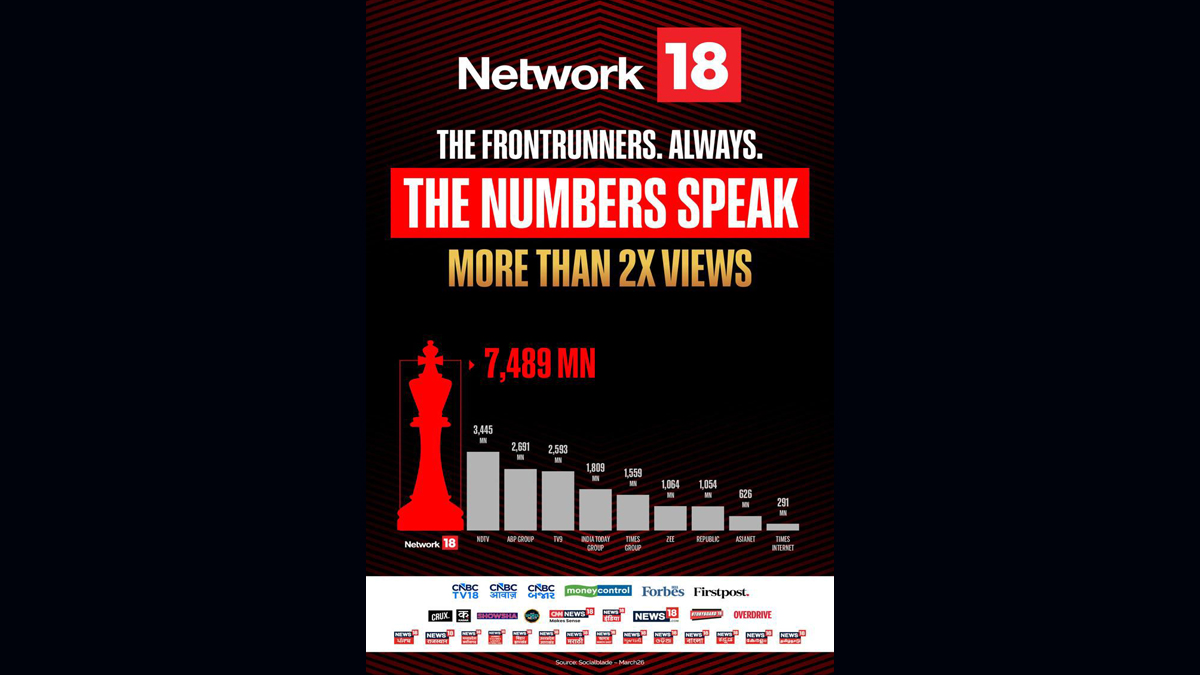
MUMBAI: When the world hit refresh on breaking news, Network18’s channels were already streaming ahead. As geopolitical tensions and war-driven headlines fuelled a surge in global news consumption, the network’s digital playbook delivered big clocking record Youtube viewership across English, Hindi and business news categories in March 2026.
At the forefront was CNN-News18, which emerged as the clear leader in the English news segment with 130 million live and video-on-demand views. The channel edged past competitors such as Times of India (126.5 million), Times Now (101.1 million), India Today (88.2 million) and NDTV (77.5 million), according to Databeings data for March.
In the Hindi news arena, News18 India delivered a commanding performance, racking up a staggering 3,297 million views on YouTube. The channel comfortably outpaced NDTV India, which recorded 3,119 million views, underlining its deep reach and consistent engagement with mass audiences, as per Playboard data.
The network’s dominance wasn’t confined to general news. In the Hindi business segment, CNBC Awaaz topped the charts with 92 million views, narrowly ahead of Zee Business (90 million) and well ahead of ET Now Swadesh (57 million). Meanwhile, its English counterpart CNBC-TV18 posted a strong 58 million views, reinforcing the network’s cross-category strength.
The spike in viewership reflects a broader shift in audience behaviour, with viewers increasingly turning to digital platforms particularly Youtube for real-time updates and in-depth coverage during high-intensity news cycles. For Network18, the numbers signal more than just scale; they underline the effectiveness of a multi-platform strategy that blends speed, credibility and continuous coverage.
In a month where the news never paused, it seems viewers chose to stay tuned where the stream never stopped.






