News Broadcasting
92.7 Big FM announces sixth edition of big green Ganesha campaign across eight Indian cities


Mumbai, 29 July 2013: 92.7 BIG FM, India’s No. 1 radio network, today announced the launch of the 6th edition of BIG Green Ganesha, its hugely popular and immensely successful campaign launched in 2008 as part of a vision for a better tomorrow. The initiative aims at instilling a sense of responsibility amongst citizens towards creating a better environment by celebrating Ganesh Chaturthi, one of India’s most widely followed festivals, in an eco-friendly way. This year’s campaign will be initiated in eight different cities that will involve Mumbai, Bengaluru, Hyderabad, Mysore, Tirupati, Sholapur, Vizag and Mangalore.
The 2013 campaign is being launched by way of the brand new concept of ‘Ashta-Vinayak’, where eight unique eco-friendly paper mâché Ganesha idols will be installed at the eight locations in which the campaign will be run. In addition, the campaign will also attempt to set a record by collecting the maximum number of old newspapers from a single location and enter the prestigious ‘Limca Book of Records’. With the installation of 30 Ganesha Pandals, the campaign will be spread across 8 cities with the setting up of 48 paper mâché idols.
Drawing attention to the massive use of toxins and non-biodegradable elements for the construction of Ganesha idols, the BIG Green Ganesha Campaign comes as a fresh reminder of change for all. A massive on-ground newspaper collection drive in residential areas, offices, shops and commercial establishments will mark the beginning of the campaign. The collected newspapers will be supplied to renowned sculptors and be used to create beautiful eco-friendly paper mâché Ganesha idols. The donation drive is a significant move since it educates the community and draws their support in order to create a better environment.

The campaign will be promoted through high-decibel strategies and promotions involving an amalgamation of media networks that will include radio, print, outdoor, on-ground and digital. Apart from connecting with 1.5 crore people each year, more than 200 celebrities and 350 civic authorities will support the campaign.
Commenting on BIG Green Ganesha Campaign 2013, Ashwin Padmanabhan, Business Head, 92.7 BIG FM said, “We are delighted to launch the 6th successive edition of the Big Green Ganesha Campaign, which is a fundamental part of our vision and responsibility to care for the environment. We believe that respecting the earth is the need of the hour. Whilst we spend time in prayer and celebration, we also do our bit towards creating a greener tomorrow by installing biodegradable and eco-friendly idols. We extend a warm welcome to all our partners in this sustainable celebration and would like to thank the community for the support that has helped make this campaign bigger each year.”
Powered by the strong message it carries, the BIG Green Ganesha Campaign has witnessed unparalleled success and popularity, inspiring over a million people in multiple cities across India. The movement has cornered glory at prestigious global platforms including the Silver Radio Award at the New York Festivals and nine awards at the India Radio Forum 2013, proving that 92.7 BIG FM is not just about great music but passionate about creating a better world.







News Broadcasting
Network18 channels lead YouTube news viewership in March 2026
CNN-News18, News18 India and CNBC channels top categories with record views
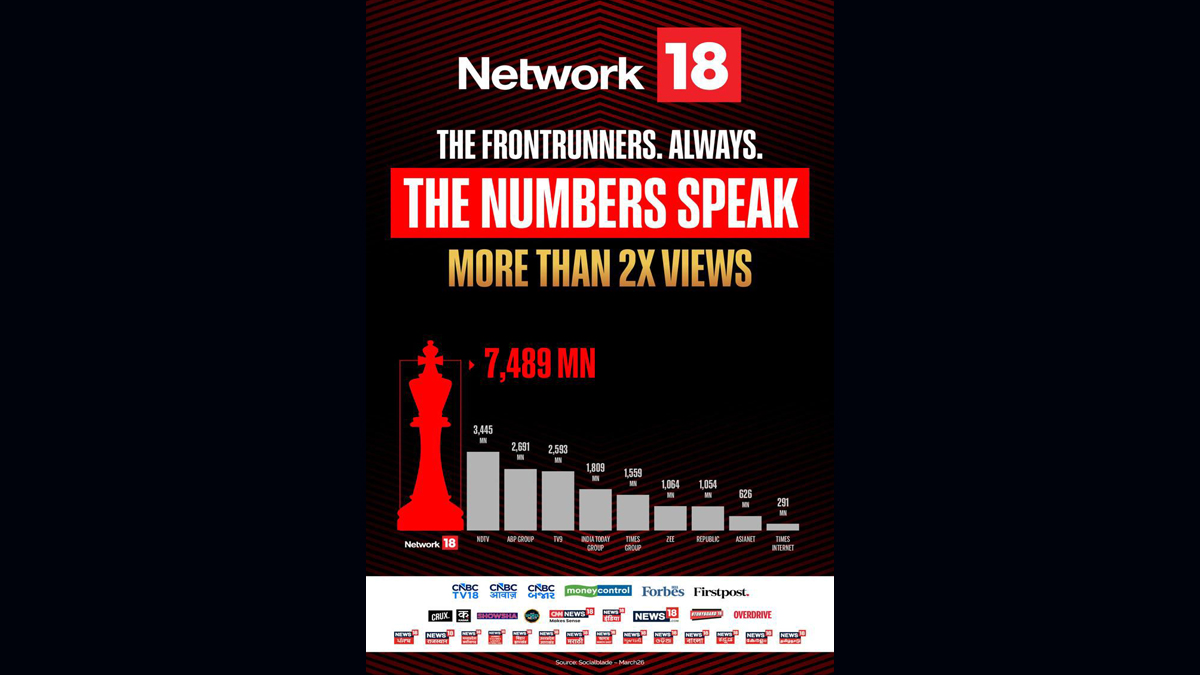
MUMBAI: When the world hit refresh on breaking news, Network18’s channels were already streaming ahead. As geopolitical tensions and war-driven headlines fuelled a surge in global news consumption, the network’s digital playbook delivered big clocking record Youtube viewership across English, Hindi and business news categories in March 2026.
At the forefront was CNN-News18, which emerged as the clear leader in the English news segment with 130 million live and video-on-demand views. The channel edged past competitors such as Times of India (126.5 million), Times Now (101.1 million), India Today (88.2 million) and NDTV (77.5 million), according to Databeings data for March.
In the Hindi news arena, News18 India delivered a commanding performance, racking up a staggering 3,297 million views on YouTube. The channel comfortably outpaced NDTV India, which recorded 3,119 million views, underlining its deep reach and consistent engagement with mass audiences, as per Playboard data.
The network’s dominance wasn’t confined to general news. In the Hindi business segment, CNBC Awaaz topped the charts with 92 million views, narrowly ahead of Zee Business (90 million) and well ahead of ET Now Swadesh (57 million). Meanwhile, its English counterpart CNBC-TV18 posted a strong 58 million views, reinforcing the network’s cross-category strength.
The spike in viewership reflects a broader shift in audience behaviour, with viewers increasingly turning to digital platforms particularly Youtube for real-time updates and in-depth coverage during high-intensity news cycles. For Network18, the numbers signal more than just scale; they underline the effectiveness of a multi-platform strategy that blends speed, credibility and continuous coverage.
In a month where the news never paused, it seems viewers chose to stay tuned where the stream never stopped.






