GECs
Zee TV launches second part of ‘Maharakshak’ trilogy

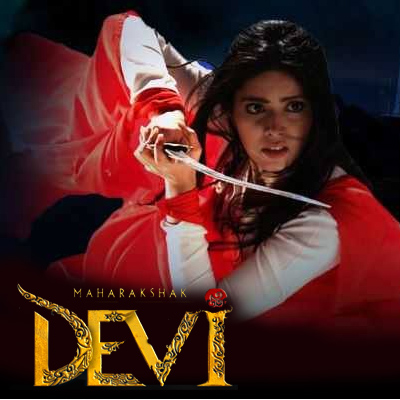
MUMBAI: Evil might have taken on different contemporary forms but their origins can be traced back to ancient mythology. Fantasy, as a genre, had little or no representation on Indian television until Zee TV introduced the ‘Maharakshak’ trilogy in November 2014.
Experiencing a fantasy world brought alive through cutting-edge visual effects, state-of-the-art graphics technology and stunt choreography of international standards for the very first time on Indian television, viewers instantly connected with the first part of the trilogy – Aryan.

Having raised the bar for action thrillers and the fantasy genre on Indian television with Aryan, Zee TV has now launched the second part of the ‘Maharakshak’ trilogy – Devi, which tells the story of a girl who discovers superpowers within her and sets out on a mission to combat contemporary social evils.
Produced by Essel Vision Productions, it will occupy the weekend slot and will air every Saturday and Sunday at 7 pm. Where on one hand, Aryan appealed especially to children and men, adding great value to Zee TV’s weekend ‘family unifier’, Devi aims to provide entertainment for each member of the family inclusive women this time.
Six months of brain storming
Devi has been a part of the plan ever since the channel launched its first part in trilogy series – Maharakshak Aryan. Zee TV programming head Namit Sharma said that the channel was sure that it wanted to tell a story on the super-heroine.
Sharma revealed that extensive research had been done for the show. The channel had researched about the well-known epic battle in Hindu mythology, about good vs evil that occurred between Brihaspati and Shukracharya. “We used that as a point to start writing
the story and even before Aryan went on-air, we had started penning the second series.”
Essel Vision Productions business head and also the producer of the show Akash Chawla states that shows like these, which involve a little bit more of research take anywhere around six months and sometimes even more considering the special effects and graphics behind the show.
While Umang Jain will essay the title role of Devi, popular actor Rohit Bakshi will essay the role of her guru Brihaspati. The evil Shukracharya will be played by actor Indraneil Sengupta.
Chawla further reveals that the actors first got trained for martial arts before the show went on-floors. “It is just not research. It is also how that research has to be converted into something which is more entertainment led, rather than just a ‘gyan’ led show,” he added.
Chawla believes that this kind of show caters to a worldwide audience. “If you look at any kind of audience world over, you will see that unless it is factual content being made for a factual based channel, you will need to doctor the script and modulate it in a manner which can become more entertaining for the audiences,” said Chawla.
According to Chawla, for an audience what matters is the kind of content running on the channel. “For them it is not about research or training; for audiences it is what they basically watch. I can talk about what went behind the research but it has no meaning for the audience.”
Unlike fiction shows, which takes an entire day to shoot a single episode, fantasy shows have a different story to tell. Some episodes will have more of VFX and some will have less. The action sequences take much longer time to shoot. “If you have action sequences, you cannot give out content more than seven to eight minutes a day. But if you have a linear story-telling, the content that you take out in a day will be far more,” explained Chawla.
A panel of four-five writers are working on the show. The second part of the series will run for 13 weeks with 26 episodes planned. The show will open with a bank of four-five episodes. The shoot location is based out of Madh Island in Mumbai and a lot of the shoot is outdoors.
The Maharakshak Devi promo VFX has been done by Hardik Gajjar’s Vertex Volt.
Chawla feels that with regards to such shows, quality of execution is not an issue. “It always depends upon the kind of time, production planning and how much is it that you want to simplify or complicate the story,” Chawla said.
He believes that as a story-teller, the above factors should be taken into account; otherwise it may fall into the loop of complex story-telling which is not going to work. “That is the basic requirement. For audiences, it is the execution which matters,” he explained.
Fantasy as a genre works for a certain set of audiences like kids, but not the entire family. “Channel’s experiment with a new story is always welcome but in the end, content is king. Let’s see if the channel is able to entertain the audiences and grab the attention of a new set of people,” opined a media planner.

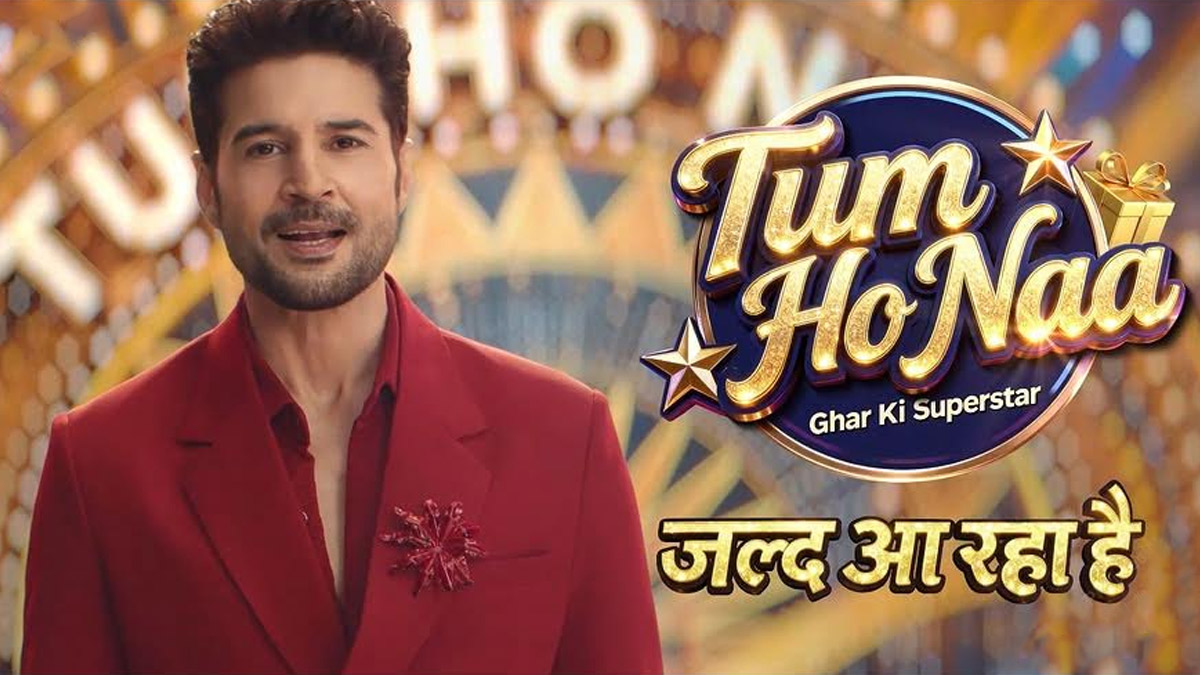
MUMBAI: Lights, camera… connection because this time, the game isn’t just about winning, it’s about who’s with you. Sony Pictures Networks India is gearing up to launch a new reality game show, Tum Ho Naa, expanding its unscripted slate with a format that promises both emotion and engagement.
The show will premiere soon on Sony Entertainment Television and stream on Sony LIV, with Rajeev Khandelwal stepping in as host. Known for his measured screen presence and selective choices, Khandelwal’s return to television adds a layer of familiarity and credibility to the upcoming format.
While specific details of the gameplay remain under wraps, the positioning suggests a reality format that leans as much on emotional resonance as it does on competition, an increasingly popular blend in Indian television, where audiences are gravitating towards content that offers both stakes and storytelling.
Khandelwal, reflecting on his return, noted that his choices have often been guided by instinct rather than convention, describing Tum Ho Naa as a project that feels “close to the heart”. His association also signals Sony’s continued focus on anchoring new formats with recognisable faces who bring both relatability and depth.
The launch comes at a time when broadcasters are doubling down on original non-fiction formats to drive appointment viewing, even as digital platforms expand parallel reach. By placing the show across both linear television and OTT, Sony appears to be aiming for a dual-audience strategy capturing traditional viewers while engaging digital-first consumers.
As the countdown to premiere begins, Tum Ho Naa positions itself not just as another game show, but as a reminder that sometimes, the biggest prize on screen isn’t the jackpot, it’s the journey shared along the way.






