GECs
Zee Telefilms notches up middling performance in Q1 Y2K1


Zee Telefilms continues to surprise you. Just when everyone was writing its obituary and investigations were proceeding against the firm and his group, chairman Subhash Chandra pulled out a rabbit out of his hat: first quarter 2001 (Q1 Y2K1) results which show that the company is not taking things lying down.
Yes, its bottomline has not fared as well as it should have. It is up by a razor thin 12 per cent to Rs 298.8 million in Q1 Y2K1 from Rs 267 million in Q1 Y2K on the back of higher programming costs of Rs 441.7 million (Rs 270.7 million), staffing costs of Rs 80 million (Rs 49.5 million), interest burden of Rs 141.4 million (Rs 43.3 million) and other expenses of Rs 136.7 million (Rs 84.5 million). (Higher programming and staffing costs should be taken positively because it means Chandra and his team are taking care of two areas where Zee Telefilms has been weak: programming and people management.)

The positive is that revenue from sales & services is up 40 per cent to Rs 988.6 million (RS 706.7 million) while other income has raced ahead 95 per cent to RS 203.6 million from RS 104.3 million. This at a time when everyone expected Zee Telefilms to come up with shoddy results on account of the perceived hammering it received from viewers and advertisers.
Net profit for the Zee Network as a whole has taken a beating. At RS 363.7 million, it is down by 13 per cent from RS 418.3 million in Q1 Y2K. Ad revenues – probably for the first time in its history – are down by 13 per cent to RS 1373.1 million (RS 1576.9 million).
But the positive is that subscription revenue for the network is up by 36.6 per cent to RS 667.9 million (RS 488.7 million ). RS 130 million of this is chipped in by domestic pay TV revenues (Zee TV went pay in June). Additionally, the company says that the Internet over cable business through subsidiary has started notching up income of RS 5 million a month, which is expected to rise much further in the coming months as the service spreads.
Income from sales & service has gone up 353 per cent to RS 294.1 million (RS 64.8 million), while other income (in the form of interest) has doubled to RS 206.5 million (RS 108.5 million).(Deduct these two income streams and the network appears to be in dire straits.)
Total revenue for the network has climbed up by 13.5 per cent to RS 2541.5 million (RS 2238.8 million).
Expenditure for the network is up 13.5 per cent to RS 1739.6 million from RS 1532.6 million, while interest costs have risen sharply by 83 per cent to 204.3 million from RS 111.8 million. The Zee Telefilms share surged 22.18 percent to close at RS 86.75 ahead of the results, while the main Bombay index ended up 1.32 percent.
Why the recovery in the scrip when it was being pummeled earlier, is a question that one may ask, especially when the financial performance has not been something to write home about?
For one, the network has kicked its main rival Sony off the TV ratings chart and is looking set to give leader Star Plus a run for its money. New CEO Sandeep Goyal is working on giving the company an aggressiveness and a focus it has not displayed for some years. New programming initiatives for which investments were made in Q1 Y2K1 – and are being made – are expected to see the light of day in end August. At least some of these should bear fruit, in terms of viewership and ad revenues.
Additionally, its first film Gadar – Ek Prem Katha is expected to chalk up box office collections like no other movie has done before in India. Finally, it has also – unsuccessfully – been scouting around for a strategic investment partner. That may take some doing courtesy the investigations it is undergoing from various authorities.







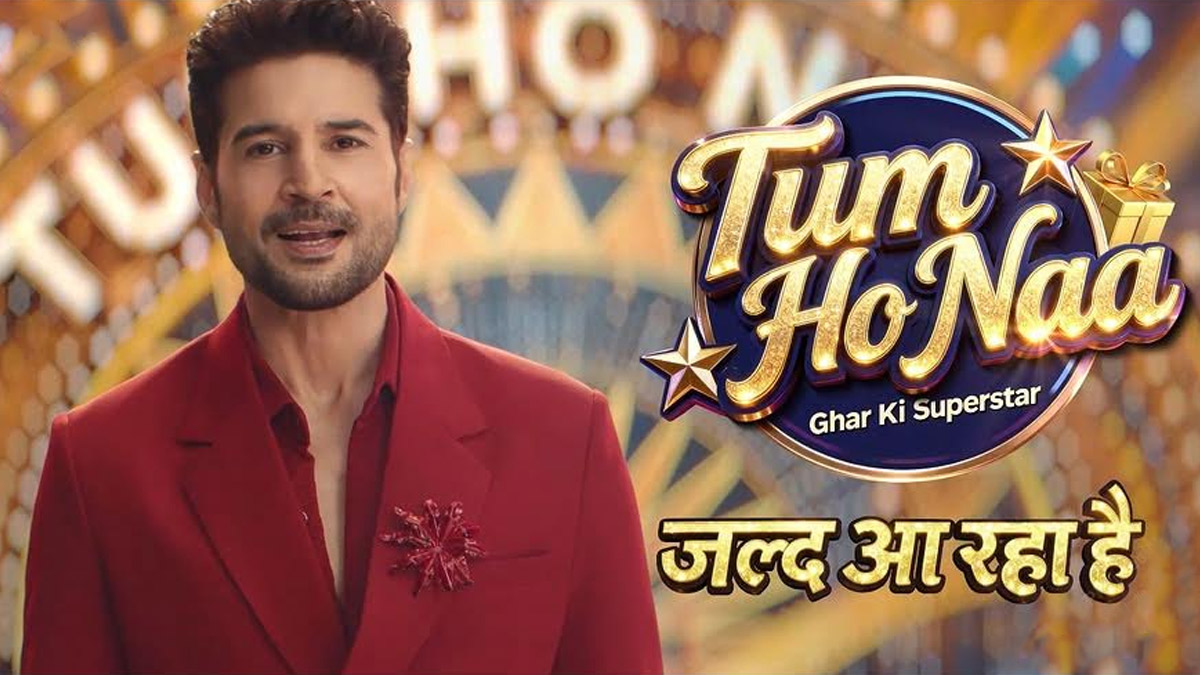
MUMBAI: Lights, camera… connection because this time, the game isn’t just about winning, it’s about who’s with you. Sony Pictures Networks India is gearing up to launch a new reality game show, Tum Ho Naa, expanding its unscripted slate with a format that promises both emotion and engagement.
The show will premiere soon on Sony Entertainment Television and stream on Sony LIV, with Rajeev Khandelwal stepping in as host. Known for his measured screen presence and selective choices, Khandelwal’s return to television adds a layer of familiarity and credibility to the upcoming format.
While specific details of the gameplay remain under wraps, the positioning suggests a reality format that leans as much on emotional resonance as it does on competition, an increasingly popular blend in Indian television, where audiences are gravitating towards content that offers both stakes and storytelling.
Khandelwal, reflecting on his return, noted that his choices have often been guided by instinct rather than convention, describing Tum Ho Naa as a project that feels “close to the heart”. His association also signals Sony’s continued focus on anchoring new formats with recognisable faces who bring both relatability and depth.
The launch comes at a time when broadcasters are doubling down on original non-fiction formats to drive appointment viewing, even as digital platforms expand parallel reach. By placing the show across both linear television and OTT, Sony appears to be aiming for a dual-audience strategy capturing traditional viewers while engaging digital-first consumers.
As the countdown to premiere begins, Tum Ho Naa positions itself not just as another game show, but as a reminder that sometimes, the biggest prize on screen isn’t the jackpot, it’s the journey shared along the way.







