News Headline
Zee, Star, NBA oppose converged regulator for broadcast and telecoms


MUMBAI: Two of India’s biggest broadcasters Star India and Zee Network and industry association News Broadcasters Association (NBA) have opposed the TRAI’s proposal to have a converged regulator, a concept being debated as part of a consultation paper floated by the regulatory body.
In its lengthy submission to the TRAI’s paper on formulation of National Telecoms Policy 2018, Star, while suggesting a “separate regulator” for broadcasting sector was unfeasible, has said, “With a converged regulator for ICT and broadcasting there is always the risk of ‘false equivalence’ being drawn between the two sectors.”
Pointing out that convergence was an aid to make content available to consumers and increasing the opportunities for content producers/rights holders to maximise monetisation opportunities involving intellectual property rights over content, Star highlighted, “Creative eco-system being an entirely separate unique value chain from ICT, should always be treated with a view to uphold and protect IPs.”

Echoing similar sentiments, Zee said the Ministry of Information and Broadcasting (MIB) was the nodal ministry for all broadcasting related issues and it would be “inappropriate” for the Department of Telecommunications (DoT) to propose a converged regulator in its policy document without making the MIB a part of the process.
“It may also be pointed out that setting up a convergent regulator would also require a convergence bill (to be okayed by Parliament) outlining the very scope of convergent regulations and various issues associated with it,” Zee explained its stance.
Subhash Chandra-controlled Zee network has gone ahead and questioned the TRAI’s various consultation papers on broadcasting industry-related issues that include the one on NTP 2018 and another one on uplinking and downlinking.
“It is astounding that there is no correlation between the two consultation papers,” Zee has submitted, “If the comments (from the industry) provided against one consultation paper are accepted, these would be counter to the comments/ recommendations against the other consultation paper.”
Both Star and Zee in their submissions have cited in the defence of their stance views of Parliament’s Standing Committee on Information Technology on broadcast regulation articulated in its latest report tabled few weeks back.
In its report, the parliamentary panel observed that the broadcast sector has developed so much that it would be advisable for the government to explore a separate regulator and till that happens, powers of TRAI could be explored to be expanded as an interim measure.
By trying to bring in the “convergence issue”, wherein broadcasting and telecom were “treated under the same umbrella” in a converged manner, the TRAI “would be acting contrary” to the views articulated by the parliamentary panel that had pushed for separate regulators for telecoms and broadcast sectors, both Star and Zee pointed out.
NBA, which is an apex industry body comprising most of the TV (and digital) news ventures as its members, also joined in the issue with Star and Zee to observe the regulatory authority dealing with content issues must be different from the body dealing with other issues in the broadcasting sector.
The TRAI regulates the carriage side of the broadcast industry that includes issues such as tariff, inter-connect and quality of service. It also holds sway over matters like OTT, broadband and net neutrality that straddle both segments of broadcast and telecoms services.
Also Read :
MIB reverts to earlier norms of seeking nod from ISRO on uplink/downlink of TV channels
Government toying easing downlink norms
The Communication Convergence Bill, 2001







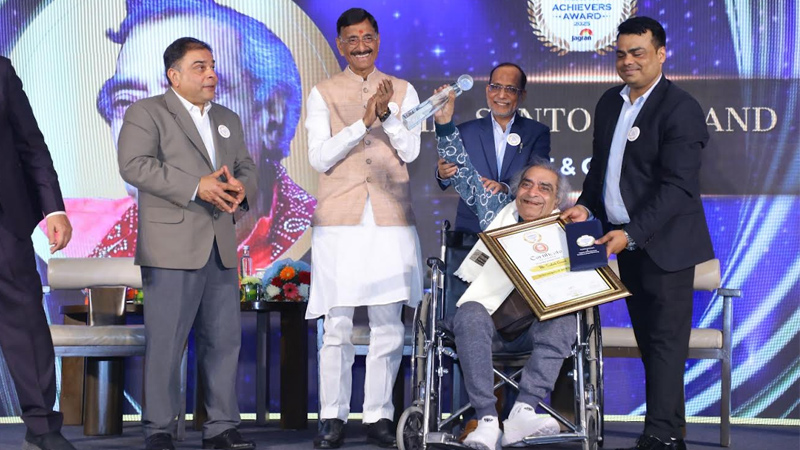
NEW DELHI: Hamdard Laboratories gathered a cross-section of India’s achievers in New Delhi on Friday, handing out the Hakeem Abdul Hameed Excellence Awards to figures who have left their mark across healthcare, education, sport, public service and the arts.
The ceremony, attended by minister of state for defence Sanjay Seth and senior officials from the ministry of Ayush, celebrated individuals whose work blends professional success with a sense of public purpose. It was as much a roll call of achievement as it was a reminder that influence is not measured only in profits or podiums, but in people reached and lives improved.
Among the headline awardees was Alakh Pandey, founder and chief executive of PhysicsWallah, recognised for turning affordable digital learning into a mass movement. On the sporting front, Arjuna Awardee and kabaddi player Sakshi Puniya was honoured for her contribution to the game and for pushing women’s participation onto bigger stages.
The cultural spotlight fell on veteran lyricist and poet Santosh Anand, whose songs have echoed across generations of Hindi cinema. At 97, Anand accepted the honour with characteristic humility, reflecting on a life shaped by perseverance and hope.
Healthcare honours spanned both modern and traditional systems. Manoj N. Nesari was recognised for strengthening Ayurveda’s place in national and global health frameworks. Padma shri Mohammed Abdul Waheed was honoured for his research-backed work in Unani medicine, while padma shri Mohsin Wali received recognition for his long-standing contribution to patient-centred care.
Education and social development also featured prominently. Padma shri Zahir Ishaq Kazi was honoured for decades of work in education, while former Meghalaya superintendent of Police T. C. Chacko was recognised for public service. Goonj founder Anshu Gupta received an award for his dignity-centred rural development initiatives, and the Hunar Shakti Foundation was honoured for empowering women and young girls through skill development.
The Lifetime Achievement Award went to former IAS officer Shailaja Chandra for her long career in public healthcare and governance, particularly in the traditional systems under Ayush.
Speaking at the event, Hamdard chairman Abdul Majeed said the awards were a tribute to those who combine excellence with empathy. “These awardees reflect Hakeem Sahib’s belief that healthcare, education and public service must ultimately serve humanity,” he said.
Minister Seth struck a forward-looking note, saying India’s young population gives the country a unique opportunity to become a global destination for learning, health and wellness by 2047.
The ceremony also featured the trailer launch of Unani Ki Kahaani, an upcoming documentary starring actor Jim Sarbh, set to premiere on Discovery on 11 February.
Instituted in memory of Unani scholar and educationist Hakeem Abdul Hameed, the awards have grown into a national platform that celebrates those building a more inclusive and resilient India. For one evening at least, the spotlight was not just on success, but on service with substance.