News Broadcasting
Zee News to launch two interactive shows


MUMBAI: Zee News is coming up with two interactive discussion programmes this weekend, Kitna Bole Baba and Main Azaad Hoon.
These programmes will primarily focus on two issues – Have religious gurus become the role models of the society today; and Is the society in Gujarat accepting the liberal women. Viewers can send in their queries through SMS.
The two programmes have been designed in a way to have the highest possible viewer’s interactivity. Main Azaad Hoon initiates the discussion on today’s liberal attitude of women, whereas it is commoner’s increasing dependency on the religious gurus takes the center stage in Kitna Bole Baba.

The programmes are aimed at clarifying the prevailing misconceptions about the issues. Kitna Bole Baba will focus the society’s current mindset of making larger than life picture of their religious gurus.
It is going to be a discussion between today’s famous gurus and the social scientists with a view to bring a clearer picture of the thought process the gurus put in, while advising their disciples in their day to day affairs. It will be telecast on 23 December at 8 pm.
Main Azaad Hoon will focus on the pragmatic situations, which today’s women often find them into. From having a boyfriend to having an extra marital affair, no question is going to be hypothetical, asserts an official release.
The discussion will further cover the morality factor in the women’s action from society’s viewpoint. Apart from survey and field stories, the guests in the studio will also contribute with their views. Guests would include some social activists, young girls and a psychologist. This will be telecast on 24 December at 8 pm. The survey was conducted in four cities – Ahmedabad, Surat, Vadodara and Rajkot.
A deep research was conducted, before zeroing down on these topics. The channel has been frequently providing a platform to discuss the important topics, which will pave way to an open-minded society, adds the release.






News Broadcasting
UDF poised to return to power in Kerala, says Manorama-CVoter survey
Massive opinion poll projects shift in Kerala politics ahead of 2026 Assembly elections.
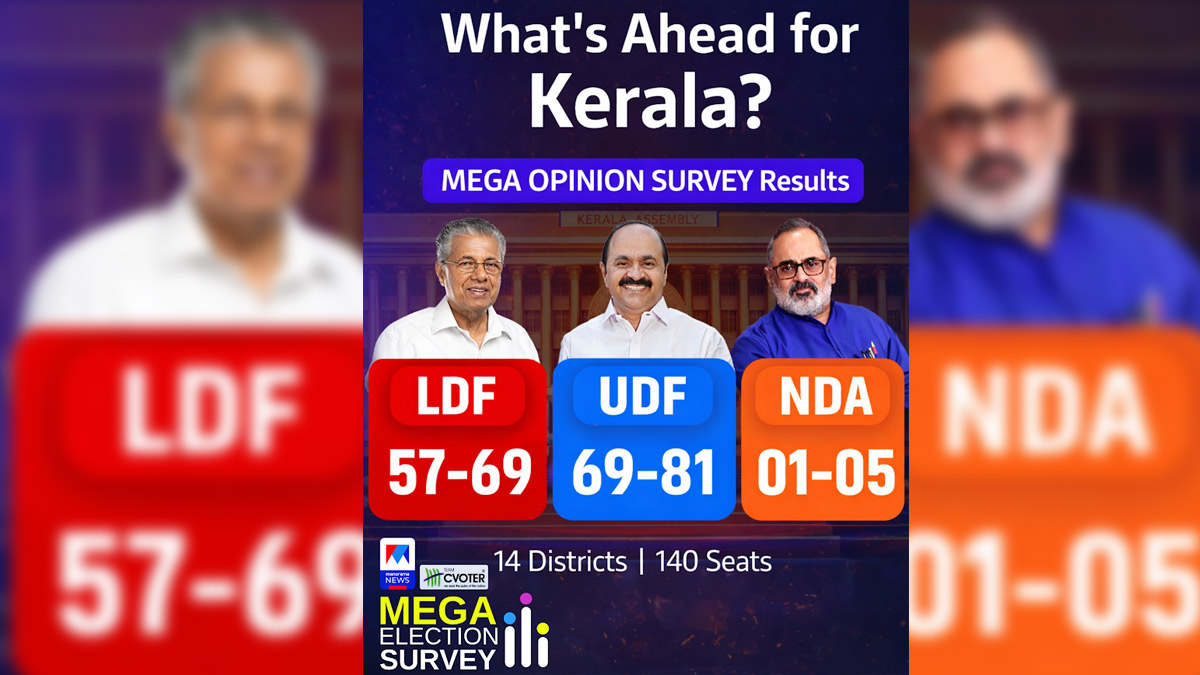
MUMBAI: The winds of change appear to be blowing through Kerala’s political landscape and this time, they seem to favour the United Democratic Front. A comprehensive mega opinion survey conducted by Manorama News in partnership with CVoter projects a potential comeback for the UDF in the upcoming Kerala Legislative Assembly Elections 2026. The survey, covering all 140 constituencies with a massive sample size of nearly 90,000 respondents, predicts the UDF could win between 69 and 81 seats.
The ruling Left Democratic Front (LDF) is expected to secure 57 to 69 seats, a significant drop from the 99 seats it won in the 2021 elections. This would mean the LDF losing 30 to 42 of its sitting seats. Meanwhile, the National Democratic Alliance (NDA), which drew a blank in 2021, is projected to open its account with 1 to 5 seats.
Region-wise, the UDF is expected to make strong gains in Malabar, winning 25 to 34 out of 48 seats, and in Central Kerala, where it could bag 29 to 33 out of 53 seats. In South Kerala, the LDF is likely to retain an edge with 21 to 25 seats, while the UDF may improve to 12 to 16 seats. The NDA could pick up 1 to 3 seats in the southern region.
The survey was conducted between 14 and 26 March 2026, with additional tracker and snap polls carried out from December 2025 to March 2026. A total of 89,693 respondents participated, ensuring representation across all demographics and social segments.
Manorama News has a strong track record of accuracy, with its previous projections closely matching the actual results of the 2019 and 2024 Lok Sabha elections as well as the 2021 Kerala Assembly polls.
In Kerala’s famously fierce political battles, this survey suggests the pendulum may be swinging back. Whether the final verdict matches these numbers or throws up another surprise, one thing is clear, the 2026 Assembly elections are shaping up to be one of the most keenly watched contests in the state’s history.






