News Broadcasting
Zee moves SC, Prasar Bharati also to file suit for telecast rights


MUMBAI / NEW DELHI: The Indian cricket rights imbroglio is fast entering the realm of the theatre of the absurd. Even as Zee Telefilms this morning filed an application before the Supreme Court seeking a direction to the Indian cricket board not to give television coverage rights to Sony TV and Ten Sports, pubcaster Prasar Bharati declared that it would be filing its own writ as an “aggrieved party”.
Zee has submitted that it be should given the telecast rights for the India-Australia Test cricket series starting from 6 October. The court has fixed Tuesday for hearing of the application.
Speaking to indiantelevision com today, Zee Telefilms additional vice-chairman Jawahar Goel said, “We certainly have a strategy and seeking legal recourse is one of them. But let me tell you, millions of fans of cricket in India may miss out on cricket because of some people’s mis-doings.”
Goel reiterated that as the declared highest bidder, Zee Telefilms would not give up easily on something that it thinks is “rightfully” its. “We are sure the court would finally see our point of view too,” he added.

Meanwhile, Prasar Bharati, the third highest bidder for the cricket rights after Zee and ESPN Star Sports at $ 150 million, stated it would be filing its submission before the apex court.
Confirming the move to indiantelevision.com, Prasar Bharati CEO KS Sarma said the decision to approach the courts had come in the wake of the Board of Control for Cricket in India’s (BCCI) announcement yesterday that the board would arrange for the live telecast of the India-Australia series beginning on 6 October through Sony Television Entertainment India.
Sarma said, “As the third highest bidder, we feel we should be rightfully offered the rights for cricket at the price we had bid for. BCCI’s current intentions make us an aggrieved party and we’d move the court next working day (Monday, 4 October).”
As per the BCCI plan, the live feeds would be produced by the Dubai-based Ten Sports network to be shown on a Sony channel.
As the cricket rights saga was unfolding and getting into a legal logjam with parties moving the court, BCCI did try to sell the rights to Prasar Bharati to be shown on Doordarshan, but was rebuffed as the asking price was “high”.
According to Prasar Bharati sources, BCCI had conveyed to DD that even if it offers a dollar more than $ 308 (Zee’s quote), the telecast rights were for the taking.”But when we had bid almost half the amount that, taking into account all aspects, we could not have paid up more on the second invitation,” a source privy to the confabulations between BCCI and DD said.






News Broadcasting
News18 India launches Command Centre war explainer with Arya
New show shifts from debates to decoding global conflicts and impacts
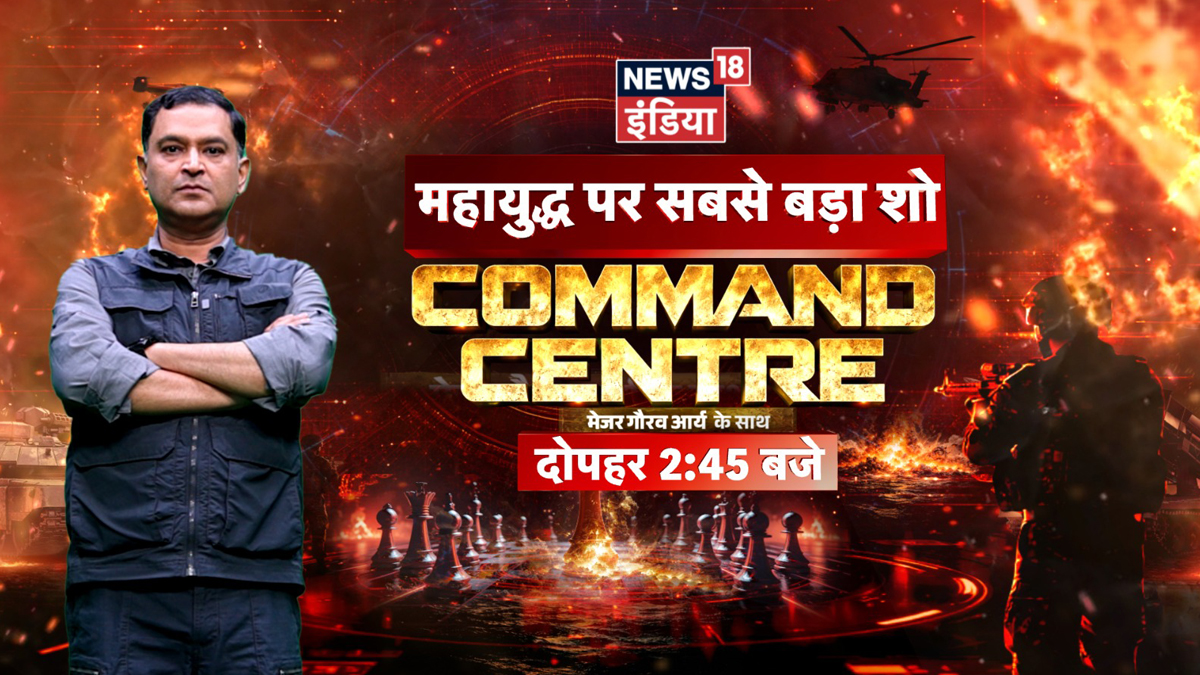
MUMBAI: News18 India has rolled out a new war-focused programme, Command Centre, featuring Gaurav Arya, as it looks to offer viewers a sharper, more grounded take on global conflicts amid rising tensions in West Asia.
Positioned as an “insider war room”, the show moves away from conventional panel debates and instead focuses on explaining military developments, decoding strategy and connecting global events to their everyday impact, from fuel prices to economic shifts.
The format leans heavily on visuals and data. The studio has been designed like a command hub, complete with large LED war maps, real-time graphics and an alert system to track developments as they unfold.
At the centre of it all is Arya, who brings his military background to simplify complex war strategies for viewers. His signature line, “Seedhi baat samjhiye”, anchors the show’s promise of clarity over noise.
News18 India managing editor Jyoti Kamal said, “Command Centre, featuring Major Gaurav Arya is designed to deliver accurate insights and a clear perspective on how evolving conflicts impact everyday life, from household budgets to national security. With expert voices analysing every development in real time, the show goes beyond headlines to decode what’s happening now, what it means, and what could come next.”
Echoing the intent, Gaurav Arya added, “In times of war, confusion is the biggest threat. With News18 India’s Command Centre, we are bringing viewers inside the war room, decoding strategies, tracking every escalation, and explaining, in the simplest terms, what it means for India and for every household. Seedhi baat samjhiye, this is where you understand not just what is happening, but what happens next.”
The weekday show will air in the afternoon slot and will also feature Gaurav Shukla, adding to its editorial depth.
With its mix of analysis, visuals and a clear focus on impact, the show reflects a broader shift in news consumption. Viewers are no longer just watching events unfold, they are looking to understand what those events mean for them.






