News Broadcasting
Zee MGM, Zee English set for revamp


MUMBAI: After a period of inactivity, Zee MGM and Zee English are pushing ahead in terms of a new look as well as innovative programme strategies.
The channels’ vice president Ajay Trigunayat says a new look has been put in place for Zee MGM from 11 December. This sees the return of the roaring lion on the channel logo since that is what Indians associate the MGM brand with. The channel has also taken a decision to delve into the brand heritage of MGM and is therefore using the famous tagline Lions Share of Hollywood.
The decision to go in for a revamp was taken in mid-September and Zee asked MGM to do the needful, says Trigunayat. The Zee network then did its own upgrades using state of the art facilities. The channel now also has a new promo director in Shrett Garnett who has worked in Dubai and the UK for ten years, says Trigunayat.

Elaborating on the strategy for Zee English, Trigunayat says, ” What we did for Zee English is to put all the graphic elements which were already available but which had not yet been used into place like new fonts. Every promo has a time and day, which is standardised across the channel. For Zee English, we are not going for a new look right now. We will wait for some time and then proceed. Effectively we are taking things in various stages and I call it the ‘afterburner’ approach.”
Trigunayat says the broadcaster renogitiated the contract with MGM in August 2002 after which it started airing non MGM movies like the Oscar Winner Traffic..
As far as positioning Zee MGM was concerned, he says, “During our research, viewers told us that when they watch an English movie channel, they look forward to unreleased and unknown movies in India. those that have not been seen in theatres or on the DVD, video circuits. This led us to the assumption that maybe we should be a channel which plays good movies at all times. We took the decision to not be a functional or a symbolic brand. We will be an experiential brand. You can watch a good movie at any time and there will be no appointment viewing required. “
In terms of channel share, Trigunayat says that during the top of the line slot, which is Romantic Monday’s , Zee MGM’s share had gone up by thrice as much.
Reagrding programming on Zee English Trigunayat says, ” We tinkered only slightly with the FPC. When Friends aired at 10:30 pm on weekends, channel share was 55 per cent between 9-12 pm. So we decided to put it back on weekdays at 10 pm. After the eighth season of Friends was over, we went back to the first episode from 11 November and channel shares have jumped back up to 47 per cent.”
Trigunayat says Zee English plans to bring in four shows from next month, for which a fresh approach has been taken. Zee MGM will premiere Run Lola Run in end January. It will also air English movies with an Indian feel like David Lean’s A Passage to India on Tuesdays at 9 pm.



News Broadcasting
UDF poised to return to power in Kerala, says Manorama-CVoter survey
Massive opinion poll projects shift in Kerala politics ahead of 2026 Assembly elections.
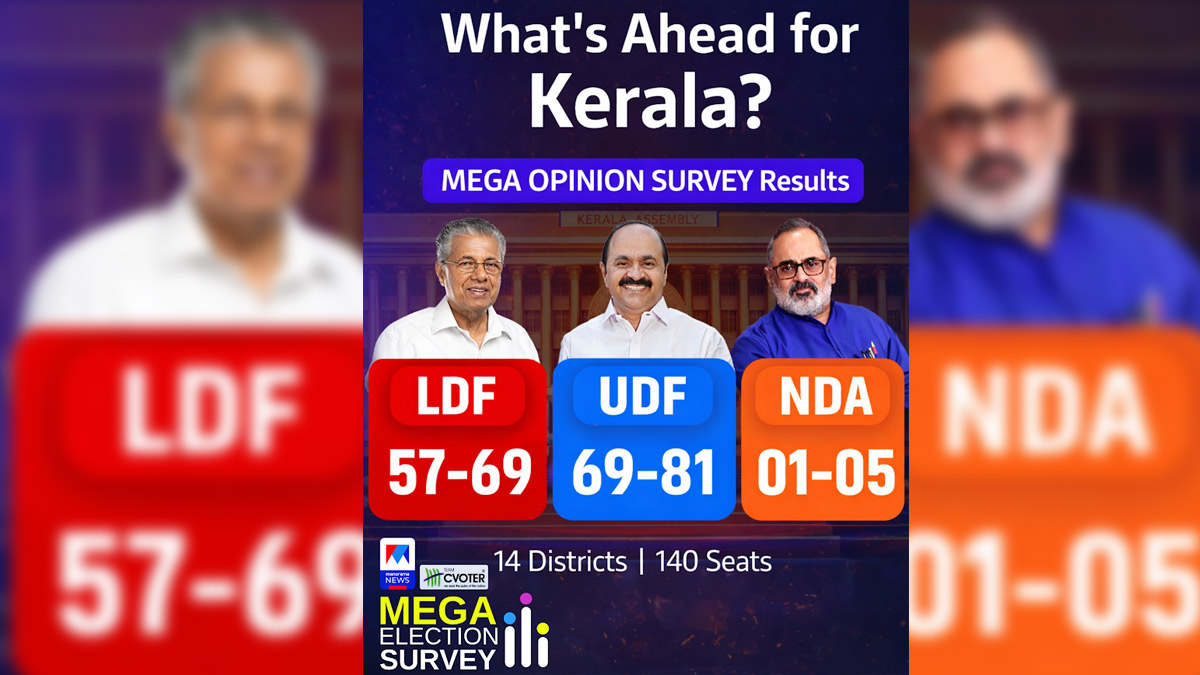
MUMBAI: The winds of change appear to be blowing through Kerala’s political landscape and this time, they seem to favour the United Democratic Front. A comprehensive mega opinion survey conducted by Manorama News in partnership with CVoter projects a potential comeback for the UDF in the upcoming Kerala Legislative Assembly Elections 2026. The survey, covering all 140 constituencies with a massive sample size of nearly 90,000 respondents, predicts the UDF could win between 69 and 81 seats.
The ruling Left Democratic Front (LDF) is expected to secure 57 to 69 seats, a significant drop from the 99 seats it won in the 2021 elections. This would mean the LDF losing 30 to 42 of its sitting seats. Meanwhile, the National Democratic Alliance (NDA), which drew a blank in 2021, is projected to open its account with 1 to 5 seats.
Region-wise, the UDF is expected to make strong gains in Malabar, winning 25 to 34 out of 48 seats, and in Central Kerala, where it could bag 29 to 33 out of 53 seats. In South Kerala, the LDF is likely to retain an edge with 21 to 25 seats, while the UDF may improve to 12 to 16 seats. The NDA could pick up 1 to 3 seats in the southern region.
The survey was conducted between 14 and 26 March 2026, with additional tracker and snap polls carried out from December 2025 to March 2026. A total of 89,693 respondents participated, ensuring representation across all demographics and social segments.
Manorama News has a strong track record of accuracy, with its previous projections closely matching the actual results of the 2019 and 2024 Lok Sabha elections as well as the 2021 Kerala Assembly polls.
In Kerala’s famously fierce political battles, this survey suggests the pendulum may be swinging back. Whether the final verdict matches these numbers or throws up another surprise, one thing is clear, the 2026 Assembly elections are shaping up to be one of the most keenly watched contests in the state’s history.






