News Broadcasting
Zee Jagran sports new look; repositions itself


MUMBAI: Enriching Lives! That’s the new tag line of Zee Jagran, the spiritual TV channel from the Zee group, which is looking at repositioning itself.
The new positioning statement – Enriching Lives – exudes the essence of Zee Jagran. Enriching Lives is a sum total of seven elements called hope, joy, peace, celebration, balance, silence and awakening. The right mix of these elements helps a person in experiencing life in its true colours.
In order to break the perception that the channel is aimed at elderly people, the new positioning is targeted to all those who want to connect to their souls and live life to the fullest.

In an official statement issued, the new positioning of Zee Jagran will be reflected in the overall aesthetics, look and feel of the channel, innovative channel packaging, colorful promos, all new range of programs and a lot more.
The programmes designed for the channel are divided into thematic time bands, which will highlight the seven elements that lead towards enriching lives. These programmes are full of variety and cater to almost all age-groups and profiles of people who want to celebrate the festival called life, everyday.
Starting from 2 pm, the first time band with the theme – Hope – showcases alternative healing programs like Tarot, The Good Food Show, Lifestyle Gurus, Beauty Mantras, etc.
Joy will air at 2:30 pm showcasing serials like Ramayan, Vishnu Puran and Jai Ganesh. From 3 pm to 3:30 pm the channel will air Silence, which features programmes like Mano ya na Mano and Anant, which unveils the truth about various superstitions, evils and demons that affect life at one point or the other.
The channel will also air shows like Celebrate, Jahan Jahan Ram Charan Chali Jahin (JJRCCJ), Namaste India, Home Healers, Green Mantra, mystical show Peace, Balance, Awakening from Monday to Thursday.
Weekends will showcase inspirational movies. The channel recently aired hard hitting realities of the country in the form of documentaries made with the support of NGO’s like Prayaas, which are working hard for the upliftment of the underprivileged. Also there was a special feature on Bhopal Gas Tragedy victims, who are still struggling for their rights.
The channel will also air special programmes on various festivals through a range of celebrations in the form of film festival, live shows and special features.



News Broadcasting
Network18 channels lead YouTube news viewership in March 2026
CNN-News18, News18 India and CNBC channels top categories with record views
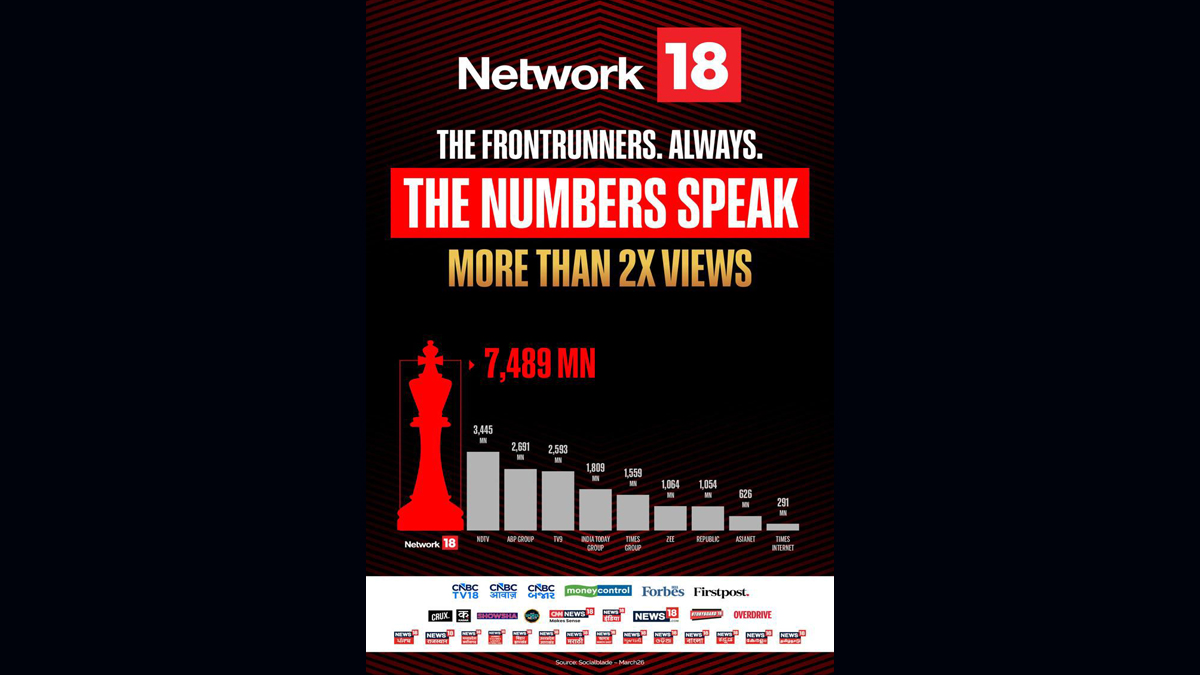
MUMBAI: When the world hit refresh on breaking news, Network18’s channels were already streaming ahead. As geopolitical tensions and war-driven headlines fuelled a surge in global news consumption, the network’s digital playbook delivered big clocking record Youtube viewership across English, Hindi and business news categories in March 2026.
At the forefront was CNN-News18, which emerged as the clear leader in the English news segment with 130 million live and video-on-demand views. The channel edged past competitors such as Times of India (126.5 million), Times Now (101.1 million), India Today (88.2 million) and NDTV (77.5 million), according to Databeings data for March.
In the Hindi news arena, News18 India delivered a commanding performance, racking up a staggering 3,297 million views on YouTube. The channel comfortably outpaced NDTV India, which recorded 3,119 million views, underlining its deep reach and consistent engagement with mass audiences, as per Playboard data.
The network’s dominance wasn’t confined to general news. In the Hindi business segment, CNBC Awaaz topped the charts with 92 million views, narrowly ahead of Zee Business (90 million) and well ahead of ET Now Swadesh (57 million). Meanwhile, its English counterpart CNBC-TV18 posted a strong 58 million views, reinforcing the network’s cross-category strength.
The spike in viewership reflects a broader shift in audience behaviour, with viewers increasingly turning to digital platforms particularly Youtube for real-time updates and in-depth coverage during high-intensity news cycles. For Network18, the numbers signal more than just scale; they underline the effectiveness of a multi-platform strategy that blends speed, credibility and continuous coverage.
In a month where the news never paused, it seems viewers chose to stay tuned where the stream never stopped.






