Applications
Yulu flags off its service in Tirunelveli

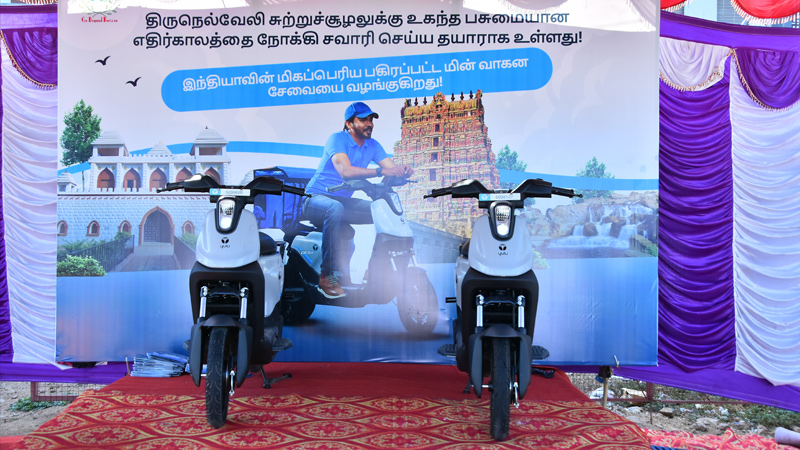
Mumbai: Yulu, a shared electric vehicle (EV) mobility technology firm, launched its service in Tirunelveli, Tamil Nadu, in partnership with city-based Runa Motors Pvt Ltd. The service was inaugurated in the presence of Tirunelveli City’s assistant commissioner of police – traffic, K.B. Kameshwaran, as well as Startup Tamil Nadu’s project leads N Rahul and C Gigin Durai. Following the launch, Runa Motors, which is helmed by local entrepreneur V. Nagarajan, will operate a fleet of DeX GR EVs across the city with support from Yulu.
Tirunelveli is now home to the third operational Yulu Business Partnership (YBP). Previously, Yulu had launched its leisure mobility services in Indore and Kochi, in collaboration with YBP partners in those cities. The introduction of its zero-emission delivery EVs in Tirunelveli marks another remarkable stride for Yulu as it rapidly scales up its service in non-metro cities.
Tirunelveli is well known for its cement, cotton, sugar and pharmaceutical industries. An upcoming city, it also attracts a large number of students, medical tourists and jobseekers from nearby towns and villages, as well as other states. Sensing an unmet need for environmentally sustainable and affordable mobility options, Runa Motors’ founder V. Nagarajan – whose goal is to shape Tirunelveli into a modern, smart and sustainable city – decided to join hands with Yulu.

To begin with, Runa Motors and Yulu will offer hyperlocal delivery EVs for food delivery partners. In addition to providing EVs, technology, and training, Yulu has also supported Runa Motors with brand partnerships, and is working closely with Swiggy and Zomato’s city-based teams to help Runa Motors onboard new riders. With Yulu’s proposition of enabling 30-40 per centhigher savings, the partnership will unlock several gig work jobs, boost Tirunelveli’s local economy, and enable delivery companies and local businesses to easily switch to eco-friendly vehicles for their logistics needs.
Yulu co-founder & CEO Amit Gupta said: “We are excited to introduce our EV mobility services in Tirunelveli in partnership with Runa Motors and V. Nagarajan. This collaboration not only marks another milestone for the YBP initiative, but also underscores Yulu’s commitment to take the EV revolution to every city and town in the country. I am confident that Runa’s fleet, powered by Yulu’s cutting-edge technology stack, will revolutionise hyperlocal deliveries in Tirunelveli and chart a sustainable growth roadmap for this beautiful and fast-growing city.”
Runa Motors Pvt Ltd founder V. Nagarajan said that his decision to partner Yulu was made easier by the fact that it is a ‘Made in India’ brand whose world-class EVs are manufactured by Bajaj Auto. He added, “The integration of Yulu’s proven end-to-end EV mobility solution and Runa’s local expertise will transform the mobility landscape of Tirunelveli. I am confident that the residents will embrace this affordable and eco-friendly hyperlocal delivery EV service. We look forward to contributing to the community’s economic and environmental well-being and are excited at the prospect of expanding into further areas, such as personal mobility, and look forward to scaling up our business into as many cities as possible.”
Runa Motors has deployed the EVs at key spots in the city, including Thiyagarajanagar, Sambandhar Street, Megalingapuram Salai Street, Sindhupoondurai, Tirunelveli Junction and the Tirunelveli Corporation area. The EV fleet’s energy needs will be met via three battery swapping stations powered by Yuma — a leading battery-as-a-service (BaaS) firm — at Thirugnanasambandar Kovil Town, Medhablock Pushpalata, and Udayarpattisalai Junction. In addition, three Yulu Centres have been established across the city to serve as touchpoints for customer information, vehicle rentals and maintenance.






Applications
With 57 per cent single new users, Ashley Madison rebrands as discreet dating platform
Platform says majority of new members now identify as single

INDIA: Ashley Madison is shedding the “married-dating” label that defined it for two decades, repositioning itself as a platform for discreet dating in what it calls the post-social media age.
The rebrand, unveiled in India on 27 February, 2026, marks a structural shift in business model and identity. Once synonymous with married dating, the company now describes itself as the “premier destination for discreet dating” under a new tagline: Where Desire Meets Discretion.
The pivot is data-driven. Internal figures show that 57 per cent of global sign-ups between 1 January and 31 December, 2025 identified as single: a notable departure from the platform’s married core. The company argues that its community has already evolved beyond its original positioning.
“In an age where our lives have been constantly put on public display, privacy has become the new luxury,” said Ashley Madison chief strategy officer Paul Keable. He framed the platform’s offering as “ethical discretion” for singles, separated, divorced and non-monogamous users seeking private connections.
The shift also taps into wider digital fatigue. A global survey conducted by YouGov for Ashley Madison, covering 13,071 adults across Australia, Brazil, Canada, Germany, India, Italy, Mexico, Spain, Switzerland, the UK and the US, found mounting discomfort with hyper-public online lives.
Among dating app users, 30 per cent cited constant swiping and messaging as a source of fatigue, while 24 per cent pointed to pressure to curate public-facing profiles and early personal disclosure. Some 27 per cent said fears of screenshots or information being shared contributed to exhaustion; an equal share cited unwanted attention.
The retreat from oversharing appears broader. According to the survey, 46 per cent of adults actively try to keep most aspects of their life private online. Only 8 per cent feel comfortable sharing most aspects publicly, while 35 per cent say they are becoming more selective about what they disclose.
Ashley Madison is betting that this cultural recalibration towards controlled visibility can be monetised. By doubling down on privacy infrastructure and reframing itself around discretion rather than infidelity, the company is attempting to convert reputational baggage into a premium proposition.






