Hindi
Yet another disappointment from RGV


MUMBAI: When Ram Gopal Varma makes a film, one is a bit sceptical. He has not made a sensible film in a long time after all! When you go to a movie expecting nothing, you do usually come out happier than if you expected a masterpiece.
 |
|
Producer: Viacom 18 Motion Pictures, Uberoi Line Productions. |
This, however, is not the case with Department, the latest Ram Gopal Varma film. One does go in expecting nothing but one comes out exasperated and mentally fatigued. Department is an exercise in senility: it tries your patience, it tests your nerves and it challenges your sensibilities. After a run time of 2 hours 13 minutes, you come out not knowing who was who in the film, what his motives were and, to top it all, you are threatened with a sequel!
There are some cops on a killing spree in order to get the better of the underworld. Rana Daggubati, one of them, is singled out for suspension for being trigger-happy. The other one, Sanjay Dutt, knows to hide his tracks well. Since there is too much of underworld, some unknown and unexplained face decides to form a special task force called Department, which will not be answerable to anyone and which will not exist on paper.

But, this being a Ram Gopal Varma film, all and sundry know of its existence the moment it is formed. That includes a crazy looking Mumbai don, Vijay Raaz, and a secretive Dubai-based kingpin, Ghouri Mohammed. Rana and Dutt both embark on a shooting spree killing some random faces to reach Vijay Raaz. The charade goes on until a little before the interval, when Amitabh Bachchan makes his entry. He is an idiosyncratic character who ties a small bell to his wrist and has a weird story to tell about it which he never really tells. He is some sort of a minister who pulls all the strings even as he behaves like he is off his rocker. He is a don turned politician after attaining sakashtkar under Dharavi Bridge.
The Department, which is a small band of shooters, soon has different sponsors. Sanjay Dutt obeys the faceless don in Dubai, Rana listens to Amitabh Bachchan and the rest, including Deepak Tijori are incidental.
Having killed most of the Mumbai underworld, the Department heroes end up killing each other: long live the Don in Dubai; he is spared for Department 2 if you care.
Department has a sequence of events but no cohesive script. Ram Gopal Varma grossly misuses his artistes and takes the audience for granted. He makes this narration into a perfect torture device. Dialogue is pedestrian. Music is irrelevant and forced. Ram Gopal’s experiment with student cinematographers becomes a joke as he goes overboard. Editing is nonexistent.
As for performances, only Rana Daggubati looks sincere. Amitabh Bachchan’s character and getup are designed to make an impact; all they do is make him look like a psycho. Sanjay Dutt is his usual self. Vijay Raaz is unlike any don one has known or heard of. The characters of Abhimanyu Singh and his girl, Madhu Shalini, border on insane. This bunch shows the maker’s taste for the macabre.
Department is a rank bad film with poor box office prospects.
|
Lacklustre scripting, doomed to go unnoticed |
 |
|
Producer: Chandra Pemmaraju. |
Love Lies And Seeta (English with few Hindi dialogue) is directed by Chandra Pemmaraju, who clearly has a passion for filmmaking. An Indian-American, his two earlier shorts have been a part of various film festivals. The film is a shoestring-budget love story about an Indian-origin girl, Seeta (Melanie Kannokada, a former Miss India America), and three boys who fall in love with her.
The boys, Arjun Gupta, Levrenti Lopes and Michael Derek, are all students who vie with each other to win Seeta’s love and attention. They get into a silent war of deception amongst them, which verges on violence. Seeta dates all three simultaneously which further adds to the misunderstandings among the boys.
Seeta, who was adopted as a child by an American couple, seeks counsel from her father, Rob Byrnes, after which she decides to tell all three boys that she likes them as friends but is not in love with any of them. She also discovers her true love in Ryan Vigilant, with whom she had played in her childhood and who has been in love with her since then. Seeta also has her two close friends who are nursing a silent love for two of the boys but can’t open up since the boys are in love with Seeta. Eventually, all end up getting their partners.
Chandra Pemmaraju chooses the New York summer as the backdrop of his narration and presents some pleasant visuals of the New York landscape. The drawback is with his scripting which is like oral storytelling and is slow without dramatics. Music is apt and soothing.
Love Lies And Seeta, released without any sort of promotion, is fated to pass unnoticed.







Hindi
Zee5 and Applause Entertainment team up for whodunnit ‘Everybody Loves Sohrab Handa’
Rajat Kapoor directs star-studded murder mystery streaming from 10 April.
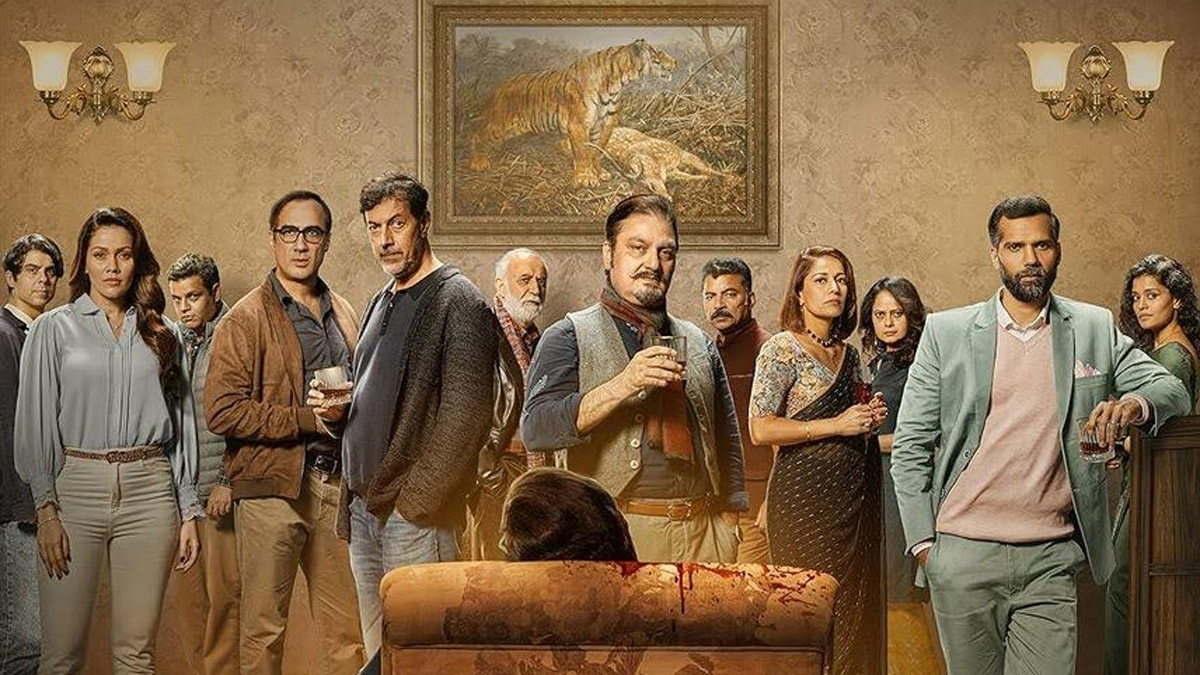
MUMBAI: Zee5 is serving up another killer collaboration and this time, the murder mystery comes with a generous side of dark humour and family dysfunction. The streaming platform has partnered with Applause Entertainment and Mithya Talkies to bring Everybody Loves Sohrab Handa, a fresh, twisted whodunnit written and directed by acclaimed filmmaker and actor Rajat Kapoor. The film will stream exclusively on Hindi Zee5 from 10 April.
The movie reimagines the classic murder mystery genre with a contemporary, darkly comic edge. It revolves around a group of friends and family who smile, drink, and celebrate together until the silence snaps and long-buried secrets spill out. The stellar ensemble cast includes Vinay Pathak, Ranvir Shorey, Waluscha De Sousa, Saurabh Shukla, Chandrachoor Rai, Neil Bhoopalam, Koel Purie, Palomi Ghosh, and Rajat Kapoor himself.
This latest offering continues the successful partnership between Zee5 and Applause Entertainment, which has previously delivered diverse hits such as Mithya, Bloody Brothers, and Jab Khuli Kitaab.
&TV Business Head of hindi Zee5 and chief channel officer Kaveri Das said, “Our collaboration with Applause Entertainment has consistently delivered distinct, high-impact storytelling. Everybody Loves Sohrab Handa is a natural progression, reinforcing our focus on genre-led content with a compelling whodunnit premise and a strong ensemble cast.”
Applause Entertainment business head for movies Sunil Chainani added, “This film adds yet another compelling layer to our slate with Rajat Kapoor’s unmistakable voice.”
Rajat Kapoor shared, “What interested me was not just the mechanics of a whodunnit, but the emotional violence that precedes physical violence. These are people who smile at each other, but there’s so much that is not said.”
The film promises razor-sharp writing, layered performances, and simmering tension, inviting viewers not just to solve the crime but to unravel the complex relationships at its heart.
If you love a good murder mystery served with wit and emotional depth, Everybody Loves Sohrab Handa looks set to be your next addictive watch. Mark your calendars, the whodunnit drops on Hindi Zee5 from 10 April.







