News Broadcasting
YES BANK and CNBC-TV18 partner for ‘The Growth Summit’ Ahmedabad edition

Mumbai: The second edition of YES BANK and CNBC-TV18’s – The Growth Summit: A vision to a $10 trillion economy, in association with Max Life Insurance, was held in Ahmedabad, Gujarat. The event convened policymakers, industry leaders, startup founders, innovators, and academic experts to deliberate on crucial factors essential for India’s economic progress. Central to the Summit’s discussions was the government’s ambitious 25-year plan aimed at positioning India as the world’s third-largest economy with a GDP of $10 trillion.
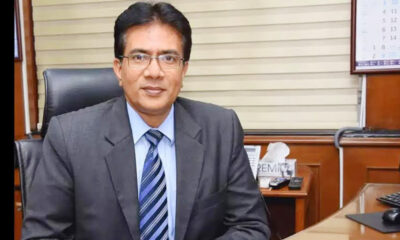
In his opening remarks at the Summit, YES BANK MD & CEO Prashant Kumar said, “Gujarat emerges as the cornerstone of India’s economic ascent, contributing a staggering 33% to the nation’s exports in FY 2022-23. With ambitions to reach a $1 trillion economy by 2030, Gujarat’s leadership extends beyond traditional sectors, fostering a thriving ecosystem for innovation and infrastructure development. As the world’s largest diamond hub in Surat and the birthplace of India’s first operational greenfield Smart City, Gujarat positions itself as the beacon of opportunity. The state is poised to absorb the influx of businesses seeking alternatives to China, catalysing India’s journey towards economic supremacy.”
During his address, Kumar announced the launch of ‘Yes Private’ in Ahmedabad, which is the Bank’s newest market offering that aims to partner HNI Business owners and C-Suite executives in their endeavour to leverage the opportunities on the road towards a $10 trillion Indian economy.

He added, “Yes Private has been thoughtfully curated to complement the retail and wholesale banking offerings in the market. It integrates the Bank’s expertise across the spectrum and brings a full-stack product suite for HNIs across family banking, business banking, wealth management and succession planning needs. The programme also lays out extraordinary privileges and experiences for clients pertaining to their distinct lifestyles in India and abroad.”
The event kicked off with a thought-provoking discussion on ‘Strengthening Indian Business from Within’ in conversation with Rasna chairman & MD Piruz Khambatta. He stated “India’s growth narrative must encompass more than just development; it must address the challenges faced by its youth, including migration due to inadequate resources like clean water and air. India’s trajectory of growth, akin to that of South Korea, Germany, Japan, and China, is undeniable, yet we must define our unique growth model. As we navigate through discussions, let’s advocate for an inclusive ‘India model’ of growth that acknowledges both its benefits and challenges, fostering sustainable progress for generations to come.”
Subsequently, panel discussion on the topic ‘From India to the World: Unleashing A New Era of Global Ambitions’ with Ashish Soparkar (MD, Meghmani Organics), Dr Vishal Rajgarhia (director, Finecure Pharmaceuticals Ltd) Rajiv Gandhi (MD & CEO, Hester Biosciences) Chirag Pan (MD & CEO, Pan Healthcare) and Behram Mehta (founder & MD, Aava Natural Mineral water) captivated the audience at the summit.
The event progressed with an engaging conversation on ‘India’s Role as A Global Hub of Growth’ featuring AMUL (GCMMF) MD Jayen Mehta, where he said, “Agriculture is the base of our economy. However, in terms of numbers, still agriculture contribution is less than 20%. Hence, we need to support agriculture and farmers, while also working on doubling their income which is also the professor policy of the government. These efforts will help in supporting the number of people associated with agriculture which is more than 60-70 per cent of the population. The country still depends on agriculture as part of its primary income. So this is where a combination of policies that are pro farmer, pro-development and pro-market is the way forward for our country. So if you can build a bridge and if only 20% of us convert our regular food into organic food, the GDP from agriculture will rise. These are very, very small and objective steps one has to take and organisations like ours are working towards the same using the cooperative model and building the country.”
In a special address, Max Life Insurance MD & CEO Prashant Tripathy added, “As India makes significant strides towards its ambitious goal of becoming a 10 trillion-dollar economy by 2030-31, there’s a growing need for India Inc. to partner with the government and democratize the benefits of this growth. It’s imperative that we ensure the advantages of our economic progress reach every segment of the society. There’s a strong call for players in the life insurance industry to align their strategies with IRDAI’s vision of ‘Insurance for All by 2047’- which calls for inclusive insurance coverage for India at large. Further, innovation and customisation must guide our product offerings to cater to the diverse and distinct needs of modern consumers, while distribution channels need to evolve to deliver convenience at every touchpoint, be it digital or otherwise. As we move forward, cross-functional collaboration supported by collective action will serve as the cornerstone for fostering inclusive growth, contributing to the shared prosperity of our nation.”
The evening continued with an engaging panel discussion ‘Scaling the Global Value Chain’, with insights from industry experts Vineet Mittal (director, Navitas Green Solutions) Dr Viranchi Shah (national president, IDMA and director, Saga Laboratories) Aditi Gupta (managing partner, Menstrupedia) Sandeep Mittal (MD, Corrtech Energy Ltd) and Ravi Bhamidipaty (MD, TCT Ventures). They shared valuable insights on navigating global markets, contributing to an enriching discussion for the audience.
Taking the evening towards its end a thought-provoking session conducted by leading neuroscientist & NeuroLeap founder Kumaar Bagrodia on ‘The Neuroscience of Investing’ was held.
Concluding the summit was the final enticing conversation between CNBC-TV18 anchor Shruti Mishra and Indian cricketer Mohammed Shami. Talking about his journey, Shami said, “If your hard work and luck are in your favour, then I don’t think anybody can stop you. You just have to stay loyal to your game and keep working hard. I believe nobody can take away my luck from me. My family has been incredibly supportive and has played an integral role in my journey.”
The Ahmedabad edition of ‘The Growth Summit – vision for a $10 trillion economy’ underscored India’s trajectory towards economic prosperity, as industry leaders and experts converged to chart a path towards a $10 trillion economy. With diverse voices and ideas from different industries of Gujarat, the summit left an indelible mark on the audience and shared a unique vision for India’s journey towards achieving its ambitious economic goals. The upcoming Summits are to be held in Bangalore, Delhi and Hyderabad in the weeks to come.
For more information visit: https://www.cnbctv18.com/ms/thegrowthsummit/





News Broadcasting
Induction cooktop demand spikes 30× amid LPG supply concerns
Supply worries linked to West Asia tensions push households and restaurants to turn to electric cooking alternatives
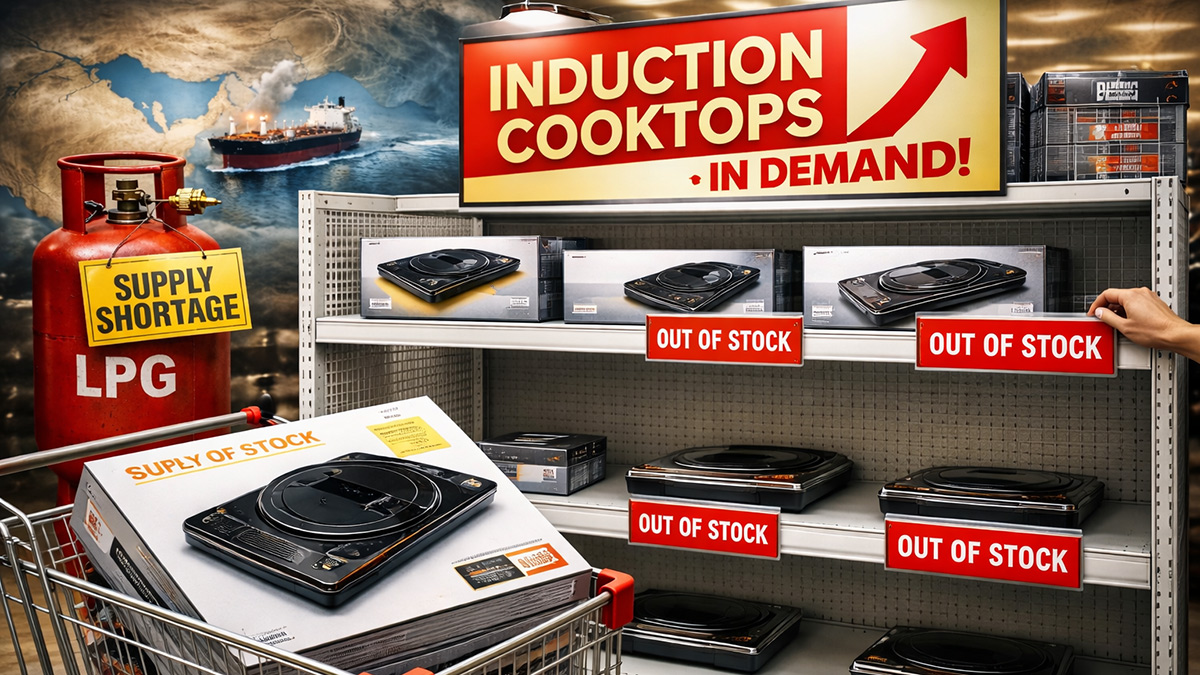
MUMBAI: As geopolitical tensions in West Asia ripple through global energy supply chains, the familiar blue flame in Indian kitchens is facing an unexpected challenger: electricity.
What began as concerns over the availability of liquefied petroleum gas (LPG) has quickly evolved into a technology-driven shift in cooking habits. Households across India are increasingly turning to induction cooktops and other electric appliances, initially as a backup but now, for many, a necessity.
A sudden surge in demand
Recent data from quick-commerce and grocery platform BigBasket highlights the scale of the shift. According to Seshu Kumar Tirumala, the company’s chief buying and merchandising officer, demand for induction cooktops has risen dramatically.
“Induction cooktops have seen a significant surge in demand, recording a fivefold jump on 10 March and a thirtyfold spike on 11 March,” Tirumala said.
The increase stands out sharply when compared with broader kitchen appliance trends. Most appliance categories are growing within 10 per cent of their typical demand levels, while induction cooktops have witnessed explosive growth as households rush to secure an alternative cooking option.
Major e-commerce platforms including Amazon and Flipkart have reported rising searches and orders for induction stoves. Quick-commerce apps such as Blinkit and Zepto have also witnessed stock shortages in major metropolitan areas including Delhi, Mumbai and Bengaluru.
What was once considered a convenient appliance for hostels, small kitchens or occasional use has suddenly become an essential addition in many homes.
A crisis thousands of miles away
The trigger for this shift lies far beyond India’s kitchens.
Escalating conflict in the Middle East has disrupted shipping routes through the Strait of Hormuz, one of the world’s most critical energy corridors. Nearly 85 to 90 per cent of India’s LPG imports pass through this narrow waterway, making the country particularly vulnerable to supply disruptions.
The ripple effects have been swift.
India currently meets roughly 60 per cent of its LPG demand through imports, and tightening global supply has already begun to affect domestic availability and prices.
Earlier this month, the price of domestic LPG cylinders increased by Rs 60, while commercial cylinders rose by more than Rs 114.
To discourage panic buying and hoarding, the government has also extended the mandatory waiting period between domestic refill bookings from 21 days to 25 days.
Restaurants feel the pressure
The strain is not limited to households. Restaurants, hotels and roadside eateries are also grappling with supply constraints as commercial LPG availability tightens under restrictions imposed through the Essential Commodities Act.
In cities such as Bengaluru and Chennai, restaurant associations report that commercial LPG availability has dropped by as much as 75 per cent, forcing many establishments to rethink their kitchen operations.
Some restaurants have reduced menu offerings, while others are rapidly installing high-efficiency induction systems, creating hybrid kitchens where electricity now shares the workload with gas.
For smaller eateries and roadside dhabas, the shift is less about sustainability and more about survival.
A potential structural shift
The government has maintained that there is no nationwide LPG crisis and has directed refineries to increase production to stabilise supply.
Nevertheless, the developments of March 2026 may already be triggering a longer-term behavioural shift.
For decades, LPG has been the backbone of cooking in Indian households. However, recent disruptions have highlighted the risks of relying on a single fuel source.
Increasingly, households appear to be hedging against uncertainty by adopting electric cooking options to guard against price volatility and delivery delays.
If the current trend continues, the induction cooktop, once viewed as a niche appliance, could emerge as a quiet symbol of India’s evolving kitchen economy.