News Broadcasting
WWE in DVD deal with the Weinstein’s


MUMBAI: Genius Products in the US has entered into a multi-year agreement with World Wrestling Entertainment (WWE) to be the exclusive home entertainment distributor of all WWE DVD titles.
The deal takes effect from 1 November, 2006.
The Weinstein Company is the majority owner of Genius Products. WWE chairman Vince McMahon says. “Home entertainment is a major part of the WWE’s business, and we believe we have found in Genius a company that understands our brand and will help us continue to drive our company’s growth. Bob and Harvey Weinstein have a tremendous track record. We are excited about this partnership and its long-term potential.”

WWE says that it has successfully used its core businesses of live events, pay-per-view, and producing television content for broadcast and cable networks to establish a vibrant global brand with a presence in more than 130 countries. The company has significantly expanded its line of popular licensed consumer products, such as video games, toys, books and magazines, to territories around the world.
WWE is focused on spreading its sports entertainment content to new media platforms, and has experienced success with subscription video on demand, broadband and mobile services, online advertising and ecommerce. It also has created a film division focused on the production of feature films, and other film and television projects.
Bob Weinstein noted, “WWE is not simply a brand; it is an American Icon. Harvey and I very much relate to Vince McMahon’s entrepreneurial style and entertainment philosophy. We love what Vince has done in making WWE the leading sports entertainment franchise in the world, and we are very interested in expanding our relationship beyond DVD distribution to other facets of WWE’s global entertainment empire. We view our relationship with WWE as a major alliance with great growth potential.”
Under the terms of the agreement, Genius will be the exclusive US distributor for all WWE DVDs. New releases will include content from WWE’s 90,000-hour video library, the largest of its kind in the world, featuring content from Raw, SmackDown! and ECW, pay-per-view events, including WrestleMania, and past and present Superstar profiles, among others.




News Broadcasting
Network18 channels lead YouTube news viewership in March 2026
CNN-News18, News18 India and CNBC channels top categories with record views
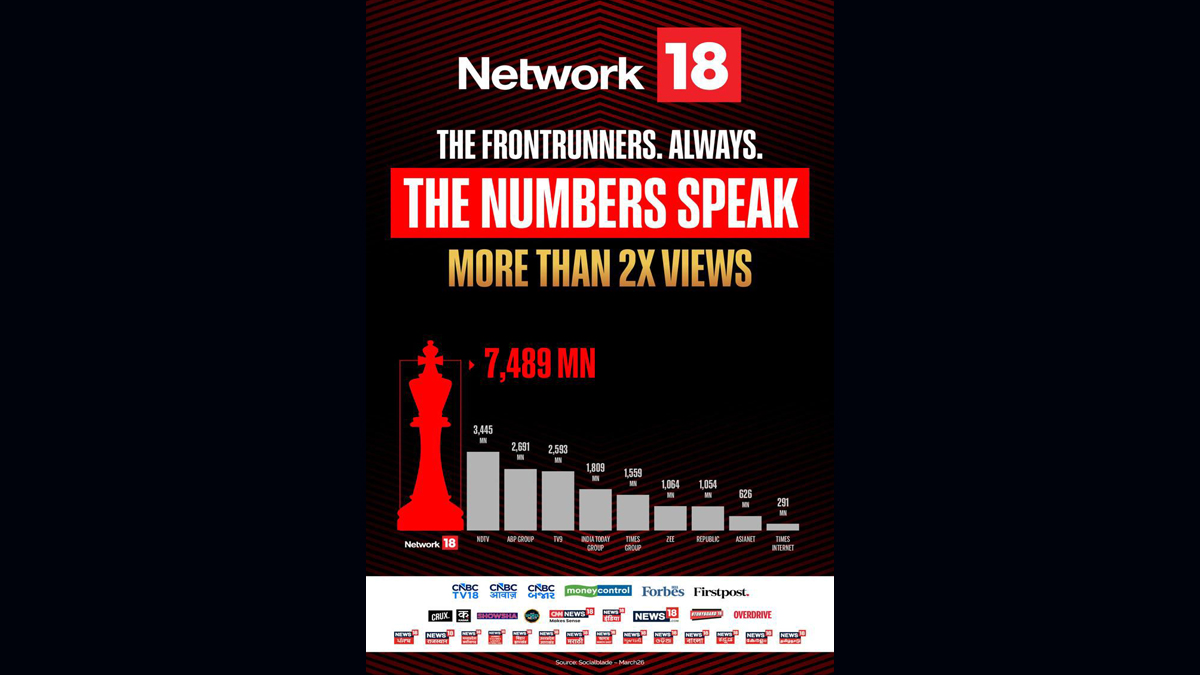
MUMBAI: When the world hit refresh on breaking news, Network18’s channels were already streaming ahead. As geopolitical tensions and war-driven headlines fuelled a surge in global news consumption, the network’s digital playbook delivered big clocking record Youtube viewership across English, Hindi and business news categories in March 2026.
At the forefront was CNN-News18, which emerged as the clear leader in the English news segment with 130 million live and video-on-demand views. The channel edged past competitors such as Times of India (126.5 million), Times Now (101.1 million), India Today (88.2 million) and NDTV (77.5 million), according to Databeings data for March.
In the Hindi news arena, News18 India delivered a commanding performance, racking up a staggering 3,297 million views on YouTube. The channel comfortably outpaced NDTV India, which recorded 3,119 million views, underlining its deep reach and consistent engagement with mass audiences, as per Playboard data.
The network’s dominance wasn’t confined to general news. In the Hindi business segment, CNBC Awaaz topped the charts with 92 million views, narrowly ahead of Zee Business (90 million) and well ahead of ET Now Swadesh (57 million). Meanwhile, its English counterpart CNBC-TV18 posted a strong 58 million views, reinforcing the network’s cross-category strength.
The spike in viewership reflects a broader shift in audience behaviour, with viewers increasingly turning to digital platforms particularly Youtube for real-time updates and in-depth coverage during high-intensity news cycles. For Network18, the numbers signal more than just scale; they underline the effectiveness of a multi-platform strategy that blends speed, credibility and continuous coverage.
In a month where the news never paused, it seems viewers chose to stay tuned where the stream never stopped.






