News Headline
Worldwide mobile phone sales grew 18% in Q2 2006: Gartner report


MUMBAI: Worldwide mobile phone sales totaled 229 million units in the second quarter of 2006, a 18.3 per cent increase from the same period last year, according to Gartner Inc. This compared to a 23.8 per cent increase in the first quarter.
Gartner said it had expected the slight slowdown compared to quarter one and that its mobile phone sales forecast is still on track to reach 960 million units in 2006, with 238 million units in the third quarter of 2006.
“While mobile operators in the mature markets of Western Europe and North America struggled to maintain the customer acquisition growth levels seen in previous quarters, but mobile operators in emerging markets continued to sign new customers driving handsets sales,” said Carolina Milanesi, principal analyst for mobile terminals research at Gartner, based in Egham.

Leading vendors Nokia and Motorola both grew their market share and accounted for more than half of the worldwide mobile phone sales in the second quarter of 2006.
Nokia maintained its number one position with a 33.6 per cent market share, gaining two per centage points compared to the same period last year. Gartner stated that as Nokia starts to ship more feature-rich phones (such as the N72 and N73) in the third quarter of 2006, it needs to ensure that it can also cater for users who put fashion ahead of functionality and are looking for thin products, states an official release.
“Motorola is the big winner this quarter,” said Milanesi. The company achieved a market share of 21.9 per cent, growing its market share by 4.2 per cent year on year, the highest growth this quarter. Motorola maintained its lead in North America and Latin America and its second position in other markets. With the Morofone, KRZR and RIZR mobile phones due to ship from the third quarter of this year, Gartner said Motorola should be able to continue to gain market share in both emerging and mature markets, informs an official release.
Samsung retained its third position but lost market share compared to the top two players. Sales reached 25.5 million units in the second quarter, approximately half of Motorola’s total sales this quarter. Lower sales in the home market coupled with weaker than expected demand in some key markets in Asia Pacific explained Samsung’s weaker performance. To grow market share in mature markets such as Western Europe and North America, Gartner said Samsung needs to match its high feature set with a more distinctive design.
Sony Ericsson regained the fourth position with sales reaching 15.3 million units. “Sony Ericsson’s bet on music and imaging continued to pay back. 25 per cent of their sales came from the Walkman branded devices and the first Cybershot phone k800 was also well received by consumers,” said Milanesi.
Despite the success of the KG800 Chocolate phone, LG lost 0.4 per cent market share year on year and slipped into fifth place. “Although The Chocolate phone sold very well and helped to increase LG’s brand awareness globally, ‘one swallow does not make summer’. LG needs to bring to market more products from the Black Label series including a 3G offering, to win back and hold the fourth position,” added Milanesi.

NEW DELHI: Hamdard Laboratories gathered a cross-section of India’s achievers in New Delhi on Friday, handing out the Hakeem Abdul Hameed Excellence Awards to figures who have left their mark across healthcare, education, sport, public service and the arts.
The ceremony, attended by minister of state for defence Sanjay Seth and senior officials from the ministry of Ayush, celebrated individuals whose work blends professional success with a sense of public purpose. It was as much a roll call of achievement as it was a reminder that influence is not measured only in profits or podiums, but in people reached and lives improved.
Among the headline awardees was Alakh Pandey, founder and chief executive of PhysicsWallah, recognised for turning affordable digital learning into a mass movement. On the sporting front, Arjuna Awardee and kabaddi player Sakshi Puniya was honoured for her contribution to the game and for pushing women’s participation onto bigger stages.
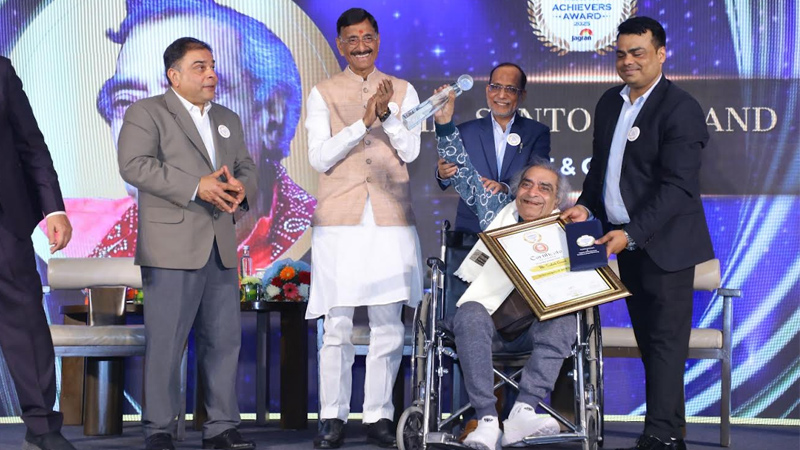
The cultural spotlight fell on veteran lyricist and poet Santosh Anand, whose songs have echoed across generations of Hindi cinema. At 97, Anand accepted the honour with characteristic humility, reflecting on a life shaped by perseverance and hope.
Healthcare honours spanned both modern and traditional systems. Manoj N. Nesari was recognised for strengthening Ayurveda’s place in national and global health frameworks. Padma shri Mohammed Abdul Waheed was honoured for his research-backed work in Unani medicine, while padma shri Mohsin Wali received recognition for his long-standing contribution to patient-centred care.
Education and social development also featured prominently. Padma shri Zahir Ishaq Kazi was honoured for decades of work in education, while former Meghalaya superintendent of Police T. C. Chacko was recognised for public service. Goonj founder Anshu Gupta received an award for his dignity-centred rural development initiatives, and the Hunar Shakti Foundation was honoured for empowering women and young girls through skill development.
The Lifetime Achievement Award went to former IAS officer Shailaja Chandra for her long career in public healthcare and governance, particularly in the traditional systems under Ayush.
Speaking at the event, Hamdard chairman Abdul Majeed said the awards were a tribute to those who combine excellence with empathy. “These awardees reflect Hakeem Sahib’s belief that healthcare, education and public service must ultimately serve humanity,” he said.
Minister Seth struck a forward-looking note, saying India’s young population gives the country a unique opportunity to become a global destination for learning, health and wellness by 2047.
The ceremony also featured the trailer launch of Unani Ki Kahaani, an upcoming documentary starring actor Jim Sarbh, set to premiere on Discovery on 11 February.
Instituted in memory of Unani scholar and educationist Hakeem Abdul Hameed, the awards have grown into a national platform that celebrates those building a more inclusive and resilient India. For one evening at least, the spotlight was not just on success, but on service with substance.







