News Broadcasting
Worldspace sings with pride for the Indian Army


Celebrates Army Day with special programming that resonates with the sounds of the Indian Army
WorldSpace Satellite Radio, one of the world leaders in satellite-based digital radio services, will reverberate with songs that celebrate the bravado, integrity and resilience of the Indian Army as radio stations on the network pay tribute to the army men on the occasion of Army Day on January 15, 2006.
WorldSpace connects the armed forces personnel stationed in the furthest reaches of the subcontinent, to the latest and best programming across the widest variety of radio content, spanning over 40 radio stations playing over 10,000 songs a day.

Army Day commemorates the appointment of the Indian army’s first Indian Commander in Chief, Field Marshal K M Cariappa on 15th January 1948. On this proud occasion, WorldSpace stations Jhankaar, Farishta and Sparsha offer listeners a series of special programs and exclusive opportunities to convey their best wishes and request dedications for their valiant loved ones from any where across India.
Farishta, the 24-hour radio station on the WorldSpace network that hums to the nostalgic tunes of classic Bollywood movies, presents a 4-hour special on “Farishta Orchestra” that showcases the patriotic rhythms of yesteryear movies.
The show will feature hits songs that celebrate the theme of patriotism and the armed forces such as ‘Mere desh ki dharti ‘ from Upkaar, ‘Kar chale hum fida’ from Haqeeqat, ‘Yeh desh hain veer jawano ka’ from Naya Daur, ‘Aye watan aye watan’ from Shaheed, ‘Vande Mataram’ from Anand Math etc. Tune in and celebrate the spirit of the Indian Army with RJ Sulagna on Farishta from 7am to 11 am on Sunday January 15, 2006.
Radio Jhankaar, the destination for the latest foot tapping Hindi film hits and Radio Sparsha, the national 24-hour Kannada music station also get into the celebratory mood and connect listeners with their family and friends in the armed forces with special requests, dedications and messages of encouragement. This unique opportunity to send a message to your loved ones in the Indian Army can be accessed from virtually any part of India.
RJ Nisha plays dedications by listeners to any relative in the army on
Radio Jhankaar as “Jhankaar Beats” presents a 4-hour request special
between 8am and 12noon while Chaitanya Hegde, WorldSpace’s resident Bollywood expert, hosts an exclusive 1-hour special on “Jhankaar Countdown”, where he pumps out songs on the army from hit Hindi films of the recent past. Catch the patriotic fervor on Radio Jhankaar on Jan 15th as songs from movies such as LOC, Refugee, Border and Lakshya, among others, fill your senses with pride.
On Radio Sparsha, RJ Madhura and RJ Avinash host dedication specials on “Ee Touchalli” between 8am and 12noon and “Masale Mandakki” between 6pm and 10pm, respectively. Both shows celebrate Army Day with Kannada songs dedicated by and to warriors from Karnataka in the Indian Army.
Tune in to WorldSpace and celebrate the Indian army with the power of music!
About WorldSpace, Inc.
WorldSpaceR (NASDAQ: WRSP) is the world’s only global media and
entertainment company positioned to offer a satellite radio experience to consumers in more than 130 countries with five billion people, driving 300 million cars. WorldSpace delivers the latest tunes, trends and information from around the world and around the corner.
WorldSpace subscribers benefit from a unique combination of local
programming, original WorldSpace content and content from leading
brands around the globe including the BBC, CNN, Virgin Radio UK, NDTV and RFI. WorldSpace’s satellites cover two-thirds of the globe with six beams. Each beam is capable of delivering up to 80 channels of high quality digital audio and multimedia programming directly to WorldSpace Satellite Radios anytime and virtually anywhere in its coverage area. WorldSpace is a pioneer of satellite-based digital radio services (DARS) and was instrumental in the development of the technology infrastructure used today by XM Satellite Radio.
For more information, visit www.worldspace.com http://www.worldspace.com/> .
About WorldSpace India
WorldSpace boasts a range of over 40 radio stations across genres – from Jazz to Classical, to Old Hindi Film Music and Rock. Its Indian programming includes two Indian classical stations – Shruti (Carnatic) and Gandharv (Hindustani), as well as regional Indian stations, viz. Tara (Bengali), KL Radio (Tamil), Sparsha (Kannada), RM Radio (Malayalam), Spandana (Telugu) and Tunak Punjabi (Punjabi) and a Spiritual and Wellness station, Moksha, among others.







News Broadcasting
UDF poised to return to power in Kerala, says Manorama-CVoter survey
Massive opinion poll projects shift in Kerala politics ahead of 2026 Assembly elections.
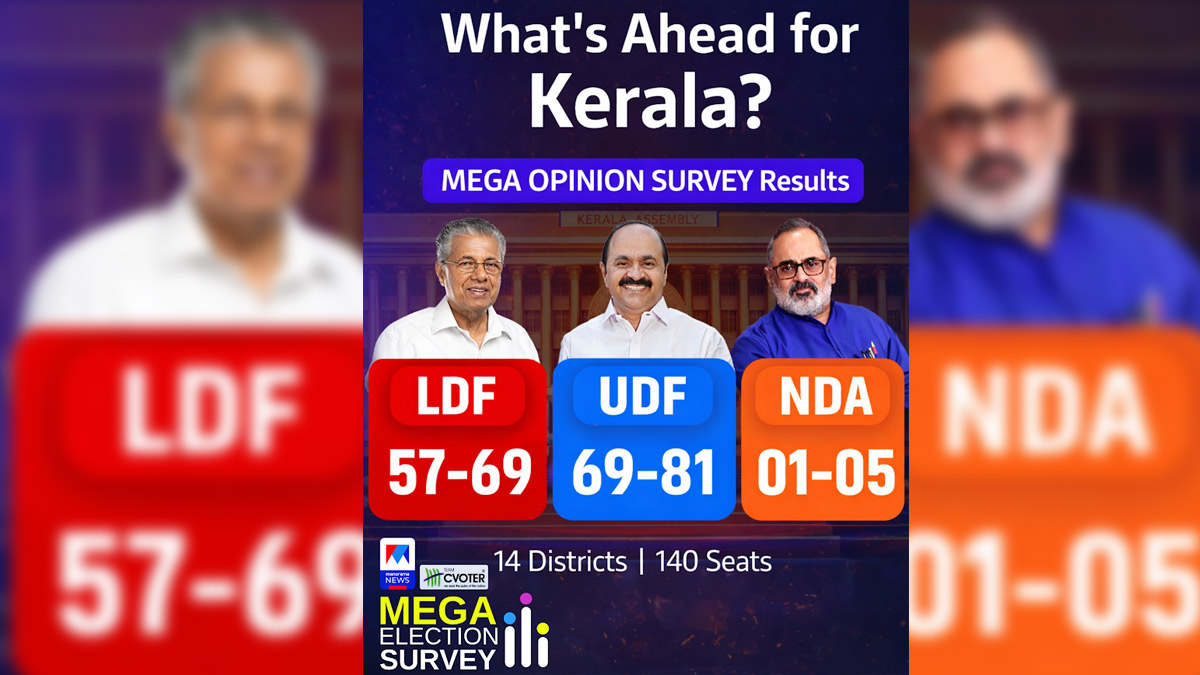
MUMBAI: The winds of change appear to be blowing through Kerala’s political landscape and this time, they seem to favour the United Democratic Front. A comprehensive mega opinion survey conducted by Manorama News in partnership with CVoter projects a potential comeback for the UDF in the upcoming Kerala Legislative Assembly Elections 2026. The survey, covering all 140 constituencies with a massive sample size of nearly 90,000 respondents, predicts the UDF could win between 69 and 81 seats.
The ruling Left Democratic Front (LDF) is expected to secure 57 to 69 seats, a significant drop from the 99 seats it won in the 2021 elections. This would mean the LDF losing 30 to 42 of its sitting seats. Meanwhile, the National Democratic Alliance (NDA), which drew a blank in 2021, is projected to open its account with 1 to 5 seats.
Region-wise, the UDF is expected to make strong gains in Malabar, winning 25 to 34 out of 48 seats, and in Central Kerala, where it could bag 29 to 33 out of 53 seats. In South Kerala, the LDF is likely to retain an edge with 21 to 25 seats, while the UDF may improve to 12 to 16 seats. The NDA could pick up 1 to 3 seats in the southern region.
The survey was conducted between 14 and 26 March 2026, with additional tracker and snap polls carried out from December 2025 to March 2026. A total of 89,693 respondents participated, ensuring representation across all demographics and social segments.
Manorama News has a strong track record of accuracy, with its previous projections closely matching the actual results of the 2019 and 2024 Lok Sabha elections as well as the 2021 Kerala Assembly polls.
In Kerala’s famously fierce political battles, this survey suggests the pendulum may be swinging back. Whether the final verdict matches these numbers or throws up another surprise, one thing is clear, the 2026 Assembly elections are shaping up to be one of the most keenly watched contests in the state’s history.






