News Broadcasting
Workshop on DVB and Internet Protocol draws healthy response


Over 150 attendees from 67 organisations, including government, institutions, international corporations, Internet Service Providers and broadcasters attended the Delhi workshop on Digital Video Broadcasting and Internet Protocol.
Dishnet DSL, a leading ISP and the first ISP in India to offer the DSL, broadband access, sponsored the workshop as an existing customer of PCM, along with other co-sponsors. Indiantelevision.com (this site) was the on-line partner for the event
Speaking at the inaugural function, director engineering of Prasar Bharati Y Pratap highlighted the advantages of DVB and IP via satellite for broadcasters and telecommunications player. He said: “As IP via satellite can offer more bandwidth, the service offered can be many and the quality will also be of good quality”.

During the same function, senior V-P sales and marketing of Pacific Century Matrix Loo Tong Mun said that the company intends to offer a global network that serves as a single resource for customers’ worldwide requirements. According to Mun, there has been exponential growth in traffic over Internet and PCM, while exploiting the opportunities, will develop beyond Internet access to a caching and multicasting and content distribution facilitator.
Focussing on the advantages of satellite for IP, Mun said that it makes the whole process “distance insensitive” while being reliable and scalable mechanism for delivery.
Other speakers during the inaugural function included RRN Prasad of the Telecom Regulatory Authority of India, Amitabh Singhal, secretary of Internet Service Providers’ Association of India and Guru Hariharan of Call Centers Association of India.





News Broadcasting
UDF poised to return to power in Kerala, says Manorama-CVoter survey
Massive opinion poll projects shift in Kerala politics ahead of 2026 Assembly elections.
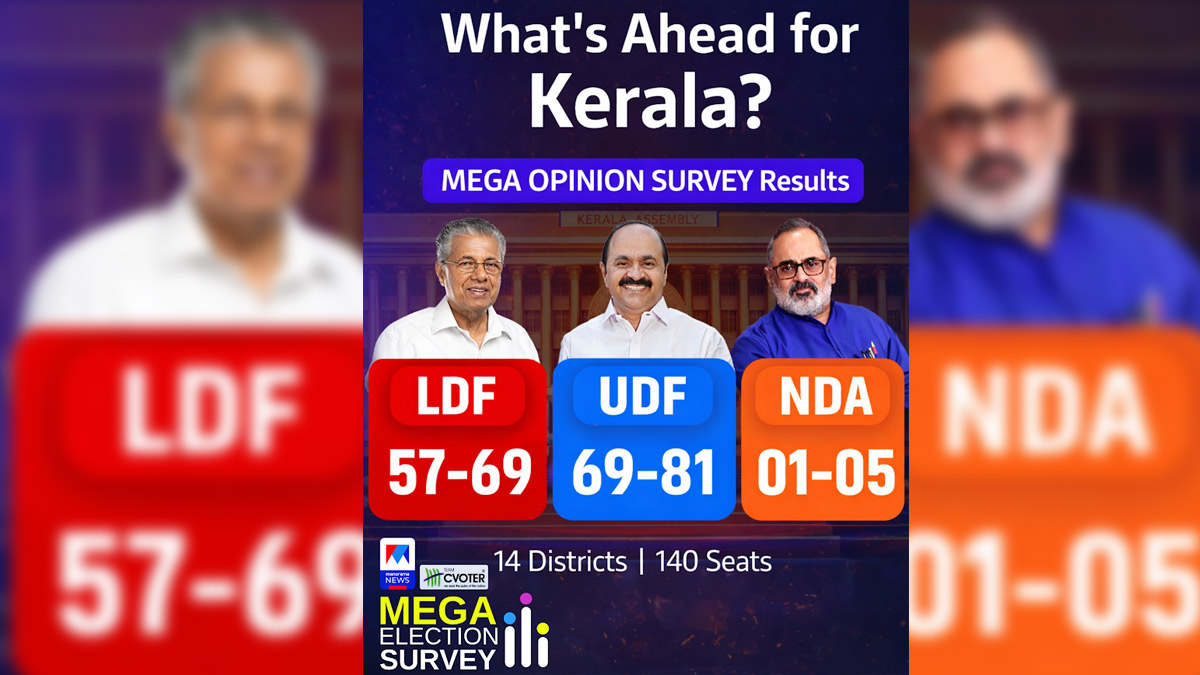
MUMBAI: The winds of change appear to be blowing through Kerala’s political landscape and this time, they seem to favour the United Democratic Front. A comprehensive mega opinion survey conducted by Manorama News in partnership with CVoter projects a potential comeback for the UDF in the upcoming Kerala Legislative Assembly Elections 2026. The survey, covering all 140 constituencies with a massive sample size of nearly 90,000 respondents, predicts the UDF could win between 69 and 81 seats.
The ruling Left Democratic Front (LDF) is expected to secure 57 to 69 seats, a significant drop from the 99 seats it won in the 2021 elections. This would mean the LDF losing 30 to 42 of its sitting seats. Meanwhile, the National Democratic Alliance (NDA), which drew a blank in 2021, is projected to open its account with 1 to 5 seats.
Region-wise, the UDF is expected to make strong gains in Malabar, winning 25 to 34 out of 48 seats, and in Central Kerala, where it could bag 29 to 33 out of 53 seats. In South Kerala, the LDF is likely to retain an edge with 21 to 25 seats, while the UDF may improve to 12 to 16 seats. The NDA could pick up 1 to 3 seats in the southern region.
The survey was conducted between 14 and 26 March 2026, with additional tracker and snap polls carried out from December 2025 to March 2026. A total of 89,693 respondents participated, ensuring representation across all demographics and social segments.
Manorama News has a strong track record of accuracy, with its previous projections closely matching the actual results of the 2019 and 2024 Lok Sabha elections as well as the 2021 Kerala Assembly polls.
In Kerala’s famously fierce political battles, this survey suggests the pendulum may be swinging back. Whether the final verdict matches these numbers or throws up another surprise, one thing is clear, the 2026 Assembly elections are shaping up to be one of the most keenly watched contests in the state’s history.






