News Headline
Win back with fresh programming, same structure

MUMBAI: Win 94.6, the private FM radio station that took a 36-day break citing ‘technical and legal hassles’ and returned to the airwaves last Thursday, is back with fine-tuned programming but the same organisational structure.
The media reticent radio station, owned by Millennium Broadcast was pulled off air on 27 May after reportedly failing to turn in the Rs 97.5 million license fee for the second year of operation. Win officials, currently enthused by the return to air, are reluctant to talk about the exact nature of the settlement that enabled it to resume operations.
The Win team, however, utilised the ‘vacation’ to spruce up its programming and drum up fresh ideas. The entire production has been redone, says head of programming Vera Mascarenhas Malkani, and three new feature shows added in.
A new jingle and variations of the same have been introduced at various times of the day since the station went on air again at 4:30 pm on 3 July. “We had barely a couple of hours notice that we could resume before we decided to go on air,” she says.
The team has however, cleaned up its entire music database with all hit songs playing throughout the day, and the effect is a crisper and fresher music channel. While the tagline, Mumbai’s No 1 hit music radio remains the same, new radio jockeys have also been added to the team that already has now-familiar names like Malishka, Anurag and television personality Roshan Abbas.
Through the uncertain 36-day sabbatical, not a single member left the team, asserts Malkani. By the time the station pulled off air in May, Win had a 23 per cent market share in terms of revenue among the FM players.
Says sales head Sanjay Hemady, “Four brands, including HP, Taj President and Forbes’ Dhan Dhanadhan have already come on board.” Several other Win loyalist brands are expected back soon. Advertisers may have waited the long wait for a uniquely positioned channel to come back (Win was the first to realize the potential of going Hindi in a big way and that of playing old Hindi film songs to a captive audience) but listeners may take a while to tune in.
The relaunch has been a quiet affair, with the communiqués announcing the return essentially targeting clients. But the listeners are trickling in with the new interactive shows that the station has already put together.
Triple Schezwan, which asks listeners three questions a day, Dhande Ka Funda, which gets different professionals in the city to talk about their work and What’s the Flavour, a show that quizzes listeners calling in on their knowledge of their immediate locality. The last show, particularly, has entailed the Win team compiling a huge database of localities in Mumbai, complete with details of each.
The 25-member team is now focusing ahead, preferring to put the forced ‘vacation’ behind it. The station had bagged four RAPA awards, three of them for the popular Khanak programme, and one Emvy award for the Kodak special moments campaign, even when it was off air. Advertisers are clambering aboard again, says Hemady, who asserts confidence that Win will do better than the first year of operations.
The moot question of who has supplied the finances to enable Win to resurface however, is as yet unanswered.
Win’s predicament is not unique. Go, promoted by Mid-Day has also served notice to terminate its operations by next June, citing high license fees. The big players like Radio City and Radio Mirchi are surviving by dint of organisational support. But talk to most FM station heads and they all say that unless the licence fee regime is changed, it will be “no-go” for everyone.
The current imbroglio has been brought about due to the incongruous bidding process intiated by the government, in which licence fees were driven up by participants, who later backed completely out. Twenty-three parties bid over Rs 4250 million for 108 frequencies in 40 cities, but only 10 paid bank guarantees.
The five private FM stations in Mumbai incurred a combined expenditure of Rs 900 million, but earned only Rs 260 million during 2002-03, according to industry estimates.
A parallel that can be drawn is that of Channel Nine Gold that had the backing of media mogul Kerry Packer and the HFCL group. HFCL Nine Gold mopped up all prime time slots on DD Metro in September 2000 for a minimum guarantee of Rs 1,210 million. Within a few months (and after spending heavily on programming and promoting its shows), the realisation dawned that the deal made no business sense and Nine Gold ceased operations in September 2001.


NEW DELHI: Hamdard Laboratories gathered a cross-section of India’s achievers in New Delhi on Friday, handing out the Hakeem Abdul Hameed Excellence Awards to figures who have left their mark across healthcare, education, sport, public service and the arts.
The ceremony, attended by minister of state for defence Sanjay Seth and senior officials from the ministry of Ayush, celebrated individuals whose work blends professional success with a sense of public purpose. It was as much a roll call of achievement as it was a reminder that influence is not measured only in profits or podiums, but in people reached and lives improved.
Among the headline awardees was Alakh Pandey, founder and chief executive of PhysicsWallah, recognised for turning affordable digital learning into a mass movement. On the sporting front, Arjuna Awardee and kabaddi player Sakshi Puniya was honoured for her contribution to the game and for pushing women’s participation onto bigger stages.

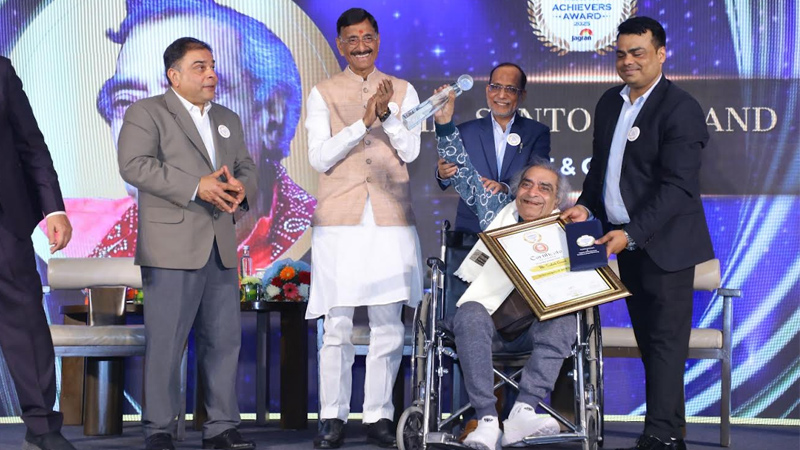
The cultural spotlight fell on veteran lyricist and poet Santosh Anand, whose songs have echoed across generations of Hindi cinema. At 97, Anand accepted the honour with characteristic humility, reflecting on a life shaped by perseverance and hope.
Healthcare honours spanned both modern and traditional systems. Manoj N. Nesari was recognised for strengthening Ayurveda’s place in national and global health frameworks. Padma shri Mohammed Abdul Waheed was honoured for his research-backed work in Unani medicine, while padma shri Mohsin Wali received recognition for his long-standing contribution to patient-centred care.
Education and social development also featured prominently. Padma shri Zahir Ishaq Kazi was honoured for decades of work in education, while former Meghalaya superintendent of Police T. C. Chacko was recognised for public service. Goonj founder Anshu Gupta received an award for his dignity-centred rural development initiatives, and the Hunar Shakti Foundation was honoured for empowering women and young girls through skill development.
The Lifetime Achievement Award went to former IAS officer Shailaja Chandra for her long career in public healthcare and governance, particularly in the traditional systems under Ayush.
Speaking at the event, Hamdard chairman Abdul Majeed said the awards were a tribute to those who combine excellence with empathy. “These awardees reflect Hakeem Sahib’s belief that healthcare, education and public service must ultimately serve humanity,” he said.
Minister Seth struck a forward-looking note, saying India’s young population gives the country a unique opportunity to become a global destination for learning, health and wellness by 2047.
The ceremony also featured the trailer launch of Unani Ki Kahaani, an upcoming documentary starring actor Jim Sarbh, set to premiere on Discovery on 11 February.
Instituted in memory of Unani scholar and educationist Hakeem Abdul Hameed, the awards have grown into a national platform that celebrates those building a more inclusive and resilient India. For one evening at least, the spotlight was not just on success, but on service with substance.






