News Headline
Will the Indian consumer bear the brunt of CAS?

MUMBAI: Will the Indian consumer get a raw deal after the implementation of the conditional access system (CAS) Experts, who beg to differ with the popular positive perceptions, claim that the passage of the Cable TV (Networks) Regulation Amendment Bill 2002 is actually punishing the Indian consumer and viewer. They have raised questions about the implementation of CAS in India and add that it is very different from what happened in the developed markets.
During the implementation of CAS in the developed markets such as the US, the consumer was never asked to invest in the set-top boxes (STBs) as the cable operators bore the burden. Also, the consumers were treated to superior content offerings post CAS. The pay TV channels that showed the premium content did not air any advertisements and avoided commercial interruptions. None of this seem to be happening in India, say experts.
Cable TV consultant Harsh Deshpande, who worked in the United States as a cable TV executive with AOL-Time-Warner, says: “CAS was conceived in the US as a way in which incremental revenues could be created for the cable operators and the producers of content. The consumer never paid for the consumer premises equipment and the cable operators bore the burden.” Deshpande is a consultant to Cachestream.com, a video-on-demand company in Atlanta, and is exploring entreprenuerial opportunities.
The Indian cable operators however haven’t considered bearing the brunt of the investing in set-top boxes on behalf of the consumer. Their issues are primarily related to providing the required number of STBs; and other technology aspects such as Head-end in the Sky (HITS) or head-end on the ground.
Zee Turner chief executive Sunil Khanna says: “The duty on STBs is as high as 58 per cent at the moment. Though, the I&B minister has assured us that she will take the issue up with the finance minister. The price of digital STBs will be around US $ 40. In digital mode, the quality of viewing will make lot of difference and more number of channels will also be available to consumer in the basic tier and pay mode.”
Questions are also raised about the willingness of the consumer to invest in the above amount. Several merchant bankers have already predicted that consumer financing of the STBs would be a great opportunity for banks and financial institutions. However, other analysts have rejected the theory as they believe that STBs don’t have a resale value, unlike other consumer goods.
Cutting Edge Media MD Rohinton Maloo adds: “If the government is saying that the consumer is under threat of rising cable subscription rates, which are still much low in India compared to other countries, then how is it being assumed that the same consumer will fork out more money for STBs?”
Maloo may have a point – the instance of a posh colony in Delhi’s Vasant Kunj can be cited in this regard. Last week, the residents’ welfare associations decided to oppose the raising of the monthly cable subscription fee to Rs 360 per month. With the cricket World Cup round the corner, the VK Cable service providers thought it a fit time to raise the subscription money much to the chagrin of the consumers. The residents went without cable for a few days as mark of protest. They demanded that the monthly fee should be in the range of Rs 200 as some other areas in Delhi; other areas are paying anything between Rs 75-150 per month.
JP Morgan India’s report on the Indian cable industry titled: “CAS: The Medicine for a chronic ailment” points out that the consumer opting for pay channels would have to pay more if they don’t make an outright purchase of set-top boxes. It also envisages that the consumer in North India who is paying Rs 200 could end up paying Rs 275. It adds that broadcasters could have to eventually reduce bundling and the individual channel rates.
Khanna adds: “Customers could decide what they wish to see on their TV sets and could plan their spend on cable in line with their budget.” But will the price-conscious customer be willing to pay for the STB as well as the recurring monthly expenses is something that no one knows.
AC Neilsen ORG-MARG’s consumer study reveals that some channels will find easy acceptance into homes even at high prices, but others may need to turn free to air. This theory is being supported by I&B minister Sushma Swaraj.
AC Nilesen ORG Marg’s team arrived at a brand equity index, BEI, for each channel. The index reflects channel awareness, availability, appeal and value for money.
With no surprises – Star Plus tops the list, with the ‘sabse tez’ Hindi news channel Aaj Tak following suit. Special interest channels like Discovery and sports channels also got an impressive BEI too.
The quality of content in the post-CAS scenario is also an important point for consideration.
“In the US, broadcasters actually offered a solution to the cable operators who wanted to increase their revenue streams by creating a premium tier that wasn’t under the US government’s purview. In India, the same fare that was offered earlier will be given in the post-CAS period,” adds Deshpande.
Zee’s business head (Zee Cinema and Music) and part of the group’s core management team Yogesh Radhakrishnan feels that the charges for premium content could actually be in the range of Rs 1500-2000. Several Indian broadcasters have already started thinking of creating premium content and charging the discerning consumers higher rates.
In the US, the cable operators are keen to split revenues with the producers in an effort to improve the quality of content. The large studios such as Time Warner, Sony, Fox and MGM, many of which have cable assets, are able to extract a good revenue-sharing bargain from the broadcasters and the cable operators.
In India, the cable operators are unwilling to share revenues with the broadcasters and the producers. Also, there are no large studios that own a massive library of programmes. The Indian cable operators have nothing to do with the content offered by the broadcasters or the producers.
Eventually it all boils down to the cost as the Indian consumer is always going to be concerned about costs.
Zee Turner’s Khanna reasons: “The scene of prime band & non-prime band will also be eliminated. Those who cannot afford the pay channels will be able to get free to air (FTA) channels at Rs 40-50 per month, plus entertainment tax and service charges that totals up to between Rs 90 to Rs 100 per month.”
Also read
Interview with Harsh Deshpande-media specialist





NEW DELHI: Hamdard Laboratories gathered a cross-section of India’s achievers in New Delhi on Friday, handing out the Hakeem Abdul Hameed Excellence Awards to figures who have left their mark across healthcare, education, sport, public service and the arts.
The ceremony, attended by minister of state for defence Sanjay Seth and senior officials from the ministry of Ayush, celebrated individuals whose work blends professional success with a sense of public purpose. It was as much a roll call of achievement as it was a reminder that influence is not measured only in profits or podiums, but in people reached and lives improved.
Among the headline awardees was Alakh Pandey, founder and chief executive of PhysicsWallah, recognised for turning affordable digital learning into a mass movement. On the sporting front, Arjuna Awardee and kabaddi player Sakshi Puniya was honoured for her contribution to the game and for pushing women’s participation onto bigger stages.

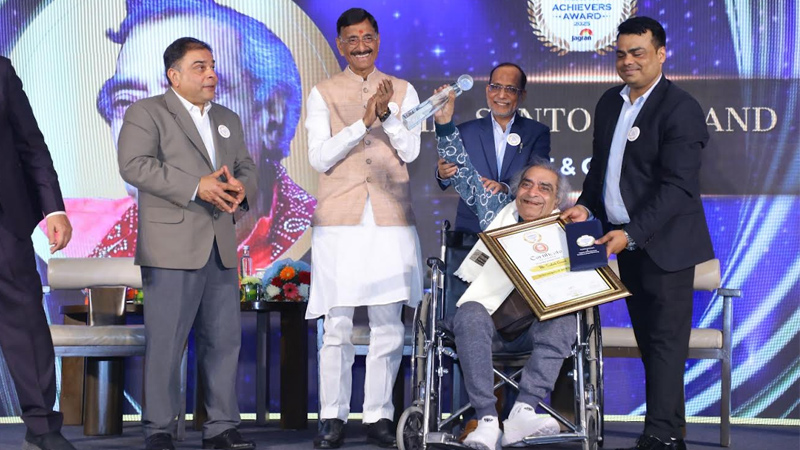
The cultural spotlight fell on veteran lyricist and poet Santosh Anand, whose songs have echoed across generations of Hindi cinema. At 97, Anand accepted the honour with characteristic humility, reflecting on a life shaped by perseverance and hope.
Healthcare honours spanned both modern and traditional systems. Manoj N. Nesari was recognised for strengthening Ayurveda’s place in national and global health frameworks. Padma shri Mohammed Abdul Waheed was honoured for his research-backed work in Unani medicine, while padma shri Mohsin Wali received recognition for his long-standing contribution to patient-centred care.
Education and social development also featured prominently. Padma shri Zahir Ishaq Kazi was honoured for decades of work in education, while former Meghalaya superintendent of Police T. C. Chacko was recognised for public service. Goonj founder Anshu Gupta received an award for his dignity-centred rural development initiatives, and the Hunar Shakti Foundation was honoured for empowering women and young girls through skill development.
The Lifetime Achievement Award went to former IAS officer Shailaja Chandra for her long career in public healthcare and governance, particularly in the traditional systems under Ayush.
Speaking at the event, Hamdard chairman Abdul Majeed said the awards were a tribute to those who combine excellence with empathy. “These awardees reflect Hakeem Sahib’s belief that healthcare, education and public service must ultimately serve humanity,” he said.
Minister Seth struck a forward-looking note, saying India’s young population gives the country a unique opportunity to become a global destination for learning, health and wellness by 2047.
The ceremony also featured the trailer launch of Unani Ki Kahaani, an upcoming documentary starring actor Jim Sarbh, set to premiere on Discovery on 11 February.
Instituted in memory of Unani scholar and educationist Hakeem Abdul Hameed, the awards have grown into a national platform that celebrates those building a more inclusive and resilient India. For one evening at least, the spotlight was not just on success, but on service with substance.







