News Headline
Will private channels make ‘Godaan’ or ‘Mirza Ghalib’, asks Gulzar

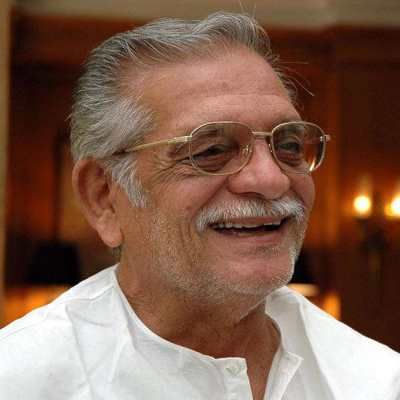
NEW DELHI: Eminent lyricist and filmmaker Gulzar, who has been awarded the film industry’s highest Dada Saheb Phalke award for Life Time Achievement, has said that cinema is a mirror and only reflects what is happening in the society.

He said that cinema cannot play the part of reformer but merely show through celluloid the ills in society and if these have a positive effect on society, it is incidental. Furthermore, cinema does show the mirror in a somewhat exaggerated manner to get the message home.
Gulzar was speaking after releasing the DVDs of two telefilms – ‘Nirmala’ and ‘Godan’ based on Munshi Premchand’s novels – which he had directed for Doordarshan.
Answering questions, Gulzar who will turn eighty later this year said that he had always learnt from his seniors and particularly paid a tribute to the late Bimal Roy who had given him his break in writing songs, and to music directors like Sachin Dev Burman and Madan Mohan.
Referring to a question about the songs of yesteryears and those of today, he said what lyricists were today was not their fault since society itself was changing. He said a song like ‘Mora gora rang lailey, mohey Shaam rang daidey’ would have no place in a society which gladly accepted songs like ‘Bidi jalai-ley’.
He said it was not true that he had only made films based on renowned novels or stories. He referred in this connection to two of his films which were his own – ‘Maachis’ which had won National Awards and ‘Hu Tu Tu’.
Asked if there was something he regretted not having done, he cryptically said: ‘I miss what I have not been able to make.’
He said in reply to a question about why DD was not changing the way private channels were changing by asking a counter-question: “Do you think any other channel would have made serials or telefilms like ‘Godaan’, ‘Nirmala’ and ‘Mirza Ghalib’?”
Earlier in his speech, he said his attempt of making ‘Nirmala’ had been to show that society had not changed since Premchand had written the novel almost a century earlier. The effort was to bring Premchand live before the viewers. At a time when people do not read classics, making the novel for television was one way of making people aware of these classics.
He said renowned authors should not only be read, but should be translated in different languages.
He noted that finding a village where there were no television antennae or modern gadgetry was not very easy for the setting of ‘Nirmala’. Although he found such a village on the border of Gujarat and Maharashtra, he said he was saddened that sixty years after independence, these villages had remained as cut off from modern society as during the British rule.
Earlier, DD director general Tripurari Sharan said DD had been fortunate to have got two eminent persons – the ‘Kahani ka jadugar’ (the magic weaver of stories) Premchand and the ‘Shabdon ka jadugar’ (magic weaver of words) together for these two telefilms.
DD additional director general VK Jain described Gulzar as an institution who was an inspiration to all. But he was particularly surprised at the manner in which Gulzar always managed to re-invent himself.
Gulzar besides being an acclaimed poet, writer and director, has contributed immensely to Hindi and Urdu literature. In addition to his songs and films, he has penned multiple collections of poems and short stories. Some of his previous works for Doordarshan include the title song for the ‘Jungle Book’ series, ‘Mirza Ghalib’, ‘Potli Baba Ki’ and ‘Guchche’ TV series.







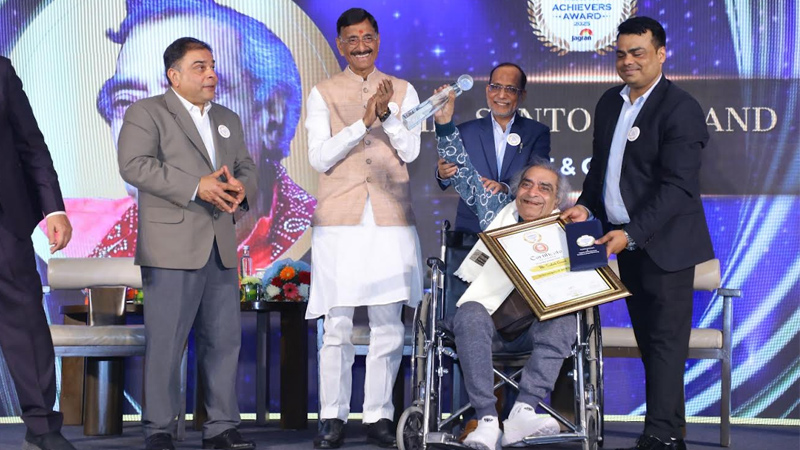
NEW DELHI: Hamdard Laboratories gathered a cross-section of India’s achievers in New Delhi on Friday, handing out the Hakeem Abdul Hameed Excellence Awards to figures who have left their mark across healthcare, education, sport, public service and the arts.
The ceremony, attended by minister of state for defence Sanjay Seth and senior officials from the ministry of Ayush, celebrated individuals whose work blends professional success with a sense of public purpose. It was as much a roll call of achievement as it was a reminder that influence is not measured only in profits or podiums, but in people reached and lives improved.
Among the headline awardees was Alakh Pandey, founder and chief executive of PhysicsWallah, recognised for turning affordable digital learning into a mass movement. On the sporting front, Arjuna Awardee and kabaddi player Sakshi Puniya was honoured for her contribution to the game and for pushing women’s participation onto bigger stages.
The cultural spotlight fell on veteran lyricist and poet Santosh Anand, whose songs have echoed across generations of Hindi cinema. At 97, Anand accepted the honour with characteristic humility, reflecting on a life shaped by perseverance and hope.
Healthcare honours spanned both modern and traditional systems. Manoj N. Nesari was recognised for strengthening Ayurveda’s place in national and global health frameworks. Padma shri Mohammed Abdul Waheed was honoured for his research-backed work in Unani medicine, while padma shri Mohsin Wali received recognition for his long-standing contribution to patient-centred care.
Education and social development also featured prominently. Padma shri Zahir Ishaq Kazi was honoured for decades of work in education, while former Meghalaya superintendent of Police T. C. Chacko was recognised for public service. Goonj founder Anshu Gupta received an award for his dignity-centred rural development initiatives, and the Hunar Shakti Foundation was honoured for empowering women and young girls through skill development.
The Lifetime Achievement Award went to former IAS officer Shailaja Chandra for her long career in public healthcare and governance, particularly in the traditional systems under Ayush.
Speaking at the event, Hamdard chairman Abdul Majeed said the awards were a tribute to those who combine excellence with empathy. “These awardees reflect Hakeem Sahib’s belief that healthcare, education and public service must ultimately serve humanity,” he said.
Minister Seth struck a forward-looking note, saying India’s young population gives the country a unique opportunity to become a global destination for learning, health and wellness by 2047.
The ceremony also featured the trailer launch of Unani Ki Kahaani, an upcoming documentary starring actor Jim Sarbh, set to premiere on Discovery on 11 February.
Instituted in memory of Unani scholar and educationist Hakeem Abdul Hameed, the awards have grown into a national platform that celebrates those building a more inclusive and resilient India. For one evening at least, the spotlight was not just on success, but on service with substance.







