iWorld
Will people vote for VOOT?


MUMBAI: Banking heavily on building a compelling proposition with a focus on the big drivers of digital video on demand business, Viacom’s recently launched digital arm VOOT has successfully managed to create its own niche within a few months of its launch. From being the biggest online destination in India for kids’ premium content to having four successful originals with one new addition every month, the platform has strategically mapped its differentiated play and competitive edge over the rest.
Targeted to be the one stop destination from tots to adults, the platform currently airs 17,000 hours of programming which includes reality, drama, comedy and kids’ content. The platform is majorly investing on the network’s rich kids content and plans to go beyond the network’s flagship shows like Motu Patlu and Shiva, and to acquire kids content from an array of producers, small and large.
“The two critical aspects of a digital video on demand business are content and product and we have a fairly differentiated play, with a competitive edge, on both the fronts. With our collection of biggest toons in Voot Kids’, we have a huge competitive advantage of being the only destination to catch the all your most favourite characters and toons online. And our original strategy gives us the ultimate edge”, says Viacom18 Digital Ventures COO Gaurav Gandhi.

Apart from the rich kids’ content, Viacom18’s entire content library, including Colors, MTV and Nick is also digitally available on the platform.
Additionally, VOOT embellishes this with content around content as Voot originals. Long and short form of originals includes web-series like Chinese Bhassad which is written by Raahil Qaazi and directed and produced by Saurabh Tewari, a chat show with Alok Nath titled Sinskari produced by Monozygotic Productions, a mocumentary film Badman starring Gulshan Grover and Soadies, a sitcom tribute to the iconic reality show Roadies which stars Baba Sehgal.
Sharing the experience of working with the evolving platform, Monozygotic Productions co-founder Rajiv Laxman asserts, “I am happy with the launch of Voot as a player that encourages and supports differentiating edgy content. We created Sinskaari for it and it was an awesome experience for us. This is just the beginning for them. It will eventually see lot more growth during its entire journey”.
Not only its distinctive UI enhances each of its content piece, the platform also has social features like shouts, micro celebrity and sharing integrated with video, many of which are first in this space. Further, for the kids’ section, it has first of its kind features like parental lock and shake to search.
“What Indian players can do to improve the industry is that the OTT platforms and the producers can synergise and think together to bring greater value to the consumer. They could start by releasing unseen footages, shooting goof-ups, candid reactions of stars, etc., on OTT platforms over the contextual to the film”, adds another spokesperson from the industry.
“It was a nice experience working with Voot and Gaurav. Digital gives us the liberty to experiment with various content formats and also gives us an opportunity to attempt various subjects that are not possible to put on TV. Content with limited budget can go on digital platform with a different treatment and narrative like a movie”, says producer Saurabh Tewari.
According to Frost and Sullivan’s market insight on the OTT video market in India, there are about 66 million unique connected video viewers in India every month, and about 1.3 million OTT paid video subscribers. Growth in the space can be attributed to the increase in smart-phones penetration as well as the improvement in Internet speeds in India.
Voot has already set an aggressive target of getting to 3 million (30 lakh) daily active users within the first 12 months of launch in India. It also plans to actively evaluate the space on subscription have extensions in that space when the time is right. The team is also exploring the option of taking Voot to international markets.
“Because the entertainment market is so broad, multiple brands can be successful. Many people will subscribe to several services (including Netflix) since we have different, exclusive content. The transition to Internet TV, with its greater consumer satisfaction, will mean growth for many Internet TV services”, adds a Netflix spokesperson
“It’s still early days in this space for everyone in India where the overall digital video consumption is booming. While the space is large enough for multiple players, there are many challenges. “The right model (ad supported vs freemium vs pay -TVOD/SVOD) is a function of content as well as target audience and many of these models (and others) will emerge over a period of time. This is an expensive business with long gestation where spends are required on technology (product), content and marketing on a continuous basis. So, players coming into these business need to factor in all of these factors”, stresses Gandhi.
The platform will start taking advertising from June and already has large advertising deals in place with the two of the largest media agencies as well as several large advertisers. The players are closing out the formalities for the same and will see advertising starting on VOOT very shortly.
The new digital content brand has clearly laid down three imperatives, first on the list is building a compelling brand proposition. Establishing on this, the player recently launched three brand campaigns focusing on the uncontrollable excitement of the consumers; all craving for Voot anywhere anytime like a good addiction. This excitement from consumers across all age groups leads to a loud encore Voot Wanting Wanting! Amplification of the brand identity will continue across all mediums.
The campaigns cater to multiple target groups expanding from kids to adults. With a catchy jingle ‘what to do, VOOT to do, wanting wanting’, the service wants to urge, excite and make its viewers restless for addictive content which if started to consume is unstoppable. An overwhelmed Gandhi adds, “We have had a phenomenal response to our launch campaign (wanting wanting) and have seen a huge inflow of audiences and users both on the app and the web. The engagement time we are seeing on the app as well as the web is also very healthy. The response to our original shows has also been fantastic”.
The second key element is to drive consumer adoption for a new and a mass brand. Mass media continues to give it reach, helping in driving awareness of the new brand. The player extensively concentrates on digital mediums to get relevant consumers and precisely target their nice. “It becomes important for us to get good quality consumers at scale, each of them watching their favourite content and discovering new stories on the platform”, points out Gandhi.
The VOD platform accelerates engagement with consumers driving daily watch-time. Its cornerstone marketing strategy implies to all the digital essentials that are primarily focused on getting more people to come often and spend more time in watching videos.
“Voot looks very promising and will deliver audiences which are tough to catch. Some of the content on it is unique and has huge potential even on mass channels like TV. This might just be the beginning of content reverse flow from digital to TV”, says Vibrant Media VP Karthik Lakshminarayan.
“The winner is the one who invests heavily on original content and that is Voot’ plus point. This helps in creating its own identity, its own niche rather than banking on other players who just put their GEC content on board. This will definitely make a difference going further”, adds Tewari.
With YouTube at the helm of this space followed by various other digital properties, the space is poised to grow at a fast pace in the years ahead. Media observers are expecting a revolution in the Indian digital market in the coming two years.
The competition in the digital space is set to intensify with the key differentiators being user experience and variety of content offering. It will be interesting to see what this new addition to the entire digital ecosystem has in store for its viewers.




iWorld
Parineeti Chopra hosts new parenting series Mom Talks on Zee5 and Bullet
Celebrity parents share honest stories in 9-episode show launching 4 April 2026.
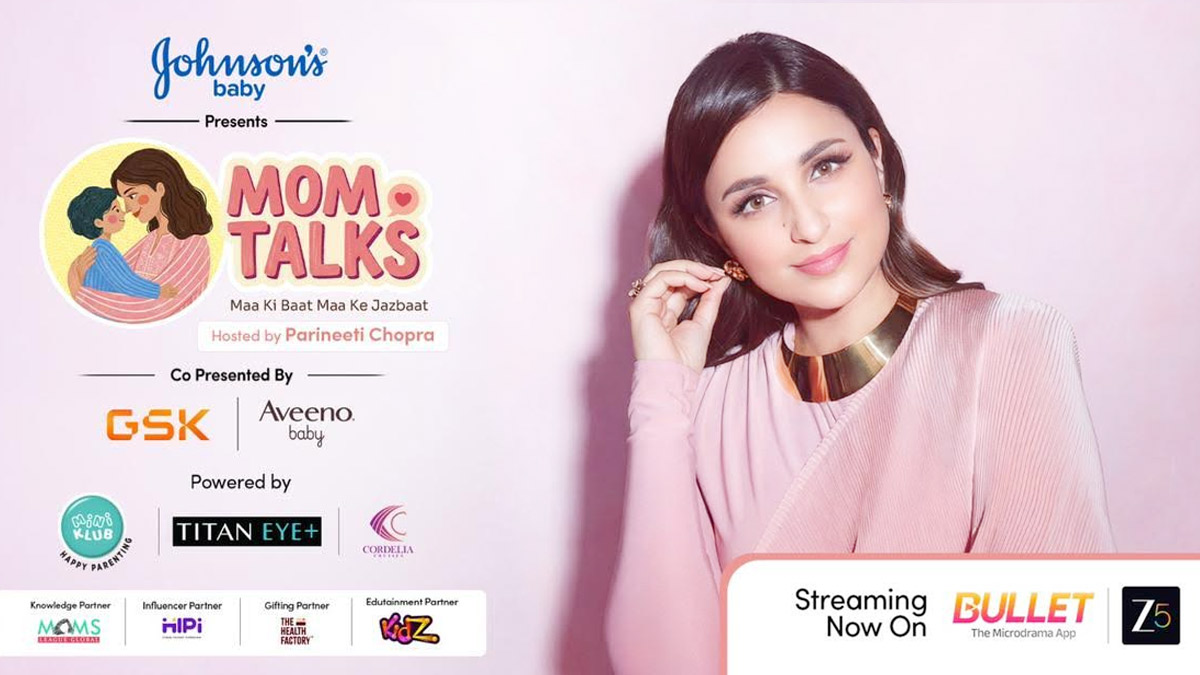
MUMBAI: Parineeti Chopra is stepping into a brand-new role not on the big screen, but as the warm, relatable host helping parents navigate the beautiful chaos of raising children. Bullet microdrama and Zee5 have announced the launch of Mom Talks, a fresh content-led IP hosted by the popular actress. The 9-episode series brings together celebrity parents including Imran Khan, Neha Dhupia, Vikrant Massey & Sheetal, and Gauahar Khan & Zaid Darbar to share candid, real-life perspectives on everyday parenting.
Positioned as a high-engagement format, Mom Talks taps into the growing demand for authentic and credible parenting content. It also offers seamless, contextual integration opportunities for brands. The series is backed by a strong lineup of partners including Johnson’s Baby, GSK, Aveeno Baby, Mini Klub, Titan Eye+ and Cordelia Cruises.
Bullet microdrama app, co-founder & chief business officer Azim Lalani said the show exemplifies how content is evolving towards more rooted, sustained engagement. “It’s about bringing content that people come back to, while creating a natural space for brands to be part of the narrative,” he noted.
Mom Talks creator Bullet head of AVOD & partnerships Munaf Merchant explained the core idea, “We wanted to build a safe, honest, one-stop destination for parents seeking real answers to everyday questions.”
The first episodes will stream for free on ee5 AVOD starting 4 April 2026, with new episodes dropping every Friday and Saturday. The series will also be available on the Bullet microdrama app.
Speaking about their association, Peeyush Unikkat from Johnson’s Baby highlighted the brand’s focus on supporting modern parenting journeys, while Aakash Mehta from GSK emphasised the show’s role in making important health conversations more relatable for new parents.
In a digital space often filled with filtered perfection, Mom Talks promises something refreshingly real honest conversations, celebrity insights, and practical wisdom, all wrapped in Parineeti Chopra’s engaging presence. For Indian parents, this could be the parenting series they’ve been waiting to binge.






