News Headline
Will More News Make Less Cents


When you lose in television news you lose big time! TV news, 24/7, is a huge, hungry, unforgiving animal that will swallow up every paisa you have and still want more.
Amid the euphoria and excitement that’s swirling around the industry at the moment, not least from the handful of stars who are seeing their pay packets go through the roof, spare a thought for the accountants. They have a tough year ahead.

The clamour to climb on the TV news bandwagon is being driven by the belief that audiences cannot get enough of watching live drama unfolding before their very eyes. Terrible, but gripping events like 9/11, the Afghan war and the attacks on Parliament and Gujarat’s Akshardham have all pulled in the viewers. And viewers, in a very crude sense, mean money.
“Advertisers have woken up to TV news as an untapped and cost effective way to sell your product; certainly compared to the price of sticking your toilet cleaner between two halves of an expensive drama”
Advertisers have woken up to TV news as an untapped and cost effective way to sell your product; certainly compared to the price of sticking your toilet cleaner between two halves of an expensive drama. And so, to come full circle, where the money goes the TV execs follow hence the five new TV operations heading our way next year. The question is how much is too much.
All these TV channels are essentially competing for the same audience i.e the great middle class. The audience is large and it will grow larger but not as quickly as the number of TV channels trying to serve it. Some media analysts suggest that only three of the new channels will survive. But even for those that do, it’ll be an expensive and painful experience which may leave even some of the already established Indian channels feeling more than a little bruised.
And what of the other players in the market like BBC World and the other international news channels? CNN already appears to have abandoned its South Asia coverage to fight a rearguard action in the United States with FOX who, for the first time this year, have edged ahead in the ratings war. The sight of CNN’s correspondent reporting on the count in Gujarat from a telephone line in Delhi shows that Atlanta has its eyes and its resources elsewhere.
So in India that’s meant CNBC has taken over the second slot from CNN. BBC World is still no 1 in India and by far the most watched international news channel taking up 33 of the top fifty slots in a recent survey on audience viewing habits but even so, we’ve still had to have a re-think, and react not only to the changing conditions in South Asia but from across the world. New markets are constantly opening up to the organisation, like the fact that in the last few years, BBC World has gone from practically zero to now being in 86% of American homes.
So this month the BBC created a new global news division to bring BBC World TV, World Service Radio and the BBC News On-line service under one Boss to fight a united international campaign. My appointment too as the first BBC South Asia Bureau Editor responsible for our entire news operation from Kabul to Colombo (via Delhi!) is an acknowledgment that the organisation cannot manage and adapt to the new environment in South Asia with a long arm from London.
But for the time being, the international channels are the last thing the Indian companies are worrying about. Their big priorities at the moment are how to catch and keep the local talent. TV news is still a young industry here and the pool of reserves are quite small.
So everyone is trying to poach from everyone else, pushing up wages and expectations. And the canny players, like Prannoy Roy know the importance of the talent. He has built up and seems likely to keep, with some hefty pay rises and attractive packages, his very good people. The likes of Rajdeep are tried and trusted by ordinary Indians. No one, least of all Mr Roy, under estimates the importance to the brand of a familiar face. That’s why anchors in the US are paid tens of millions of dollars a year to essentially read an auto cue for half an hour a day. But the crunch will come when all the channels suddenly come up against a big costly running story hitting the headlines. Wars and conflicts are expensive.
Both for the participants and the people trying to cover them. If you want to be a big player you have to make a serious financial commitment, if you don’t the audience will turn over to those that do. And the first big story in the brave new world of Indian 24 hour news will probably not be in South Asia at all but in Iraq. The programme makers will have to decide whether they want to ride the backs of their international partners (if they have them) or dip deep into their pockets to put the likes of Barkha on a tank in the Iraqi desert to show they really mean business. A serious conflict between Pakistan and India would be even more expensive.
So what will the scene look like two years from now. Journalists are lousy at predictions but that never seems to stop us (the Gujarat poll is proof of that) so here goes. Firstly I’d be surprised, like everyone else, if one or two Chief execs don’t end up watching their new cars being towed out the drive as the bills come rolling in and the advertising tapers off. The stars will stay stars though and their salaries will stay with them but the middle rung correspondents and producers, cashing in now on their new found market value, should enjoy it while it lasts. If someone crashes so will their big pay rises.
That at least was what happened in Europe during the swings and roundabouts of the media there. But the industry as a whole will emerge stronger and fitter and a new generation of talent will be created. That, in the long run, can only be good for the Indian viewer.
(The author is BBC South Asia Bureau Editor. His e-mail is paul.danahar@bbc.co.uk)







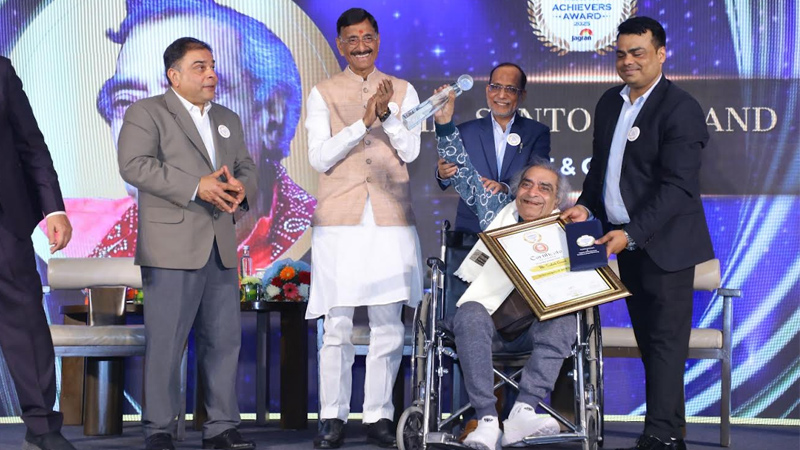
NEW DELHI: Hamdard Laboratories gathered a cross-section of India’s achievers in New Delhi on Friday, handing out the Hakeem Abdul Hameed Excellence Awards to figures who have left their mark across healthcare, education, sport, public service and the arts.
The ceremony, attended by minister of state for defence Sanjay Seth and senior officials from the ministry of Ayush, celebrated individuals whose work blends professional success with a sense of public purpose. It was as much a roll call of achievement as it was a reminder that influence is not measured only in profits or podiums, but in people reached and lives improved.
Among the headline awardees was Alakh Pandey, founder and chief executive of PhysicsWallah, recognised for turning affordable digital learning into a mass movement. On the sporting front, Arjuna Awardee and kabaddi player Sakshi Puniya was honoured for her contribution to the game and for pushing women’s participation onto bigger stages.
The cultural spotlight fell on veteran lyricist and poet Santosh Anand, whose songs have echoed across generations of Hindi cinema. At 97, Anand accepted the honour with characteristic humility, reflecting on a life shaped by perseverance and hope.
Healthcare honours spanned both modern and traditional systems. Manoj N. Nesari was recognised for strengthening Ayurveda’s place in national and global health frameworks. Padma shri Mohammed Abdul Waheed was honoured for his research-backed work in Unani medicine, while padma shri Mohsin Wali received recognition for his long-standing contribution to patient-centred care.
Education and social development also featured prominently. Padma shri Zahir Ishaq Kazi was honoured for decades of work in education, while former Meghalaya superintendent of Police T. C. Chacko was recognised for public service. Goonj founder Anshu Gupta received an award for his dignity-centred rural development initiatives, and the Hunar Shakti Foundation was honoured for empowering women and young girls through skill development.
The Lifetime Achievement Award went to former IAS officer Shailaja Chandra for her long career in public healthcare and governance, particularly in the traditional systems under Ayush.
Speaking at the event, Hamdard chairman Abdul Majeed said the awards were a tribute to those who combine excellence with empathy. “These awardees reflect Hakeem Sahib’s belief that healthcare, education and public service must ultimately serve humanity,” he said.
Minister Seth struck a forward-looking note, saying India’s young population gives the country a unique opportunity to become a global destination for learning, health and wellness by 2047.
The ceremony also featured the trailer launch of Unani Ki Kahaani, an upcoming documentary starring actor Jim Sarbh, set to premiere on Discovery on 11 February.
Instituted in memory of Unani scholar and educationist Hakeem Abdul Hameed, the awards have grown into a national platform that celebrates those building a more inclusive and resilient India. For one evening at least, the spotlight was not just on success, but on service with substance.