News Broadcasting
Why telecasting cricket hurts DD


MUMBAI: It has been six years that India’s public broadcaster Doordarshan (DD) started showing cricket matches to the Indian audience for free, allowing even the underprivileged viewers to watch their favourite sport.
Apparently the public broadcaster has to pay a price for citizens of India to watch cricket matches for free. And if you think it hardly matters, it’s about time to correct it. Let’s first understand how the whole process actually works.
In 2007, the Sports Broadcasting Act was passed that stated that live signals of all cricket matches (ODI and T20) of national importance that are played in India must be shared with the public broadcaster DD and AIR (All India Radio). Post the formation of this law, any commercial sports channel needs to share its signals with DD for all such matches. In a recent ruling, it directed Star Sports to provide feeds without advertisements since Star Sports is currently the right holder of these matches.

Before a series, both the commercial broadcaster and DD get together and bid for the Revenue Management Control (RMC).The highest bidder becomes the RMC and gets the rights to market the advertisements for the match. According to the Act, 75 per cent of the revenue will be with the main channel and 25 per cent will be with DD. All the money is pooled into an escrow account to maintain transparency over the dealings and revenue earned. If DD makes more than the bidding amount, it profits, but if it doesn’t meet the target then it has to shell out money from its pocket to give the 75 per cent of the bid amount to the other party.
 |
|
Mukesh Sharma feels that it it the well wishes of people that works for DD in the end
|
When DD telecasts these important matches, it loses out the revenue that it generates from its daily soaps on the national channel. At the same time, the regional channels have terrestrial support between 8: 00 pm to 11: 00 pm from the national channel. So, while a match is aired on one channel, shows from several DD channels are cut off for hours.
“For DD, this is a loss making exercise but the government wants to show cricket to even those who cannot pay for the commercial channels,” says DD Sahyadri additional director general Mukesh Sharma.
DD has always battled to have at least a 50:50 deal along with suitable changes in the law. The revenue that DD makes through its shows, which would have been telecast in place of the cricket match, is called as the opportunity cost (OC). In order for DD to gain its OC, it has to earn four times the revenue from the cricket match. For example, if the OC is Rs 5 crore, then DD needs to make Rs 20 crore (excluding tax) so that Rs 15 crore is given to the channel that holds the rights and DD recovers Rs 5 crore.
However, the possibility of this happening is nearly zero because of the difference in advertisers on board with DD and the commercial channel. Factors such as opponent country, type of match, time of viewing, audience demographics come into the picture. For an India vs Pakistan match, the ad rates may be high, the bid would be high too as compared to an India vs Zimbabwe one. “During prime time, we suffer huge losses and there isn’t much money in the market that can help us recover our opportunity cost,” adds Sharma.
Had test matches also been included in the Act, probably the pubcaster would have been constantly stitching holes in its pocket. In fact, a recent letter by the Prasar Bharati to the Ministry of Information & Broadcasting (I&B), DD said that although it had wanted to telecast Sachin Tendulkar’s final match, restrictions in the Act and the possibility of a huge financial loss thwarted it from doing so. The OC for the two test matches would be Rs 10 crore as compared to the advertising revenue of just Rs 1 crore. That signals a loss of Rs 9.25 crore for it.
The letter also highlighted how it was a huge financial loss for DD when the money allotted to Prasar Bharati was cut down. Therefore, another request to amend the act has been put forth that lets the pubcaster choose the matches it wants to telecast and the channel on which it wants to show it.
The Sports Broadcasting Act of 2007 says, “No content rights owner or holder and no television or radio broadcasting service provider shall carry a live television broadcast on any cable or Direct- to- Home network or radio commentary broadcast in India of sporting events of national importance, unless it simultaneously shares the live broadcasting signal, without its advertisements, with the Prasar Bharati to enable them to re-transmit the same on its terrestrial networks and Direct- to- Home networks in such manner and on such terms and conditions as may be specified.”
Prasar Bharati has asked for it to be changed to “its terrestrial networks or Direct- to- Home networks” or “on its FTA networks available on various platforms” so that they have flexibility on the channel they want to show it. The OC on DD Sports is negligible.
Prasar Bharati has been asking for the revenue sharing to be changed to 40:60 in its favour. Since the initiation of the Act, 43 such matches have been telecast (ODIs and T20) till November 2012. Out of them, in 18 matches the bid amount quoted was not enough to meet the OC while for 25 matches it suffered a loss even when the OC was not realised. The demand for changes in the act, it says, will be consistent with its aim to provide viewers free viewing of the matches without having to subscribe to pay channels.
“It needs to be re-emphasised that carriage of sporting events of national importance on DD National results in disruption of normal programmes and loss of precious revenue. The proposed amendment will help Prasar Bharati in realising optimally its existing revenue potential and enhancing it further,” reads a letter dated 17 September 2013 by Prasar Bharati finance member B B Pandit to the I & B ministry additional secretary J S Mathur.
Star Sports is currently the channel that has the rights to broadcast all such matches and has to share the feed with DD. The channel refused to comment on this story saying the matter is sub-judice. In October this year, the Delhi High Court directed Star Sports to provide signals devoid of advertisements to DD, which it had earlier said it cannot do as they come embedded with the feed.
DD is a public broadcaster so its main sources of revenue are public funds and advertising revenue. “Well, even if we don’t get any money, we make do with the well wishes of the people,” says Sharma.




News Broadcasting
Network18 channels lead YouTube news viewership in March 2026
CNN-News18, News18 India and CNBC channels top categories with record views
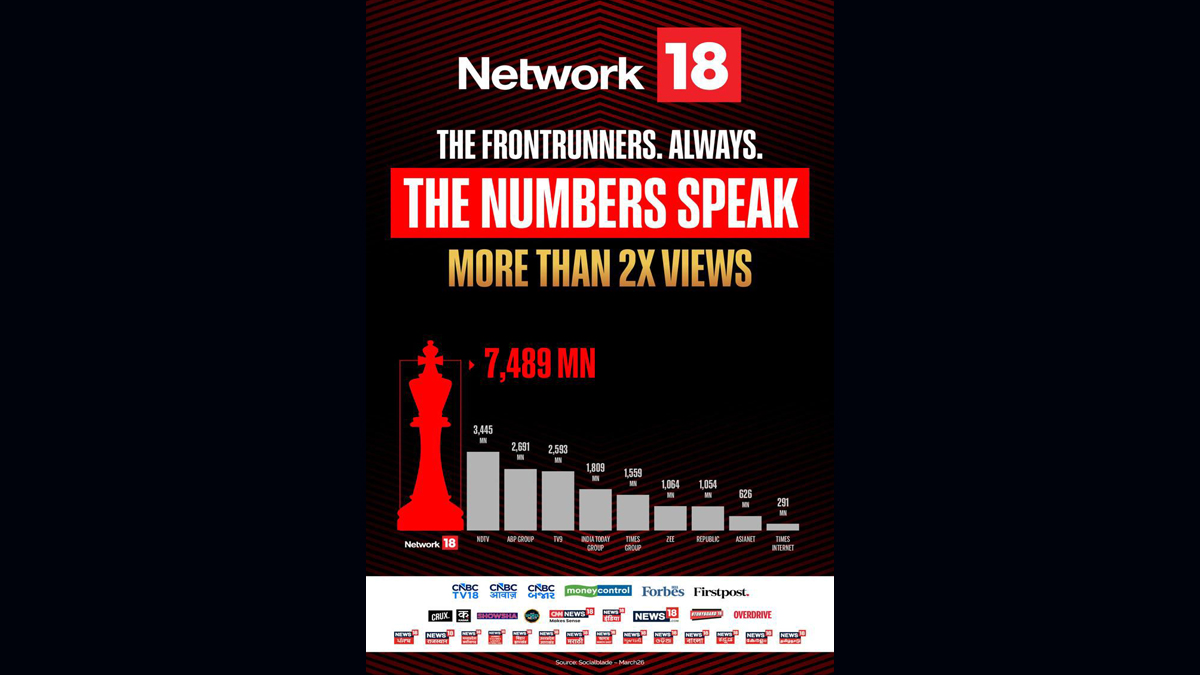
MUMBAI: When the world hit refresh on breaking news, Network18’s channels were already streaming ahead. As geopolitical tensions and war-driven headlines fuelled a surge in global news consumption, the network’s digital playbook delivered big clocking record Youtube viewership across English, Hindi and business news categories in March 2026.
At the forefront was CNN-News18, which emerged as the clear leader in the English news segment with 130 million live and video-on-demand views. The channel edged past competitors such as Times of India (126.5 million), Times Now (101.1 million), India Today (88.2 million) and NDTV (77.5 million), according to Databeings data for March.
In the Hindi news arena, News18 India delivered a commanding performance, racking up a staggering 3,297 million views on YouTube. The channel comfortably outpaced NDTV India, which recorded 3,119 million views, underlining its deep reach and consistent engagement with mass audiences, as per Playboard data.
The network’s dominance wasn’t confined to general news. In the Hindi business segment, CNBC Awaaz topped the charts with 92 million views, narrowly ahead of Zee Business (90 million) and well ahead of ET Now Swadesh (57 million). Meanwhile, its English counterpart CNBC-TV18 posted a strong 58 million views, reinforcing the network’s cross-category strength.
The spike in viewership reflects a broader shift in audience behaviour, with viewers increasingly turning to digital platforms particularly Youtube for real-time updates and in-depth coverage during high-intensity news cycles. For Network18, the numbers signal more than just scale; they underline the effectiveness of a multi-platform strategy that blends speed, credibility and continuous coverage.
In a month where the news never paused, it seems viewers chose to stay tuned where the stream never stopped.






