News Headline
Why 2026 will be a defining year for Indian motorsport


MUMBAI: For decades, motorsport in India existed on the edge of mainstream culture, admired for speed, respected for skill, but rarely understood or embraced beyond a niche audience. That changed in 2025. Not through noise or novelty, but through visibility that felt earned. As the industry enters 2026, the challenge is no longer about being seen. It is about being believed.
Last year marked a turning point in how motorsport presented itself to the public. The conversation moved decisively away from just machines and lap times to the people and pressure behind performance. Engineers, data analysts, pit crews and young aspirants stepped into the spotlight, making motorsport more human, accessible and emotionally engaging.
“Motorsport finally stopped talking only to insiders,” says Omkar Sachin Rane, founder of United Motorsports Academy and D&O Motorsports. “In 2025, the narrative widened to include the grind, the learning curve and the uncertainty. That’s what allowed new audiences to connect with it.”

Digital platforms played a critical role in this shift. Short-form video, behind-the-scenes storytelling and creator-led content helped motorsport reach younger, more curious audiences without diluting its complexity. Importantly, this wasn’t about chasing mass reach. The most effective content spoke clearly to people who cared about performance, engineering and ambition.
“High-performance categories don’t need louder messaging,” Rane says. “They need clarity. Motorsport became more visible because it stopped trying to impress everyone and focused on explaining what it actually takes to perform.”
Experiential storytelling also gained ground. Motorsport, by nature, resists simplification. In 2025, greater emphasis on on-ground exposure, immersive learning and real-world engagement helped bridge that gap. Seeing effort, discipline and pressure up close created a deeper connection than any polished campaign could.
This approach extended naturally into education and skill-building. Across the ecosystem, initiatives that prioritised proof over promise quietly gained traction. Intensive boot camps, global exposure models and realistic training environments attracted serious aspirants, not because they were aggressively marketed, but because they aligned with what young professionals increasingly value.
“Aspirational audiences are far more informed today,” says Rane. “They don’t want glossy guarantees. They want to know the conditions, the expectations and the outcomes. When you show them the real environment, intent follows.”
As 2026 unfolds, expectations will only sharpen. Audiences are more discerning, and surface-level storytelling will struggle to hold attention. For motorsport, and for brands operating in similarly complex spaces, the next phase demands depth. Content will need to educate without overwhelming, inspire without exaggeration and invite participation rather than passive consumption.
There is also a broader opportunity ahead. As electric vehicles, data-led performance and advanced engineering become part of everyday mobility conversations, motorsport’s relevance is set to expand. The sport can increasingly position itself not just as entertainment, but as a living laboratory for innovation and progress.
“Motorsport sits at the intersection of mobility, technology and human performance,” Rane notes. “If 2026 is approached with honesty and intent, it can become a cultural reference point, not just a sporting one.”
What 2025 ultimately proved is that visibility is no longer about volume. It is about value. Motorsport earned attention by respecting its audience’s intelligence and inviting them closer to the process. The year ahead will test whether the industry can sustain that trust.
If 2026 builds on this foundation with sharper storytelling, clearer positioning and meaningful experiences, motorsport’s place in India’s cultural and brand landscape will grow stronger still. And for marketers watching from the sidelines, the lesson is unmistakable. When credibility leads the narrative, aspiration follows.

NEW DELHI: Hamdard Laboratories gathered a cross-section of India’s achievers in New Delhi on Friday, handing out the Hakeem Abdul Hameed Excellence Awards to figures who have left their mark across healthcare, education, sport, public service and the arts.
The ceremony, attended by minister of state for defence Sanjay Seth and senior officials from the ministry of Ayush, celebrated individuals whose work blends professional success with a sense of public purpose. It was as much a roll call of achievement as it was a reminder that influence is not measured only in profits or podiums, but in people reached and lives improved.
Among the headline awardees was Alakh Pandey, founder and chief executive of PhysicsWallah, recognised for turning affordable digital learning into a mass movement. On the sporting front, Arjuna Awardee and kabaddi player Sakshi Puniya was honoured for her contribution to the game and for pushing women’s participation onto bigger stages.
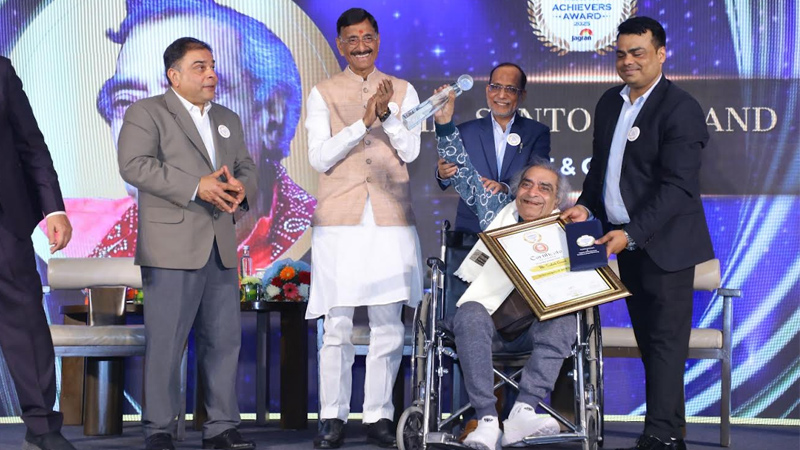
The cultural spotlight fell on veteran lyricist and poet Santosh Anand, whose songs have echoed across generations of Hindi cinema. At 97, Anand accepted the honour with characteristic humility, reflecting on a life shaped by perseverance and hope.
Healthcare honours spanned both modern and traditional systems. Manoj N. Nesari was recognised for strengthening Ayurveda’s place in national and global health frameworks. Padma shri Mohammed Abdul Waheed was honoured for his research-backed work in Unani medicine, while padma shri Mohsin Wali received recognition for his long-standing contribution to patient-centred care.
Education and social development also featured prominently. Padma shri Zahir Ishaq Kazi was honoured for decades of work in education, while former Meghalaya superintendent of Police T. C. Chacko was recognised for public service. Goonj founder Anshu Gupta received an award for his dignity-centred rural development initiatives, and the Hunar Shakti Foundation was honoured for empowering women and young girls through skill development.
The Lifetime Achievement Award went to former IAS officer Shailaja Chandra for her long career in public healthcare and governance, particularly in the traditional systems under Ayush.
Speaking at the event, Hamdard chairman Abdul Majeed said the awards were a tribute to those who combine excellence with empathy. “These awardees reflect Hakeem Sahib’s belief that healthcare, education and public service must ultimately serve humanity,” he said.
Minister Seth struck a forward-looking note, saying India’s young population gives the country a unique opportunity to become a global destination for learning, health and wellness by 2047.
The ceremony also featured the trailer launch of Unani Ki Kahaani, an upcoming documentary starring actor Jim Sarbh, set to premiere on Discovery on 11 February.
Instituted in memory of Unani scholar and educationist Hakeem Abdul Hameed, the awards have grown into a national platform that celebrates those building a more inclusive and resilient India. For one evening at least, the spotlight was not just on success, but on service with substance.







