Applications
“Welcome Mota Bhai, ab ayega maza” – CloudTV embraces JioTele OS in India

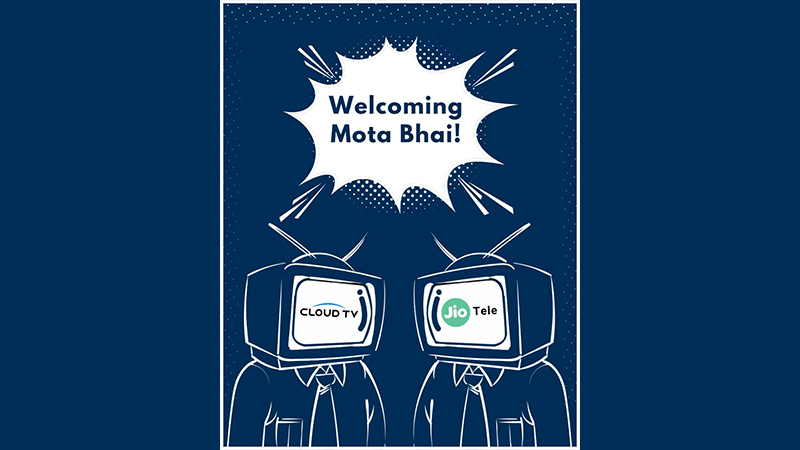
MUMBAI: India’s Smart TV market just got more interesting. CloudTV, the country’s first certified Smart TV OS provider, has welcomed JioTele OS to the landscape with flair. Developed by Mumbai-based CloudWalker Streaming Technologies, CloudTV has built a strong foothold with 12+ million users, 250+ Smart TV brands, 100+ app partners, 200+ content partners, and 25+ manufacturing partners across India.
In a statement filled with both excitement and confidence, CloudTV COO & co-founder Abhijeet Rajpurohit shared his thoughts via Linkedin on this latest industry shake-up. “We look at this as a market opening opportunity (Jio effect). The Smart TV market in India will expand, and the dependency on set-top box hardware to deliver operator services will shrink further,” he noted.
CloudTV sees itself as a pioneer of the Independent OS Era, a space where operating systems stand on their own without being tied to proprietary content apps. “CloudTV is probably the only OS in India without its own content app, and we will continue to serve our goal—bridging the gap between consumers and content discovery without any discrimination,” Rajpurohit added.

In a world where foreign tech giants often dominate the conversation, CloudTV takes pride in its homegrown roots. “I’m glad it’s an Indian company and not another foreign player doing a favour to Indian brands,” Rajpurohit remarked.
With JioTele OS entering the space, the Indian Smart TV industry is poised for rapid transformation. Experts predict that competition will drive innovation, leading to better features, improved user experiences, and greater accessibility for consumers.
CloudTV’s warm reception of JioTele OS signals a more collaborative and growth-oriented approach rather than a turf war. For consumers, this means a broader choice of Smart TV experiences, enhanced content discovery, and fewer restrictions when it comes to accessing digital entertainment.
With 200+ TV brands already powered by CloudTV and a growing ecosystem of OTT and FAST (Free Ad-Supported TV) services, the platform is already making waves in the industry.
As CloudTV playfully put it: “Welcome Mota Bhai, ab ayega maza.” The future of India’s Smart TV market just got a whole lot more exciting.

Applications
With 57 per cent single new users, Ashley Madison rebrands as discreet dating platform
Platform says majority of new members now identify as single

INDIA: Ashley Madison is shedding the “married-dating” label that defined it for two decades, repositioning itself as a platform for discreet dating in what it calls the post-social media age.
The rebrand, unveiled in India on 27 February, 2026, marks a structural shift in business model and identity. Once synonymous with married dating, the company now describes itself as the “premier destination for discreet dating” under a new tagline: Where Desire Meets Discretion.
The pivot is data-driven. Internal figures show that 57 per cent of global sign-ups between 1 January and 31 December, 2025 identified as single: a notable departure from the platform’s married core. The company argues that its community has already evolved beyond its original positioning.
“In an age where our lives have been constantly put on public display, privacy has become the new luxury,” said Ashley Madison chief strategy officer Paul Keable. He framed the platform’s offering as “ethical discretion” for singles, separated, divorced and non-monogamous users seeking private connections.
The shift also taps into wider digital fatigue. A global survey conducted by YouGov for Ashley Madison, covering 13,071 adults across Australia, Brazil, Canada, Germany, India, Italy, Mexico, Spain, Switzerland, the UK and the US, found mounting discomfort with hyper-public online lives.
Among dating app users, 30 per cent cited constant swiping and messaging as a source of fatigue, while 24 per cent pointed to pressure to curate public-facing profiles and early personal disclosure. Some 27 per cent said fears of screenshots or information being shared contributed to exhaustion; an equal share cited unwanted attention.
The retreat from oversharing appears broader. According to the survey, 46 per cent of adults actively try to keep most aspects of their life private online. Only 8 per cent feel comfortable sharing most aspects publicly, while 35 per cent say they are becoming more selective about what they disclose.
Ashley Madison is betting that this cultural recalibration towards controlled visibility can be monetised. By doubling down on privacy infrastructure and reframing itself around discretion rather than infidelity, the company is attempting to convert reputational baggage into a premium proposition.







