News Broadcasting
Vizeum to lead rebranding of BBC Knowledge to BBC Earth across Asia


MUMBAI: Vizeum has been appointed to lead the launch of the BBC Earth channel across Asia.
Consistent with BBC Worldwide’s global strategy BBC Knowledge was rebranded to BBC Earth on 3 October, 2015.

In Asia, BBC Earth will be available in Cambodia, Hong Kong, Indonesia, Malaysia, Mongolia, Singapore, South Korea, Taiwan, Thailand and Vietnam. There is also a BBC Earth block in Japan on Wowow.
For India, BBC Worldwide entered into a joint venture partnership with Multi Screen Media (MSM) to launch the channel of BBC Earth. The co-branded channel will be called Sony BBC Earth.
“It’s fantastic to have been appointed to launch BBC Earth in Asia and to expand Vizeum’s global relationship with the BBC. We look forward to working with the team at the BBC to deliver incredible content to consumers across the region,” said Vizeum Asia Pacific MD Duncan Pointer.
BBC Earth offers premium content, original commissions and a world beating pipeline of factual programmes that define the human experience, our planet and the wider universe. The channel will deliver awe inspiring programmes in the BBC’s well-known world class style.
BBC Earth launched with Shark, the history of the ocean’s greatest predators.
The new channel will also see the Asia premiere of The Hunt, within 24 hours of the UK telecast. The blue chip landmark series, narrated by Sir David Attenborough and executive produced by award-winning producer, Alistair Fothergill, explores the dramatic world of predation as never before, taking an intimate look at the remarkable strategies of hunters and the hunted, exploring the challenges animals face and the tactics they employ.
Other programmes on the channel will include the series Life Below Zero, which follows the lives of hard-working people living off the grid in Alaska, Infested in which Dr Michael Mosley explores the bizarre and fascinating world of parasites by turning his body into a living laboratory and deliberately infesting himself with them, and Human Universe, in which rockstar turned nuclear physicist Professor Brian Cox explores our place in the universe.







News Broadcasting
Network18 channels lead YouTube news viewership in March 2026
CNN-News18, News18 India and CNBC channels top categories with record views
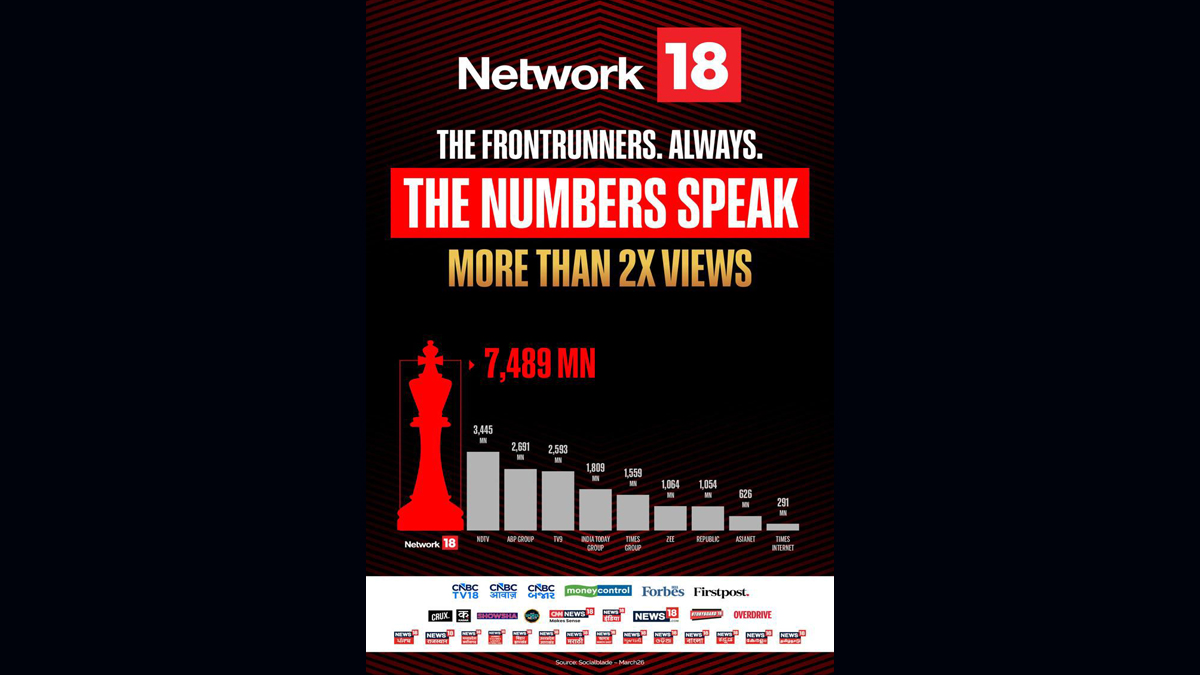
MUMBAI: When the world hit refresh on breaking news, Network18’s channels were already streaming ahead. As geopolitical tensions and war-driven headlines fuelled a surge in global news consumption, the network’s digital playbook delivered big clocking record Youtube viewership across English, Hindi and business news categories in March 2026.
At the forefront was CNN-News18, which emerged as the clear leader in the English news segment with 130 million live and video-on-demand views. The channel edged past competitors such as Times of India (126.5 million), Times Now (101.1 million), India Today (88.2 million) and NDTV (77.5 million), according to Databeings data for March.
In the Hindi news arena, News18 India delivered a commanding performance, racking up a staggering 3,297 million views on YouTube. The channel comfortably outpaced NDTV India, which recorded 3,119 million views, underlining its deep reach and consistent engagement with mass audiences, as per Playboard data.
The network’s dominance wasn’t confined to general news. In the Hindi business segment, CNBC Awaaz topped the charts with 92 million views, narrowly ahead of Zee Business (90 million) and well ahead of ET Now Swadesh (57 million). Meanwhile, its English counterpart CNBC-TV18 posted a strong 58 million views, reinforcing the network’s cross-category strength.
The spike in viewership reflects a broader shift in audience behaviour, with viewers increasingly turning to digital platforms particularly Youtube for real-time updates and in-depth coverage during high-intensity news cycles. For Network18, the numbers signal more than just scale; they underline the effectiveness of a multi-platform strategy that blends speed, credibility and continuous coverage.
In a month where the news never paused, it seems viewers chose to stay tuned where the stream never stopped.






