News Broadcasting
US broadcaster ABC strictly dances to BBC’s tune

MUMBAI: BBC’s smash hit Strictly Come Dancing will debut in the US following a new production agreement between BBC Worldwide and ABC. The US version of the show will feature a new title, a new celebrity line-up, a new host and new judges.
In the first deal of its kind for BBC Worldwide, the variety show will be produced in America for ABC, by the in-house BBC Entertainment production team responsible for the hit UK version.
The as yet unnamed six-part, prime time series will feature eight celebrities paired with leading professional dancers to train and then compete in a live television knockout ballroom dancing competition. Casting is currently underway, with talent likely to be confirmed in the next few weeks. The line-up is set to include TV and movie stars, alongside other American celebrities.

BBC Worldwide’s director of format licensing Colin Jarvis said, “Working with ABC in this unique way, gives us a new opportunity to develop a hit BBC property in this extremely important market. The reaction to the show around the world has been phenomenal and proves yet again the strength of the in-house format development team within BBC Entertainment. With this pedigree, the show has all the hallmarks of a huge US hit.”
ABC executive VP alternative programming, specials and late night Andrea Wong said, “I am fully aware that this may sound like the craziest show anyone in the US has every heard of. But in a world where its easier for reality series to imitate than innovate, I just love how fresh this format is. And the show’s global success demonstrates how audiences around the world find it surprising and, undeniably, fun.”
Strictly Come Dancing is proving a success around the globe for BBC Worldwide, with deals for local versions with TV2 in Denmark, TVN in Poland, VTM in Belgium and TVNZ in New Zealand recently confirmed.
These new deals follow versions in Australia and Italy where the format was a knockout, raking in huge audiences. In Australia, Channel 7 attracted 2.1 million viewers, with the second series of Dancing with the Stars premiering to a record-breaking the 37 per cent audience share.
In Italy Ballando con le Stelle (Dancing With the Stars) was such a success, with an audience shares of over 30 per cent. The broadcaster RAI UNO commissioned extra episodes. The Strictly Come Dancing format is expected to generate income of ?20m over five years.






News Broadcasting
Network18 channels lead YouTube news viewership in March 2026
CNN-News18, News18 India and CNBC channels top categories with record views
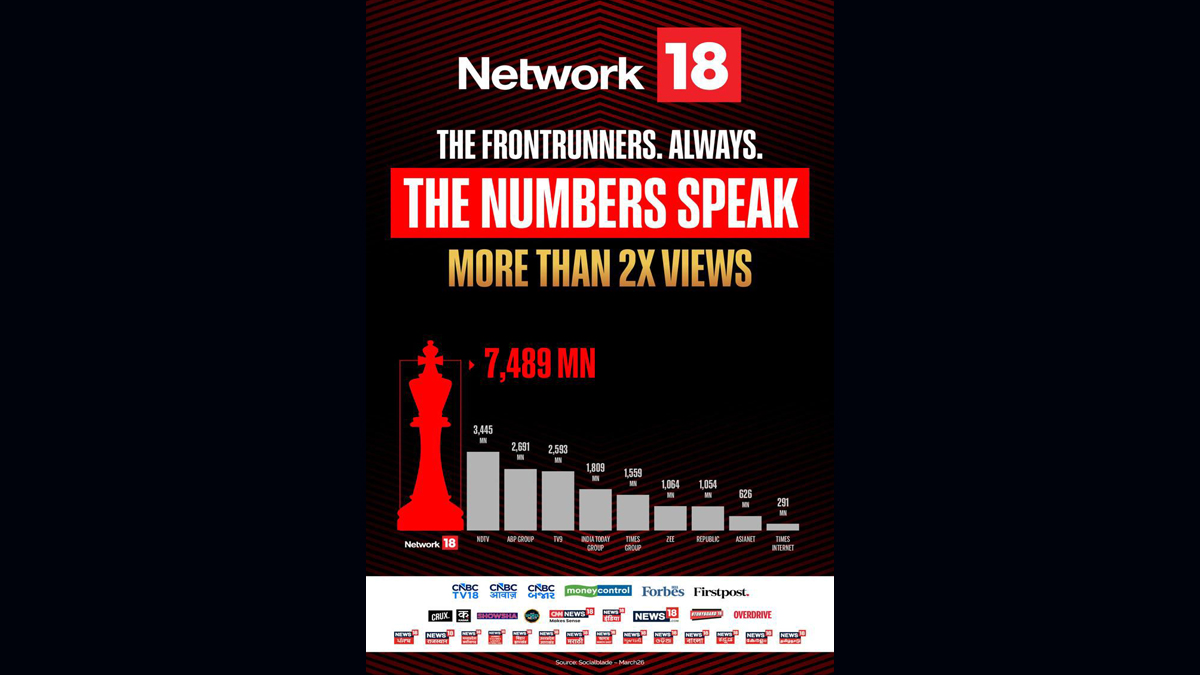
MUMBAI: When the world hit refresh on breaking news, Network18’s channels were already streaming ahead. As geopolitical tensions and war-driven headlines fuelled a surge in global news consumption, the network’s digital playbook delivered big clocking record Youtube viewership across English, Hindi and business news categories in March 2026.
At the forefront was CNN-News18, which emerged as the clear leader in the English news segment with 130 million live and video-on-demand views. The channel edged past competitors such as Times of India (126.5 million), Times Now (101.1 million), India Today (88.2 million) and NDTV (77.5 million), according to Databeings data for March.
In the Hindi news arena, News18 India delivered a commanding performance, racking up a staggering 3,297 million views on YouTube. The channel comfortably outpaced NDTV India, which recorded 3,119 million views, underlining its deep reach and consistent engagement with mass audiences, as per Playboard data.
The network’s dominance wasn’t confined to general news. In the Hindi business segment, CNBC Awaaz topped the charts with 92 million views, narrowly ahead of Zee Business (90 million) and well ahead of ET Now Swadesh (57 million). Meanwhile, its English counterpart CNBC-TV18 posted a strong 58 million views, reinforcing the network’s cross-category strength.
The spike in viewership reflects a broader shift in audience behaviour, with viewers increasingly turning to digital platforms particularly Youtube for real-time updates and in-depth coverage during high-intensity news cycles. For Network18, the numbers signal more than just scale; they underline the effectiveness of a multi-platform strategy that blends speed, credibility and continuous coverage.
In a month where the news never paused, it seems viewers chose to stay tuned where the stream never stopped.






