News Broadcasting
UP cable ops continue strike


NEW DELHI: Wholl blink first in the state of Uttar Pradesh? The cable operators, who are on the warpath blacking out cable services in some parts of the state, or the government that has termed the strike illegal?
Even as indications are on that smaller cities like Azamgarh and Bijnaur might also join in the agitation, comes news that the cable ops have appealed to the prime minister for intervention in the matter.
Despite strong-arm tactics being used by the state government, the agitation of the cable operators today spread to cities like Varanasi, Allahabad and Gorakhpur.

The reason for the cable ops of Uttar Pradesh to go on an indefinite strike from Friday is the imposition of a high 30 per cent entertainment tax by the state government.
Agency reports from Lucknow stated that UP Cable TV Udyog Sangh president Rajendra Singh stuck to his guns, saying the operators would pay only Rs 10 per connection and not the 30 per cent tax imposed by the government.
”We only agreed to pay Rs 10 per connection and not 30 per cent on the highest monthly rent of the consumer,” Singh was quoted by the United News of India as saying.
The cable operators are adamant to continue with their protest against the ”irrational” entertainment tax policy, but the state government remains rigid and has already termed the strike illegal, announcing strict action against the striking operators.
According to cable operators union leader Singh, operators charge rates on the basis of the income group of the subscriber that varies from Rs 100 to Rs 250. But the state governments entertainment tax department had served notices calculating tax on the basis of ‘highest rate’, he added.
This is not the first time that the cable ops of the state had to resort to a strike , putting cable subscribers to much inconvenience. Earlier this year, the operators had gone on a flash strike, paralysing cable services in almost the whole of Uttar Pradesh, including large areas of Ghaziabd that is on the outskirts of Delhi.
After a few days of protests, the then government, headed by Mayawati, had asked the agitating cable ops to withdraw their stir and promised to look into the matter.
This time round, the state government, under the chief ministership of Samajwadi partys Mulayam Singh, till now has maintained its stridency.
Uttar Pradeshs principal secretary (taxes and registration) Naresh Dayal had told mediapersons in Lucknow yesterday that the government would not concede to the demands of the operators. Claiming that 30 per cent tax on cable network was enforced in 1995, agencies quoted him as saying that a government survey proved that the operators in Lucknow were evading Rs 20,00,000 per month by showing less numbers of connections. ”How can they protest when the cinema industry in the state is paying 60 per cent as tax”, he had questioned.
The cable ops had stopped beaming all private satellite entertainment and news channels from 9 pm on Friday in Lucknow, the state capital, protesting the levy of entertainment tax.


News Broadcasting
Network18 channels lead YouTube news viewership in March 2026
CNN-News18, News18 India and CNBC channels top categories with record views
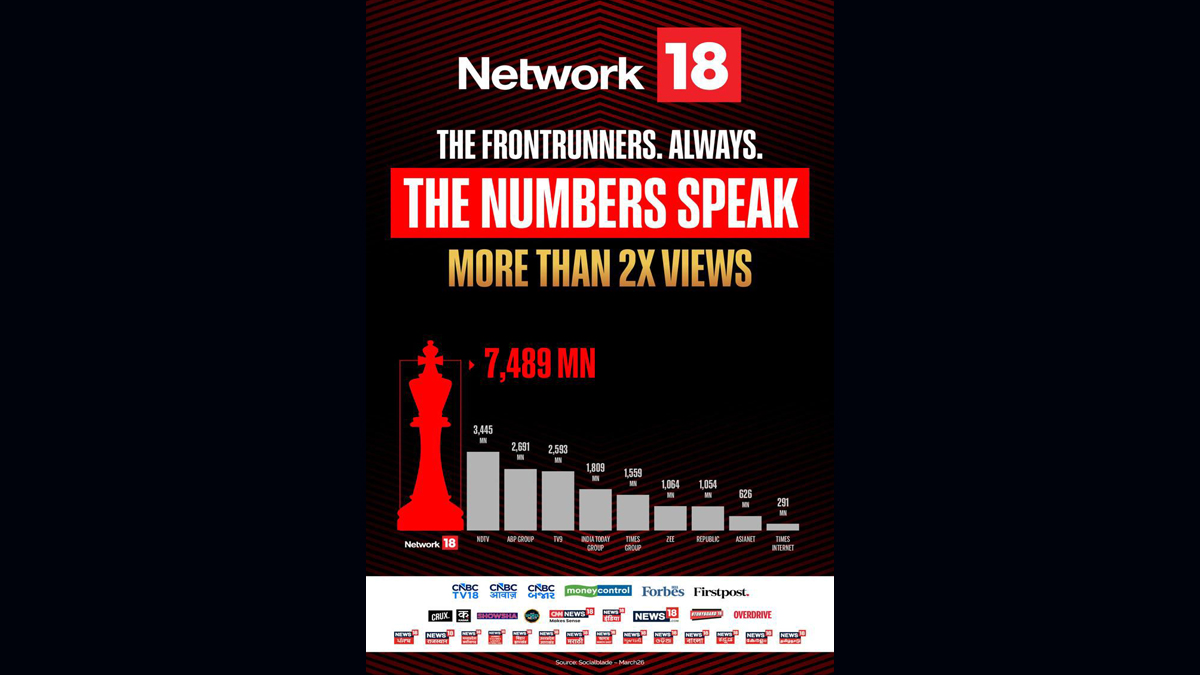
MUMBAI: When the world hit refresh on breaking news, Network18’s channels were already streaming ahead. As geopolitical tensions and war-driven headlines fuelled a surge in global news consumption, the network’s digital playbook delivered big clocking record Youtube viewership across English, Hindi and business news categories in March 2026.
At the forefront was CNN-News18, which emerged as the clear leader in the English news segment with 130 million live and video-on-demand views. The channel edged past competitors such as Times of India (126.5 million), Times Now (101.1 million), India Today (88.2 million) and NDTV (77.5 million), according to Databeings data for March.
In the Hindi news arena, News18 India delivered a commanding performance, racking up a staggering 3,297 million views on YouTube. The channel comfortably outpaced NDTV India, which recorded 3,119 million views, underlining its deep reach and consistent engagement with mass audiences, as per Playboard data.
The network’s dominance wasn’t confined to general news. In the Hindi business segment, CNBC Awaaz topped the charts with 92 million views, narrowly ahead of Zee Business (90 million) and well ahead of ET Now Swadesh (57 million). Meanwhile, its English counterpart CNBC-TV18 posted a strong 58 million views, reinforcing the network’s cross-category strength.
The spike in viewership reflects a broader shift in audience behaviour, with viewers increasingly turning to digital platforms particularly Youtube for real-time updates and in-depth coverage during high-intensity news cycles. For Network18, the numbers signal more than just scale; they underline the effectiveness of a multi-platform strategy that blends speed, credibility and continuous coverage.
In a month where the news never paused, it seems viewers chose to stay tuned where the stream never stopped.






