International
University of Southern California introduces three more chairs endowed by George Lucas

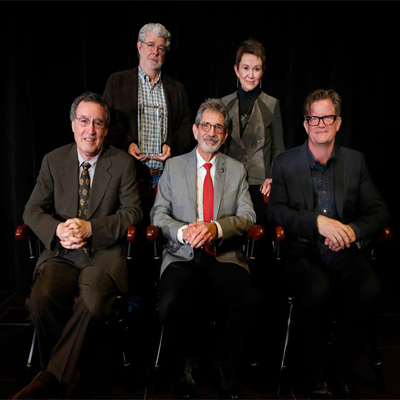
MUMBAI: On Thursday, 13 March, Lucas continued his philanthropy by endowing faculty chairs named for Sergei Eisenstein, George Méli?s and Williams Cameron Menzies. Eisenstein, Méli?s and Menzies are considered filmmaking pioneers. Their theories and practices are taught in film programs around the world.
At a dedication event at the School of Cinematic Arts (SCA), professors Bruce A. Block, Michael L. Fink and Alex B. McDowell were installed as the first holders of the new endowed chairs. Block was named the Sergei Eisenstein Endowed Chair in Cinematic Design; Fink as the George Méli?s Endowed Chair in Visual Effects; and McDowell as the William Cameron Menzies Endowed Chair in Production Design. The total number of endowed positions at SCA is currently at twenty-four, more than any other cinematic arts program in the country.

SCA Dean Elizabeth Daley said the chairs celebrate the importance of continued innovation. “In the mold of the filmmakers they are named after, these new chairs represent innovation in the cinematic arts,” she said in a press statement. Bruce Block, Michael Fink and Alex McDowell have each made singular contributions to their fields and are doing important work in the industry, while simultaneously preparing the next generation of innovative storytellers.
At the dedication event Lucas said he was naming the chairs as a way to say “don’t forget the basics. Don’t get enamored with new technology…it doesn’t change anything. The art of what we do is exactly the same. The goal that we have is exactly the same as George Méli?s, Williams Cameron Menzies and Sergei Eisenstein. It’s beyond technology. It’s the art of movies.”
Bruce Block has been teaching Filmic Expression, a course that Eisenstein originated for more than 35 years. Block’s producing and consulting credits include What Women Want, Something’s Gotta Give, The Holiday, As Good As It Gets, Stuart Little and Father of the Bride I and II. Block directs documentaries and animated films for museums, commercials, the IMAX format, and NASA simulations. Additionally, he conducts seminars in visual structure for studios including Blizzard, Blue Sky, Disney, Dreamworks, ILM, Lucasfilm, and Pixar. His book, “The Visual Story” has been published in six languages and is used as a reference text by filmmakers around the world.
“Eisenstein’s ideas influenced all of Hollywood’s filmmakers from the montages of Frank Capra’s films to the MGM dance extravaganzas of Busby Berkeley to Disney’s animation,” Block said during a speech at the dedication, noting that Eisenstein lectured at USC. “His teachings became part of our curriculum and were taught here by Slavko Vorkapich, Les Novros, Woody Omens and then by me.”
Michael Fink, who has been pioneering visual effects for more than thirty-five years, began his career on The China Syndrome in 1977. His other credits include Star Trek: The Motion Picture, Blade Runner, Batman Returns, The Golden Compass, Avatar and Life of Pi. He was nominated for the Academy Award for Best Achievement in Visual Effects for Batman Returns in 1993 and won the Oscar in that category in 2008 for The Golden Compass. Fink is on the Executive Committee of the Visual Effects Branch of the Academy of Motion Picture Arts and Sciences, and is a founding member, board member and current Vice-Chair of the Visual Effects Society.
“I believe this Chair is the first endowed chair in Visual Effects at any university,” he told the crowd gathered in the Ray Stark Theatre. “Naming it after George Méli?s, truly the father of all that we do in visual effects today, is not only appropriate, but the least we can do to carry his name forward in our teaching.”
Alex McDowell has more than thirty years’ experience as a narrative designer and is creative director of USC’s World Building Media Lab and the thought leadership network, USC 5D Institute. His credits as a production designer include Fear and Loathing in Las Vegas, Fight Club, Minority Report, Watchmen and Man of Steel. McDowell was a visiting scholar to MIT’s Media Lab from 2006 to 2011. He is a Getty Research Institute scholar and on the executive board of the Academy of Motion Pictures Arts and Sciences Designers Branch. In 2006, he was awarded Royal Designer for Industry by the UK’s Royal Society of Arts, and in 2013 the Designers & Art Directors President’s Award. He remains a practicing designer, working in multiple media with the company he leads, 5D Global Studio.







International
Russia-India cinematic spectacle Persimmon of My Love set for grand Moscow debut
Hindi cinema style musical revives Indo-Soviet cinema ties for today

MUMBAI: A new chapter in cross-border storytelling is set to unfold as Persimmon of My Love gears up for its premiere in Moscow on 1 April 2026, marking the first large-scale cinematic collaboration between Russia and India in decades.
Positioned as a modern nod to the cultural exchange that once brought Indian classics to Soviet audiences, the film blends Hindi cinema flair with Russian storytelling, aiming to rekindle a long-standing cinematic friendship.
Directed by Marius Weisberg, the musical comedy follows two brothers navigating a lively world of music, family and romance. The lead roles are played by Demis Karibidis and Mikhail Galustyan, with Karibidis also contributing as a screenwriter.
Shot entirely in India, the production leans heavily into Hindi cinema style spectacle. Filming took place across Mumbai studios and the cities of Udaipur and Jodhpur, whose architecture was used to create the fictional setting of Khurmada. A crew of over 350 worked on the project, with large-scale sequences featuring up to 1,000 extras.
The film also brings Indian creative talent into the mix. Dance sequences are choreographed by Jay Kumar, while music by Zurab Matua features songs in both Hindi and Russian, adding to its cross-cultural appeal.
Backed by TNT channel, MyWayStudio and the Russian Cinema Fund, the project reflects a broader push to strengthen cultural ties between the two countries.
With its mix of colour, comedy and cross-border collaboration, Persimmon of My Love is not just a film release but a reminder that cinema, much like music, travels well across borders.






