News Headline
UK TV content spend highest per head in the world

LONDON: Investment in new, quality programmes on British television is the highest level per head in the world. Overall market investment is also encouraged by strong public funding which benefits audiences as both citizens and consumers.
These findings are contained in independent report, by Mark Oliver of Oliver & Ohlbaum Associates. The report titled UK Television Content in the Digital Age was released yesterday. It concludes that the $75 per head spend in the UK, compares to $65 in the USA, $52 per head in Germany, $43 in France and $26 in Australia.
The current high investment enables the UK’s TV industry to play a prominent role in reflecting and reinforcing UK culture and national identity, says the report, commissioned and published by the BBC.
Despite the significant economies of scale enjoyed by the USA in television production and global exports, three quarters of UK television content is currently home grown. This compares to only 20 per cent in the film industry where the USA dominates 80 per cent of movie consumption in the UK.
But investment in domestic TV production could drop by 60p per pound for every ?1 reduction in the BBC’s public funding, hitting high cost drama, documentaries and scripted comedy in particular. Reallocating public funds to other commercial broadcasters is also highly likely to result in a fall in the total amount invested in UK content production, says the report.
The UK’s strength in homegrown television content investment stands at ?3 billion per year. This is underpinned by the BBC’s investment which accounts for 40 per cent of this total, says the report. ITV also plays a central role maintaining original production at 20 per cent above the level legally required. ITV, Channels Four and Five combined account for ?1.3 billion of programme spend a year – 43 per cent of all domestic content spend, while pay TV in the UK recycles only 3 per cent of revenues into new UK productions.
However, the report warns of pressures on the UK’s unique broadcasting model of market intervention and regulation which ensures diversity, range and investment and encourages creative competition across the industry.
Audience fragmentation, increased competition for commercial revenues and possible future pressure on advertising premiums, will threaten investment in original, diverse content by the UK’s main commercial broadcasters. Channels Four and Five may increasingly attempt to compete directly with ITV for mass-market audiences. At the same time ITV may be forced to reduce its originations to the legal minimum, says the report.
New legislation and ownership rules could also mean a single dominant owner of commercial TV networks will place more emphasis on diversity between its networks than on original content investment. “In these circumstances, the nature and structure of public funding will have a pivotal role in underpinning both total content funding and preventing dilution by the commercial networks,” says the report.
“The presence of a well-financed, publicly-funded broadcaster – the BBC – has helped ensure that each commercial TV channel needs to invest significant amounts in new content to protect its audience share. Far from crowding out investment in domestic programming by commercial TV, the BBC may well encourage such investment.”
“This also increases barriers to entry in the commercial network TV market which prevents revenue fragmentation and further pressure on programme budgets” the report adds.





NEW DELHI: Hamdard Laboratories gathered a cross-section of India’s achievers in New Delhi on Friday, handing out the Hakeem Abdul Hameed Excellence Awards to figures who have left their mark across healthcare, education, sport, public service and the arts.
The ceremony, attended by minister of state for defence Sanjay Seth and senior officials from the ministry of Ayush, celebrated individuals whose work blends professional success with a sense of public purpose. It was as much a roll call of achievement as it was a reminder that influence is not measured only in profits or podiums, but in people reached and lives improved.
Among the headline awardees was Alakh Pandey, founder and chief executive of PhysicsWallah, recognised for turning affordable digital learning into a mass movement. On the sporting front, Arjuna Awardee and kabaddi player Sakshi Puniya was honoured for her contribution to the game and for pushing women’s participation onto bigger stages.

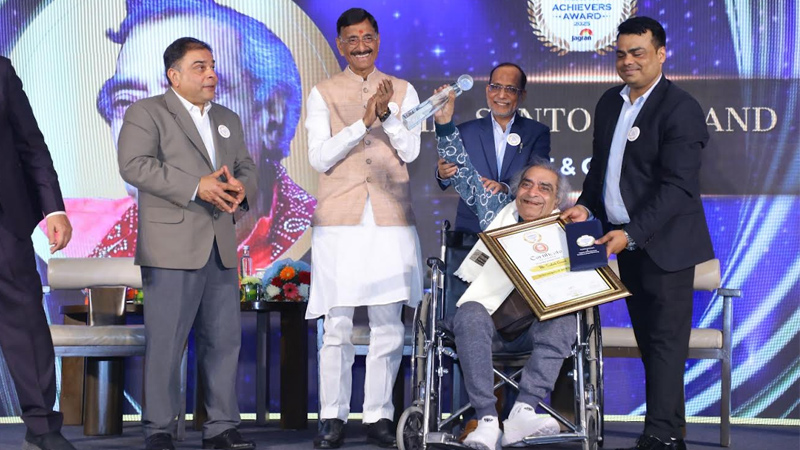
The cultural spotlight fell on veteran lyricist and poet Santosh Anand, whose songs have echoed across generations of Hindi cinema. At 97, Anand accepted the honour with characteristic humility, reflecting on a life shaped by perseverance and hope.
Healthcare honours spanned both modern and traditional systems. Manoj N. Nesari was recognised for strengthening Ayurveda’s place in national and global health frameworks. Padma shri Mohammed Abdul Waheed was honoured for his research-backed work in Unani medicine, while padma shri Mohsin Wali received recognition for his long-standing contribution to patient-centred care.
Education and social development also featured prominently. Padma shri Zahir Ishaq Kazi was honoured for decades of work in education, while former Meghalaya superintendent of Police T. C. Chacko was recognised for public service. Goonj founder Anshu Gupta received an award for his dignity-centred rural development initiatives, and the Hunar Shakti Foundation was honoured for empowering women and young girls through skill development.
The Lifetime Achievement Award went to former IAS officer Shailaja Chandra for her long career in public healthcare and governance, particularly in the traditional systems under Ayush.
Speaking at the event, Hamdard chairman Abdul Majeed said the awards were a tribute to those who combine excellence with empathy. “These awardees reflect Hakeem Sahib’s belief that healthcare, education and public service must ultimately serve humanity,” he said.
Minister Seth struck a forward-looking note, saying India’s young population gives the country a unique opportunity to become a global destination for learning, health and wellness by 2047.
The ceremony also featured the trailer launch of Unani Ki Kahaani, an upcoming documentary starring actor Jim Sarbh, set to premiere on Discovery on 11 February.
Instituted in memory of Unani scholar and educationist Hakeem Abdul Hameed, the awards have grown into a national platform that celebrates those building a more inclusive and resilient India. For one evening at least, the spotlight was not just on success, but on service with substance.






