News Broadcasting
UK pubcasters spending less on children’s, religious programming


MUMBAI: From 1998 – 2003, the five main terrestrial channels in the UK reduced their spend on arts, children’s, religion and educational programmes.
This data is contained in a report published by UK’s telecommunications regulatory body Ofcom. The report has put out the findings of the first phase of its review of the country’s public service television broadcasting.
The review has been structured in three phases and will be completed in December this year.

The report has examined the effectiveness of the main terrestrial channels in the UK – BBC One, BBC Two, ITV1 Channel 4 and Five.
The study also found that expenditure on programming across the five main terrestrial television channels excluding films and sport increased by eight per cent. The spending on news and drama rose by 13 per cent and 16 per cent respectively.
There has also been a narrowing of range within genres like drama and factual programming. Specialist programmes on topics such as arts and current affairs were pushed to the edges of peak viewing hours. While innovative approaches to programme formats were developed, the number of new titles launched each year fell during this five year period.
Television viewers in the UK feel that there is a lack of innovation and originality on the above mentioned channels, says the study. They are in favour of competition between the main terrestrial channels for improving the content quality.
In this scenario, it is not surprising to find that these channels have seen their channel share erode over the years. The audiences for more challenging types of programming fell sharply in the multichannel homes.
The channels’ audience share declined from 87 per cent to 76 per cent of total viewing. In multichannel homes their audience share started lower and declined from 63 per cent to 57 per cent during the past five years
Ofcom senior partner Ed Richards who is leading the review was quoted in a company release saying, “Viewers have made it clear that public service broadcasting matters. But there are also real issues to overcome, both today and in the future.
” Public service broadcasting will only be sustainable if it produces challenging and popular programming. This has to reach a significant audience in the digital age.”
Ofcom has made a few suggestions. They include:
1. Achieving digital switchover should be of high priority. This should be given preference over more marginal public service broadcasting obligations.
2. As far as the BBC is concerned, Ofcom said that it needed to reaffirm its position as the standard setter for delivering the highest quality public service broadcasting.
3. The central components of public service broadcasting on ITV1 and Five should be news, regional news and original production.
4. The channels should also examine the different means of sharing existing funding. This will include allowing broadcasters to bid for public service broadcasting funding.





News Broadcasting
Network18 channels lead YouTube news viewership in March 2026
CNN-News18, News18 India and CNBC channels top categories with record views
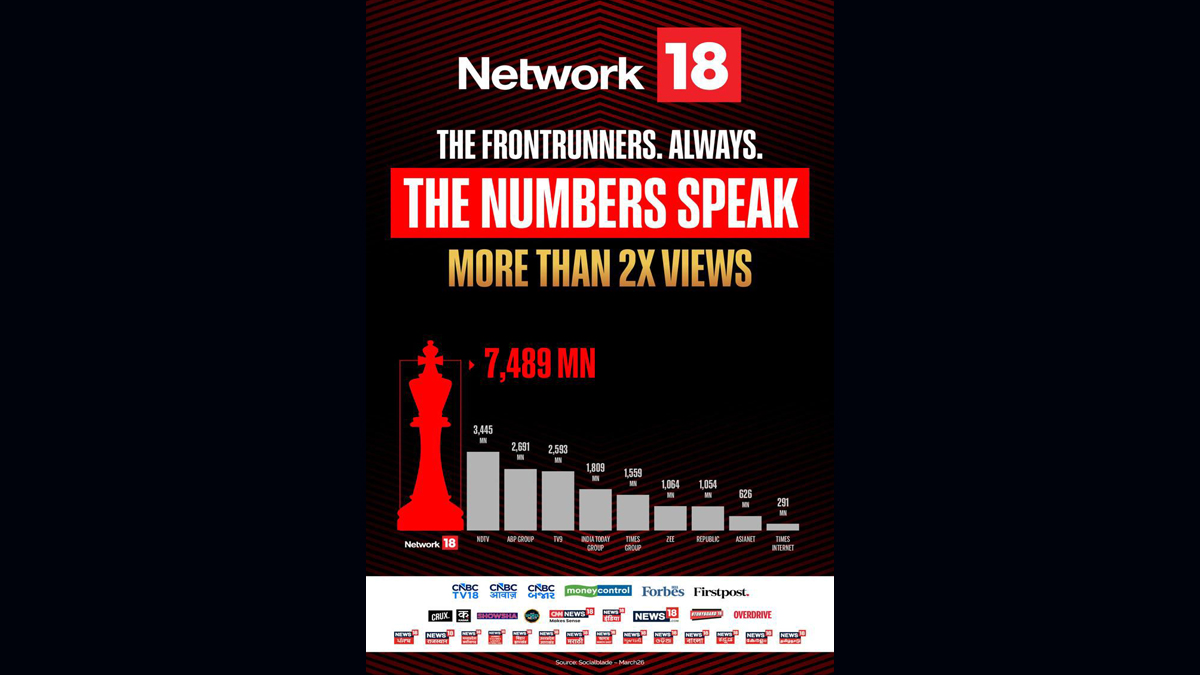
MUMBAI: When the world hit refresh on breaking news, Network18’s channels were already streaming ahead. As geopolitical tensions and war-driven headlines fuelled a surge in global news consumption, the network’s digital playbook delivered big clocking record Youtube viewership across English, Hindi and business news categories in March 2026.
At the forefront was CNN-News18, which emerged as the clear leader in the English news segment with 130 million live and video-on-demand views. The channel edged past competitors such as Times of India (126.5 million), Times Now (101.1 million), India Today (88.2 million) and NDTV (77.5 million), according to Databeings data for March.
In the Hindi news arena, News18 India delivered a commanding performance, racking up a staggering 3,297 million views on YouTube. The channel comfortably outpaced NDTV India, which recorded 3,119 million views, underlining its deep reach and consistent engagement with mass audiences, as per Playboard data.
The network’s dominance wasn’t confined to general news. In the Hindi business segment, CNBC Awaaz topped the charts with 92 million views, narrowly ahead of Zee Business (90 million) and well ahead of ET Now Swadesh (57 million). Meanwhile, its English counterpart CNBC-TV18 posted a strong 58 million views, reinforcing the network’s cross-category strength.
The spike in viewership reflects a broader shift in audience behaviour, with viewers increasingly turning to digital platforms particularly Youtube for real-time updates and in-depth coverage during high-intensity news cycles. For Network18, the numbers signal more than just scale; they underline the effectiveness of a multi-platform strategy that blends speed, credibility and continuous coverage.
In a month where the news never paused, it seems viewers chose to stay tuned where the stream never stopped.






