Cable TV
UK minister for culture, media, sport Jowell lays emphasis on India UK film co-production treaty


MUMBAI: A film co-production treaty between India and the UK was signed last year. 10 films are expected to be made in the first year..
This announcement was made Britain’s secretary of state, department of culture, media and sport Tessa Jowell at Frames. “Last year, I signed the main body of the Indo-UK co-production treaty. The treaty will enable both our film industries to take fuller advantage of the new opportunities of the digital age.
“We estimate that in the first year around 10 films would be made. This will benefit UK and India by around 155 million pounds. Cineworld cinemas in the UK are showng Indian films. There were 2.6 million visitors to Hindi films in the UK last year. Indian films accounted for 16 per cent of all releases in the UK last year, taking in 12 million pounds at the UK box office last year.

“The treaty will benefit both nations’ creative skill sets. There will be creative and technical collaborations from film festivals and marketing to production management services and the sale of cinematography equipment. It has been fantastic to the UK Film Council distribution and exhibition Fund to support The Rising. Veer Zaara took in 2.3 million pounds at the UK box office.
“We have just completed a White Paper on the BBC where a key theme is bringing the world to UK and UK to the world. Coupled with developments in the BBC Asian Network and the Window of Creative Competition which will open BBC production to a wider range of creative talent, we will surely see further collaboration between the two cultures and countries.”
She noted that this kind of progress is important not just in the film contest but as part of the UK government’s aim to nurture the creative sector. “The global market value of creative industries has increased from $831 billion in 2000 to $1.3 trillion in 2005. This represents more than seven per cent of the total GDP. In the UK creative business contributes 11.4 billion pounds to our trade balance. This is one pound in ever 12 pounds in our GDP. My job is to ensure that the creative sector is the first to benefit from the economic changes wrought by globalisation. For the film industry we know that digital technology is enabling better production, distribution and access.
“It is starting to fully examine the potential of this new technology in the ciontext of games, animation, individual and producer platforms as well as providing opportunities for areas like multiplex development.
Indian innovation is making waves across the world being the first to stream a film on mobile for instance,” said Jowell.
Jowell says that the UK government is encouraging the creative sectors to work together and share best practice and skills. “We have encouraged the BBC to work with organisations like Visit Britain and the Tate galleries. We have recently launched a flagship Creative Economy programme which is getting together luminaries from the creative sectors of film, music, fashion, advertising, publishing and computer games.”
The result, Jowell says, is that the UK is seeing regional clusters of creative business. In the film industry, the UK is seeing investment in regional production firms, visual effects firms, post production houses and film financiers.




Cable TV
Hathway Cable appoints Gurjeev Singh Kapoor as CEO
Leadership change comes as cable TV faces shrinking subscriber base and modest earnings pressure
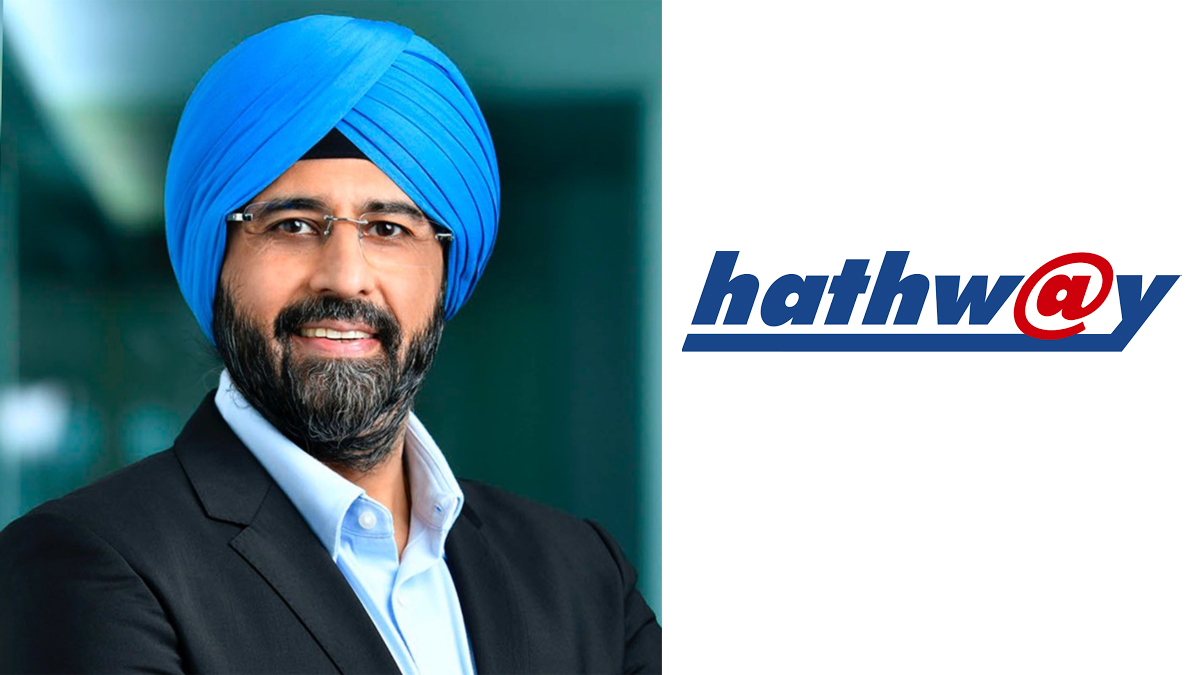
MUMBAI: Hathway Cable and Datacom has tapped industry veteran Gurjeev Singh Kapoor as chief executive officer, marking a leadership pivot at a time when India’s cable television business is under mounting strain.
Kapoor will take over from Tavinderjit Singh Panesar, who is set to retire in August after a long innings with the company. Panesar, chief executive since 2023, has held multiple leadership roles at Hathway, including his latest stint beginning in 2022.
Kapoor brings more than three decades of experience in media and entertainment. He most recently led distribution at The Walt Disney Company’s Star India business, now part of JioStar. His career spans television distribution and affiliate partnerships, with stints at Sony Pictures Networks India, Discovery Communications and Zee Entertainment.
Panesar, with over three decades in the industry, has worked across strategic planning, distribution and business development in media, broadcasting and manufacturing. His past associations include ESPN Star Sports, Star India, Apollo Tyres and JK Industries.
The transition lands as the cable sector grapples with structural disruption. Traditional operators are losing ground to streaming platforms, while telecom and broadband players tighten the squeeze with bundled offerings.
An EY report estimates India’s pay-TV base could shrink by a further 30 to 40 million households by 2030, taking the total down to 71 to 81 million. The slide follows a loss of nearly 40 million homes between 2018 and 2024, a contraction that has already wiped out more than 37,000 jobs in the local cable operator ecosystem.
Hathway’s numbers reflect the strain. The company reported a consolidated net profit of Rs 93 crore for FY25, down from Rs 99 crore a year earlier. Revenue inched up to Rs 2,040 crore from Rs 1,981 crore. As of December 2025, it had about 4.7 million cable TV subscribers and roughly 1.02 million broadband users.
Kapoor steps in with a familiar brief but a shrinking playbook. In a market where viewers are cutting cords faster than companies can reinvent them, the new chief executive inherits a business fighting to stay plugged in.







