News Broadcasting
UK leads in digital television viewing: Ofcom

MUMBAI: Latest data from UK regulator Ofcom shows that the UK has the highest digital penetration of any country in the world. As of 31 December 2005 digital television was viewed by just under 70 per cent of all UK television households, up from 65.9 per cent in the previous quarter. Ofcom is now predicting 100 per cent digital TV penetration by 2012 (across all platforms – satellite, cable and terrestrial).
The Communications Market: Digital TV Progress Report for the fourth quarter of 2005 is published by Ofcom. It examines data provided by the main digital television platform providers for the October-December 2005 period.
Preliminary sales figures of Freeview (Digital Terrestrial Television or DTT) set top boxes suggest that by the end of February 2006, digital penetration had exceeded 70% of UK homes. Take up varies across the UK and has not passed the 50% mark in any other European country.

Digital satellite is now the UK’s most popular television platform. For the first time, there are now more digital satellite subscribers in the UK than there are homes watching analogue terrestrial-only TV, as a result of continued growth in BSkyB’s subscriber base and large numbers of households switching from analogue terrestrial television to digital terrestrial services.
In the year 2005, more than 2.7 million additional households began viewing digital television for the first time – more than in any previous year. By 31 December 2005, the total number of households viewing digital television services on at least one TV set in the home stood at 17.5 million. The report also reveals that almost one in four UK adults live in homes where all TV sets are now used for digital television viewing and viewing of analogue television services has ceased entirely.
Quarterly DTT sales DTT sales DTT sales
Q3, 2005 Q4, 2005
Freeview set top boxes 826,300 1,527,600
IDTV’s 196,000 402,200
Total sales 1,022,300 1,929,800
Source: Q4 sales figures, Gfk
Cumulative total DTT boxes DTT total DTT total
Q3, 2005 Q4, 2005
Freeview set top boxes 7,214,700 8,742,300
IDTV’s 1,411,100 1,813,300
ITV Digital set top boxes 289,000 250,000
Total digital terrestrial units in market 8,914,800 10,805,600
Source: Ofcom, Gfk
Other highlights from the Ofcom data:
” By the end of 2005, just under one in four homes had fully converted all their analogue TV sets to digital (either by adding a set top box or by upgrading to an integrated digital TV set (IDTV) – up from 16% in March 2005. Sales of IDTVs doubled between Q3 and Q4 2005, from around 200,000 to 400,000, to reach a total installed base of 1.8 million (see tables below). That means that almost 60% of all UK TV sets (36 million) still receive analogue transmissions.
” There are currently an estimated 34 million VCRs in use in the UK. Those that viewers use for recording one programme while watching another amount currently to around 25% of VCRs (7.5 million recorders) and will need to be replaced by personal video recorders (PVRs) if viewers wish to retain this functionality following switchover. By the end of 2005, around 1.4 million PVRs had been sold (mostly Sky+ boxes) and 2.3 million DVD recorders. Most of the latter do not have integrated digital tuners, however, and cannot replicate the full functionality of analogue VCRs.
” Ofcom’s new forecasts suggest that digital take-up will continue to grow steadily over the next few years, as switchover starts to take place on a region-by-region basis. It expects digital penetration to grow by around 1.7 million homes in 2006, and on average by around one million homes per year thereafter, until 2012. That means that 85% of homes will have taken up digital TV by the time the first region (Border) switches over in the second half of 2008. By the end of 2010, Ofcom estimates that 95% of households will have taken up digital TV. Penetration will reach 100% by the end of 2012, by the time analogue television is due to be switched off.





News Broadcasting
India Today Group sweeps top honours at Ramnath Goenka Awards
Journalists recognised for fearless investigative and civic reporting.
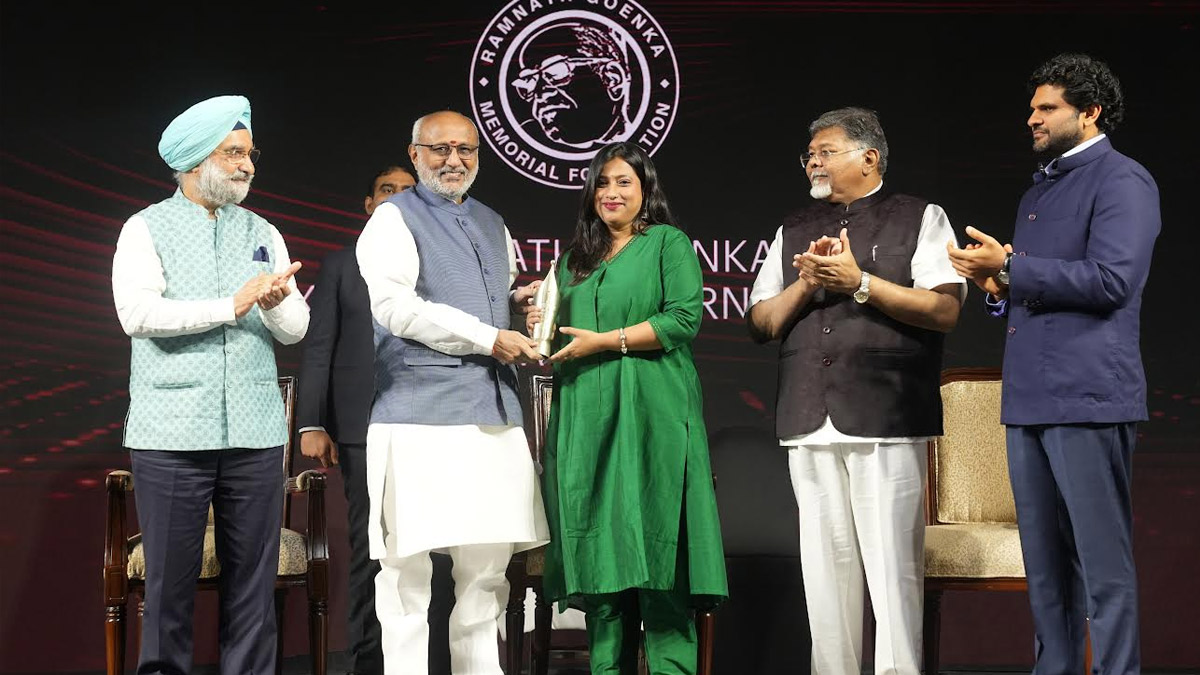
MUMBAI: India Today Group just turned the Ramnath Goenka Awards into its own trophy cabinet because when your reporters dig this deep, even the judges have to award a clean sweep. India Today Group journalists have secured multiple top honours at the latest edition of the prestigious Ramnath Goenka Excellence in Journalism Awards, reinforcing the network’s legacy as the gold standard of Indian journalism. The awards were conferred by vice president C. P. Radhakrishnan at a ceremony held on 27 March 2026.
Sreya Chatterjee won in the ‘Investigative Reporting – Broadcast’ category for her powerful India Today TV report ‘Operation Illegals: The Alarming Rise in Bangladeshi Infiltration Across India’s Fragile Eastern Frontier’. The investigation stood out for its depth, on-ground rigour and national relevance.
In the ‘Civic Journalism – Print/Digital’ category, Sreya Chatterjee along with Arvind Ojha were honoured for their indiatoday.in report on unregulated water extraction and the ‘Tanker Mafia’ in Delhi’s Bawana Industrial Area. The story exposed critical systemic gaps and environmental challenges affecting daily life.
Additionally, aajtak.in was recognised in the ‘Investigative Reporting – Print/Digital’ category for its hard-hitting exposé ‘The Surrogate Mother Market’, which highlighted the human, legal and ethical dimensions of the surrogacy ecosystem.
India Today Group emerged as the only network honoured in Investigative Journalism across both Print/Digital and Broadcast categories. The wins reflect the strength of its multi-platform newsroom and its unwavering commitment to credible, high-impact reporting that informs public discourse and drives accountability.
In an era when speed often trumps substance, these awards remind us that the most powerful stories are still the ones dug out with courage, told with clarity, and delivered with conscience, one fearless byline at a time.








