News Broadcasting
Twenty years and counting, CNN News18 still makes sense

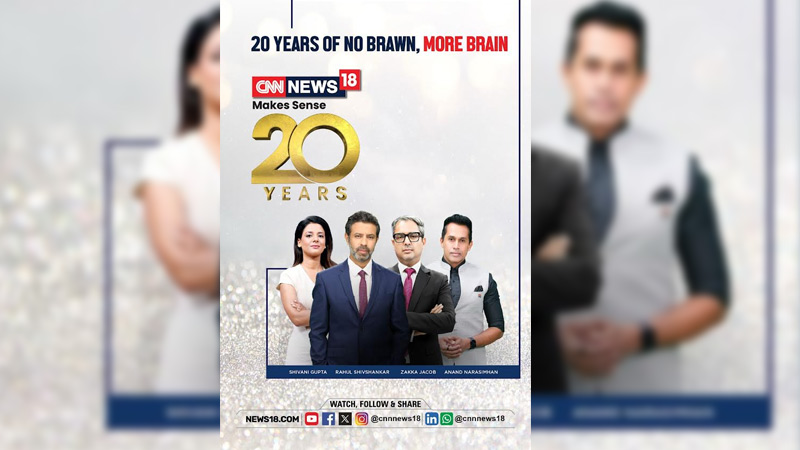
MUMBAI: If news had a memory, CNN News18 would be one of its longest running conversations. As the English news channel completes 20 years on air, it steps into its third decade with a familiar promise intact delivering news that cuts through the clutter and, quite simply, makes sense.
Launched in 2005, the channel has grown alongside a rapidly changing media landscape, balancing breaking news with depth, perspective and global context. Its long standing collaboration with CNN continues to bring international reporting into Indian living rooms, while keeping domestic stories firmly rooted in citizen first journalism.
That philosophy has translated into consistent viewership leadership. Since the resumption of BARC ratings in March 2022, CNN News18 has held on to the top position week after week, particularly during key news hours and major national moments when audiences look for clarity rather than cacophony.

Earlier this year, the channel refreshed its on screen identity with a cleaner, more immersive design built on the idea of One Screen, One Form, One Stream. The shift favours stronger visuals and fewer words, allowing stories to breathe while ensuring the content travels seamlessly across television and digital platforms.
Reflecting on the milestone, CNN News18 editorial affairs director Rahul Shivshankar said the channel’s journey has been driven by a focus on accuracy and restraint. The aim, he noted, has always been to deliver news without noise and engage viewers with sharp, credible journalism.
Network18 CEO of english and business news Smriti Mehra described the 20 year mark as a reflection of trust earned over time. She added that the channel would continue to innovate while holding firm to the fundamentals of responsible journalism.
With a strong newsroom, an expanding digital footprint and an emphasis on data led and immersive storytelling, CNN News18 enters its next chapter much as it began two decades ago intent on explaining the world, not shouting about it.






News Broadcasting
Network18 channels lead YouTube news viewership in March 2026
CNN-News18, News18 India and CNBC channels top categories with record views
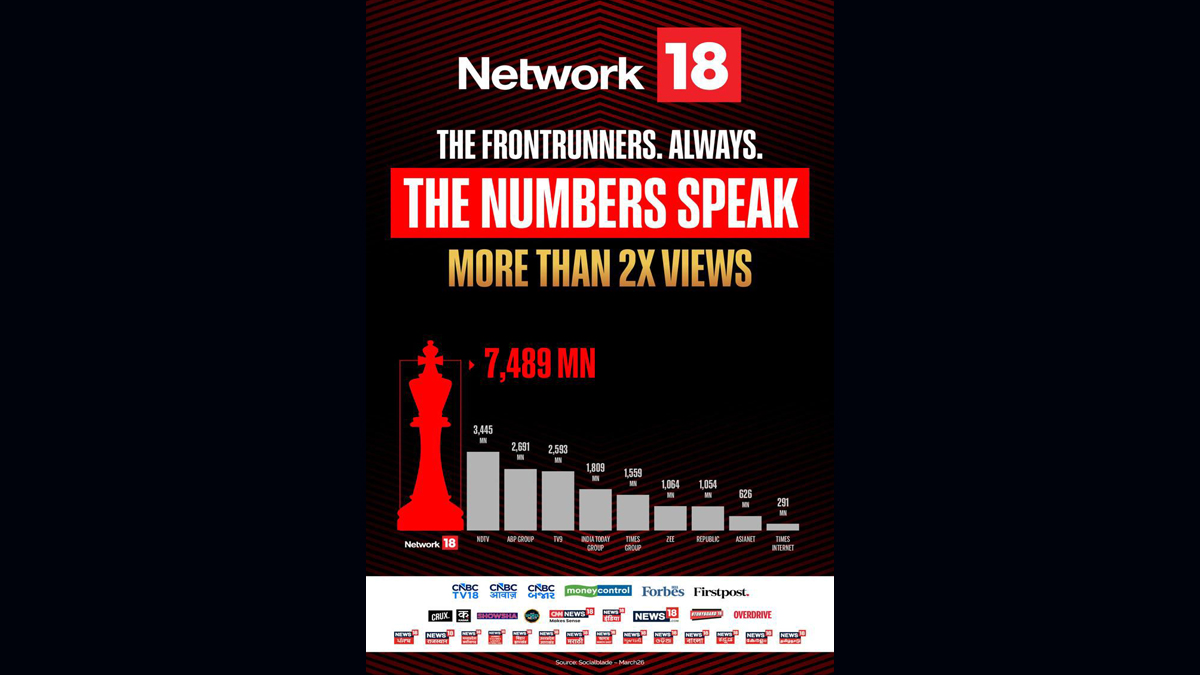
MUMBAI: When the world hit refresh on breaking news, Network18’s channels were already streaming ahead. As geopolitical tensions and war-driven headlines fuelled a surge in global news consumption, the network’s digital playbook delivered big clocking record Youtube viewership across English, Hindi and business news categories in March 2026.
At the forefront was CNN-News18, which emerged as the clear leader in the English news segment with 130 million live and video-on-demand views. The channel edged past competitors such as Times of India (126.5 million), Times Now (101.1 million), India Today (88.2 million) and NDTV (77.5 million), according to Databeings data for March.
In the Hindi news arena, News18 India delivered a commanding performance, racking up a staggering 3,297 million views on YouTube. The channel comfortably outpaced NDTV India, which recorded 3,119 million views, underlining its deep reach and consistent engagement with mass audiences, as per Playboard data.
The network’s dominance wasn’t confined to general news. In the Hindi business segment, CNBC Awaaz topped the charts with 92 million views, narrowly ahead of Zee Business (90 million) and well ahead of ET Now Swadesh (57 million). Meanwhile, its English counterpart CNBC-TV18 posted a strong 58 million views, reinforcing the network’s cross-category strength.
The spike in viewership reflects a broader shift in audience behaviour, with viewers increasingly turning to digital platforms particularly Youtube for real-time updates and in-depth coverage during high-intensity news cycles. For Network18, the numbers signal more than just scale; they underline the effectiveness of a multi-platform strategy that blends speed, credibility and continuous coverage.
In a month where the news never paused, it seems viewers chose to stay tuned where the stream never stopped.






