News Broadcasting
TVC launches 24-hour shopping channel

MUMBAI: TVC a leading brand in direct selling and a pioneer of teleshopping in India has launched TVC Online, a 24 hour dedicated teleshopping channel.
This is part of an ambitious expansion initiative undertaken by TVC Sky Shop.
TVC Online, a free to air digital channel, has a round-the-clock schedule. The telecast will be on a 12 + 12 hours cycle. TVC has 100 odd products in their collection, which they want to promote through the newly launched channel.Briefing the press, TVC chairman Vinod Agarwal informed that the company would be continuing their telecasts in other channels as well.

“We will be continuing with our schedules in other channels. We need some time to establish the TVC channel in the market,” Agarwal said.
Talking to Indiantelevision.com, Agarwal said the company is expecting a three-fold increase in their turnover with the launch of the channel. Agarwal put the company’s present turnover at Rs 500 million. He added that the channel would be viewed in 5 crore houses across India within the next two months.
Worldwide, sky shopping generates 100 billion US dollars. But in India, the industry is yet to catch up. Agarwal attributed this phenomenon to the country’s consumer culture.
“Indians are different customers. They like to feel and touch the product before buying. The middleclass is very particular about it,” said Agarwal. “The strategy TVC has adopted to tackle this is by opening 74 stores across India where people can come, see the product, touch, feel and then buy,” offered Agarwal.
In Mumbai, TVC has opened seven stores. TVC officials reiterated their priority as customer satisfaction. Agarwal pointed out that there was no question of ‘queries unanswered’ as TVC has developed a round-the-clock call center.
“We started with four people and now we have a team of 200 plus,” informed Nerula.
Agarwal expressed his hope that India would also follow the US example by adopting the sky shopping culture at a fast rate.
“We have to set the standards for the industry,” he said.
Regarding the price range TVC is offering, Agarwal said they had reduced the prices as the focus is on volume sale than target marketing.
TVC president marketing MS Nerula said with the people following a hectic life schedule, the significance of a 24-hour shopping channel has acquired immense dimensions.
“Internet shopping could only appeal to a limited section of our society as the common man was not computer savvy. But a 24 hour tele-shopping channel has great potential because television has become a popular media,” commented Nerula.
TVC executive director said that TVC would bring innovative products at affordable prices, as Indians are very particular about prices. Samtani claimed that TVC had five lakhs of satisfied customers.
“We are here for a long run and we are in the diver’s seat. We want to develop the retail industry,” Samtani said.
TVC officials expressed their willingness to carry the advertisements of other brands, which are not part of TVC, in the channel. “We welcome all and we are open to the possibilities of carrying advertisements of external brands,” offered Samtani.
Samtani defended the decision to hire stars to promote the products. “Nowadays, all the reputed brands have stars endorsing them, then why TVC can’t?” queried Samtani in a lighter vein.
TVC has roped in Jackie Shroff, Divya Dutta, Anu Kapoor and Mrinal Kulkarni to endorse the TVC products.
When asked how they were expecting the audience to sit through 25 or 30 minutes of product information telecast per product, Agarwal explained that, establishing their products in people’s minds would need time, as they are new in Indian market.
“You can’t compare them with the market’s top brands who need just 30 seconds of ad time. We don’t have brands and so our products will need more time, naturally.”
Agarwal told Indiantelevision.com that TVC had no prime time schedule as the 24-hour channel is running in two cycles of 12 hours repeat telecasts.
“TVC is targeting the whole society. This will help people to watch the channel at their convenience. A housewife might opt to watch the channel in the afternoon. Kids might watch it in the morning. The working class will be watching it in the evening,” pointed out Agarwal.
Details of TVC channel frequency:
1. Up Linking Frequency : 6570 Mhz
2. Down Link Frequency : 3545 Mhz
3. FEC : ¾
4. Symbol Rate : 26.667
5. Polarization U/L : Horizontal
6. Polarization D/L : Vertical
7. Satellite : Thaicom 3
8. Orbital : 78.5 Deg east





News Broadcasting
Network18 channels lead YouTube news viewership in March 2026
CNN-News18, News18 India and CNBC channels top categories with record views
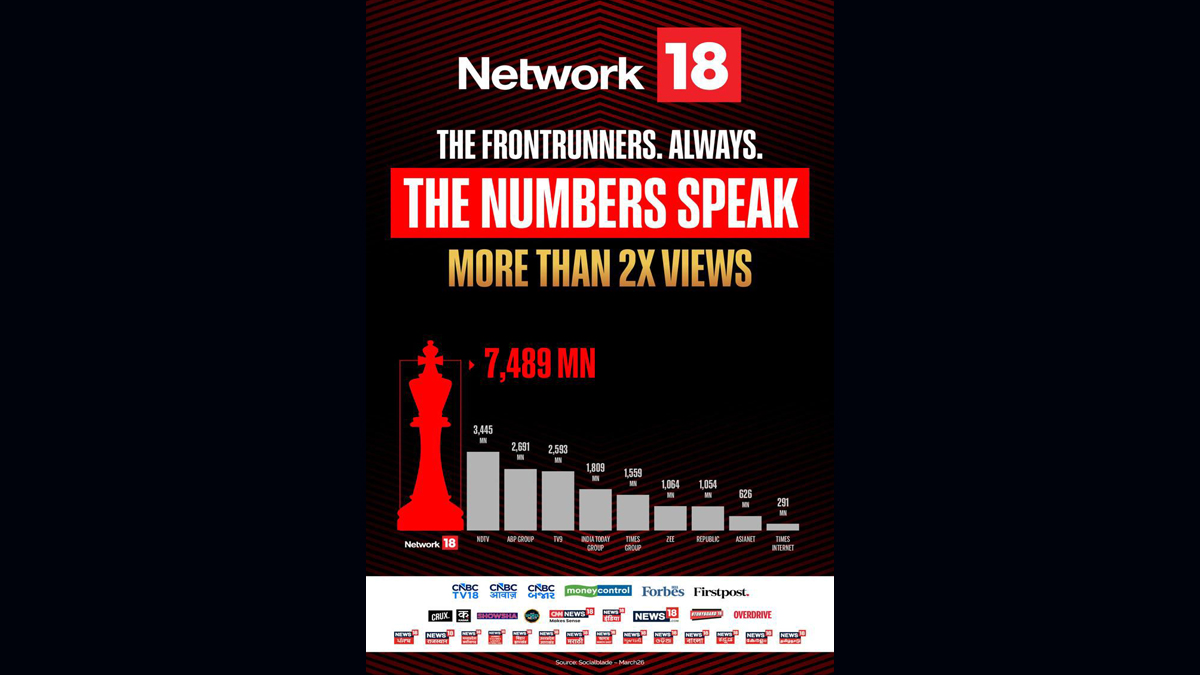
MUMBAI: When the world hit refresh on breaking news, Network18’s channels were already streaming ahead. As geopolitical tensions and war-driven headlines fuelled a surge in global news consumption, the network’s digital playbook delivered big clocking record Youtube viewership across English, Hindi and business news categories in March 2026.
At the forefront was CNN-News18, which emerged as the clear leader in the English news segment with 130 million live and video-on-demand views. The channel edged past competitors such as Times of India (126.5 million), Times Now (101.1 million), India Today (88.2 million) and NDTV (77.5 million), according to Databeings data for March.
In the Hindi news arena, News18 India delivered a commanding performance, racking up a staggering 3,297 million views on YouTube. The channel comfortably outpaced NDTV India, which recorded 3,119 million views, underlining its deep reach and consistent engagement with mass audiences, as per Playboard data.
The network’s dominance wasn’t confined to general news. In the Hindi business segment, CNBC Awaaz topped the charts with 92 million views, narrowly ahead of Zee Business (90 million) and well ahead of ET Now Swadesh (57 million). Meanwhile, its English counterpart CNBC-TV18 posted a strong 58 million views, reinforcing the network’s cross-category strength.
The spike in viewership reflects a broader shift in audience behaviour, with viewers increasingly turning to digital platforms particularly Youtube for real-time updates and in-depth coverage during high-intensity news cycles. For Network18, the numbers signal more than just scale; they underline the effectiveness of a multi-platform strategy that blends speed, credibility and continuous coverage.
In a month where the news never paused, it seems viewers chose to stay tuned where the stream never stopped.






