News Broadcasting
TVB 8 and TVB Xing He join AsiaSat 3S


HONG KONG: TVB 8 and TVB Xing He Channel have begun broadcasting on AsiaSat 3S.
An official release informs that with AsiaSat 3S TVB’s two 24-hour Mandarin language satellite channels’, the coverage will extend to all cable TV operators and more than 1.2 billion Chinese viewers across the satellite’s footprint covering over 50 countries and regions in Asia, the Middle East, Australasia and the C.I.S.
TVB 8 and TVB Xing He Channel are operated by Hong Kong-based TVB Satellite Broadcasting Limited (TVBSB), a subsidiary of Television Broadcasts Limited (TVB). TVB 8 carries a diverse mix of entertainment, infotainment and music programmes while TVB Xing He Channel offers a wide selection of top-rated classical and modern dramas.

The channels are available on AsiaSat 3S in C-band with the following reception parameters:
Transponder: 13H;
Frequency: 4109.5 MHz;
Polarisation: Horizontal;
Modulation: QPSK;
Symbol Rate: 11.23 Msym/sec;
FEC: 3/4 .
AsiaSat 3S is a Boeing 601HP satellite, with 28 C-band and 16 Ku-band linearised transponders and an estimated 16-year operational life. The C-band footprint of AsiaSat 3S covers over 50 countries and regions in Asia, the Middle East, Australasia and the Commonwealth of Independent States. The Ku-band coverage consists of two high powered fixed beams serving East Asia and South Asia, as well as an in-orbit steerable beam now positioned over Australia.
AsiaSat 3S currently broadcasts over 70 television channels, including those from SABe TV, Sahara TV, Star, Sun TV and Zee Network in India.







News Broadcasting
Network18 channels lead YouTube news viewership in March 2026
CNN-News18, News18 India and CNBC channels top categories with record views
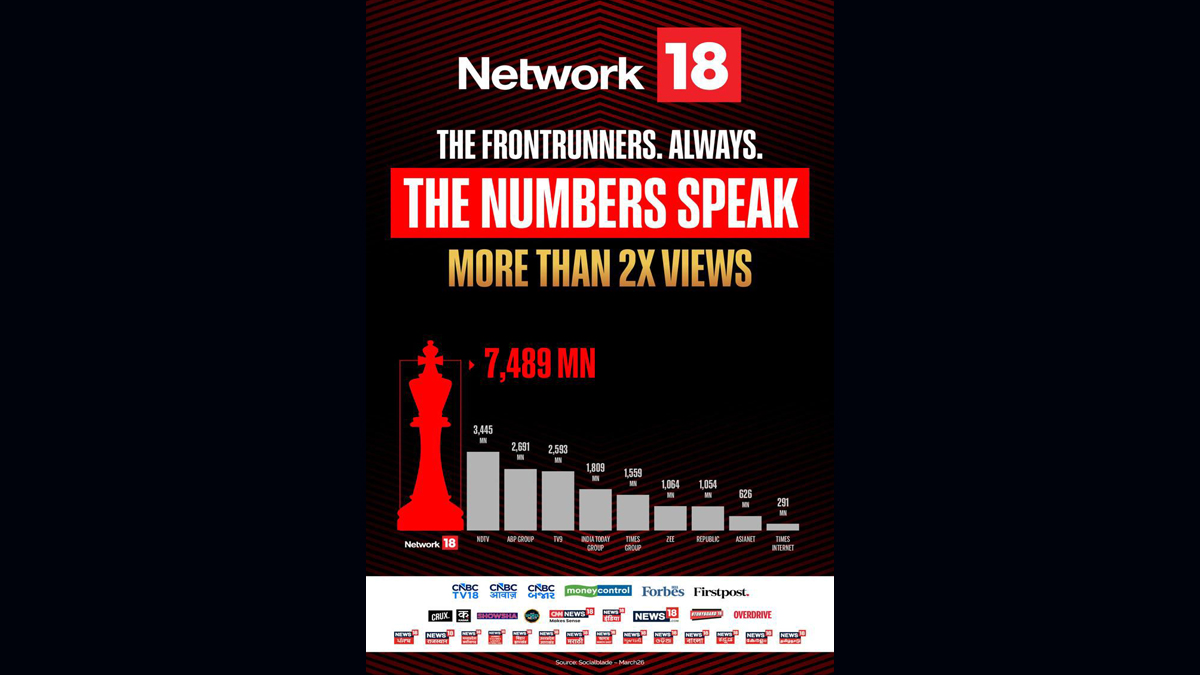
MUMBAI: When the world hit refresh on breaking news, Network18’s channels were already streaming ahead. As geopolitical tensions and war-driven headlines fuelled a surge in global news consumption, the network’s digital playbook delivered big clocking record Youtube viewership across English, Hindi and business news categories in March 2026.
At the forefront was CNN-News18, which emerged as the clear leader in the English news segment with 130 million live and video-on-demand views. The channel edged past competitors such as Times of India (126.5 million), Times Now (101.1 million), India Today (88.2 million) and NDTV (77.5 million), according to Databeings data for March.
In the Hindi news arena, News18 India delivered a commanding performance, racking up a staggering 3,297 million views on YouTube. The channel comfortably outpaced NDTV India, which recorded 3,119 million views, underlining its deep reach and consistent engagement with mass audiences, as per Playboard data.
The network’s dominance wasn’t confined to general news. In the Hindi business segment, CNBC Awaaz topped the charts with 92 million views, narrowly ahead of Zee Business (90 million) and well ahead of ET Now Swadesh (57 million). Meanwhile, its English counterpart CNBC-TV18 posted a strong 58 million views, reinforcing the network’s cross-category strength.
The spike in viewership reflects a broader shift in audience behaviour, with viewers increasingly turning to digital platforms particularly Youtube for real-time updates and in-depth coverage during high-intensity news cycles. For Network18, the numbers signal more than just scale; they underline the effectiveness of a multi-platform strategy that blends speed, credibility and continuous coverage.
In a month where the news never paused, it seems viewers chose to stay tuned where the stream never stopped.






