News Broadcasting
TV9 Bangla Sharadiya rolls out special program line-ups


Mumbai: Consequent to the newly launched AI tech TV9 Bangla Pujor Gaan, the tagline of TV9 Bangla Sharadiya affirms ‘Shoke Drohe Utsab’. This year the news channel speaks of mourning, rebellion, and celebration which means celebrating victory over evils in society, showcasing empathy, and raising voices for protesting the horrific rape and murder of the young doctor of the RG Kar hospital in Kolkata that has shaken the globe.
According to TV9 Bangla managing editor & business head Amritanshu Bhattacharya, “The mood in the state may be sombre, but that doesn’t seem to have dampened the festive spirit of Durga Puja. This vibrant festival is a celebration of good over evil, and its significance goes beyond its religious roots, embracing social and cultural aspects. Durga Puja is a time for family reunions, community gatherings, and public celebrations. So, keeping in tune with the present mood and emotion of people, puja festivities too will embrace the current mood and passion.”
TV9 Bangla this year highlights a special programme under its puja banner, ‘TV9 Bangla Sharadiya’ taking the contemporary issues of the society.

‘Mayer Pujo Meyer Hatey’ is a special Durga Puja program showcasing selected pujas organized exclusively by women across the city. It will air on TV9 Bangla from 4 to 12 October at 3:30 pm.
‘TV9 Bangla Pujo Somman’ features the sera barowari and sera abason competition, recognizing 237 puja pandals throughout Bengal. This includes nine main categories: ‘sera theme’ (best theme), ‘sera protima’ (best idol), ‘sera poribesh’ (best environment), ‘sera mohila porichalito pujo’ (best women-organized puja), ‘sera barowari’ (best puja committee), ‘sera alonkar’ (best ornaments), ‘sera suraksha’ (best safety), ‘manusher pashe’ (beside common people), and ‘jelar sera puja’ (district pujas). This series will air from 10 to 12 October at 1 pm on TV9 Bangla.
Additionally, TV9 Bangla’s ‘manusher pashe’ initiative supports underprivileged children through partnerships with NGOs to provide essential items. “For TV9 Bangla, puja means another occasion to stand beside and touch upon the lives of the people of Bengal in every possible spirit. The cross-section of people includes the privileged and underprivileged. To touch upon the lives of people TV9 Bangla has tied up with an NGO to put an additional colour and joy. To bring all and one in the warmth of the festive spirit, TV9 Bangla is plying from urban to rural corners of Bengal with the NGO. At the same time, TV9 Bangla remains committed to the present mood of people,” Bhattacharya added.
The sponsors of TV9 Bangla include several partners, co-powered by Tata Ace, with Sriniketan as the wardrobe partner, special partners Sobisco Biscuits & Cakes, Cycle Pure Agarbathi, and Sunrise Pure, and Anjali Jewellers serving as the jewellery partner.





News Broadcasting
Network18 channels lead YouTube news viewership in March 2026
CNN-News18, News18 India and CNBC channels top categories with record views
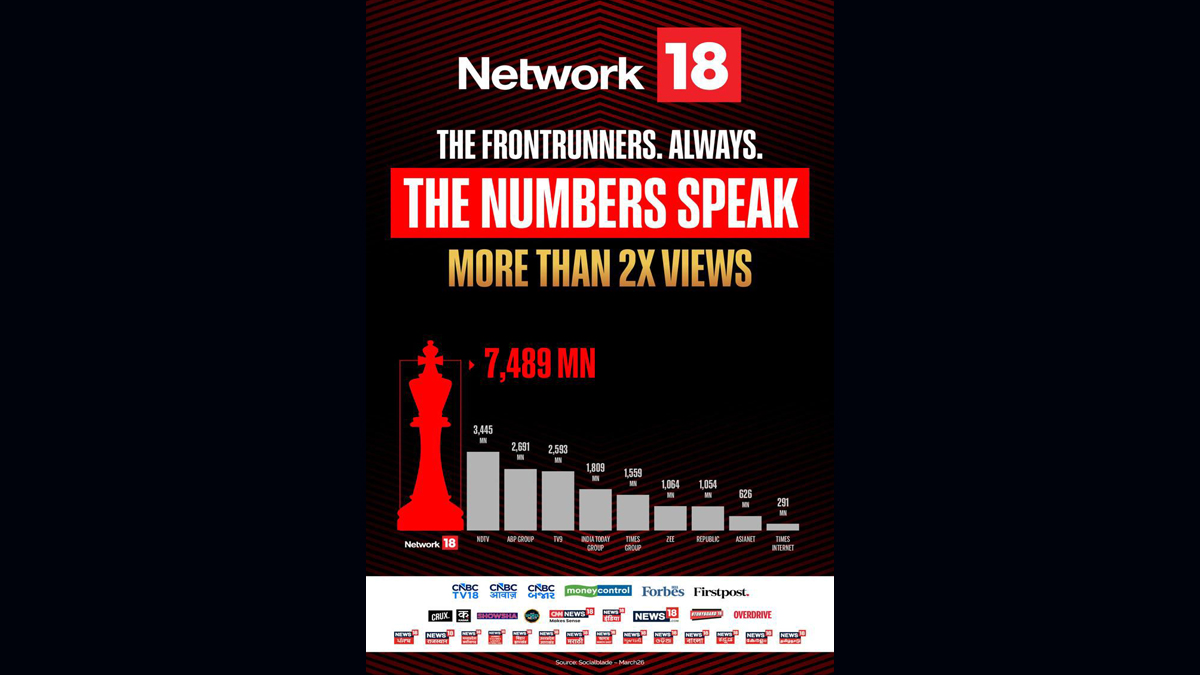
MUMBAI: When the world hit refresh on breaking news, Network18’s channels were already streaming ahead. As geopolitical tensions and war-driven headlines fuelled a surge in global news consumption, the network’s digital playbook delivered big clocking record Youtube viewership across English, Hindi and business news categories in March 2026.
At the forefront was CNN-News18, which emerged as the clear leader in the English news segment with 130 million live and video-on-demand views. The channel edged past competitors such as Times of India (126.5 million), Times Now (101.1 million), India Today (88.2 million) and NDTV (77.5 million), according to Databeings data for March.
In the Hindi news arena, News18 India delivered a commanding performance, racking up a staggering 3,297 million views on YouTube. The channel comfortably outpaced NDTV India, which recorded 3,119 million views, underlining its deep reach and consistent engagement with mass audiences, as per Playboard data.
The network’s dominance wasn’t confined to general news. In the Hindi business segment, CNBC Awaaz topped the charts with 92 million views, narrowly ahead of Zee Business (90 million) and well ahead of ET Now Swadesh (57 million). Meanwhile, its English counterpart CNBC-TV18 posted a strong 58 million views, reinforcing the network’s cross-category strength.
The spike in viewership reflects a broader shift in audience behaviour, with viewers increasingly turning to digital platforms particularly Youtube for real-time updates and in-depth coverage during high-intensity news cycles. For Network18, the numbers signal more than just scale; they underline the effectiveness of a multi-platform strategy that blends speed, credibility and continuous coverage.
In a month where the news never paused, it seems viewers chose to stay tuned where the stream never stopped.






