News Broadcasting
TV Today’s Oye FM up for sale amidst disappointing revenues


BENGALURU/MUMBAI: Entities in the radio business have started to play their cards for survival in the industry. The first one to make the move was Radio City when it entered in an acquisition agreement with Jagran Prakashan. Now, TV Today’s Oye FM is in spotlight.
According to an announcement on the BSE, the Board has approved the sale of the radio FM business, which has seven radio stations operating in Delhi, Mumbai, Kolkata, Jodhpur, Amritsar, Patiala and Shimla.

The corporate announcement stated, “TV Today Network Ltd has informed BSE that the board of directors of the company at its meeting held on 6 February 2015, inter alia, had allotted ESOP as per TVTN Employee stock option plan 2006: Satyaky Chowdhury – 10,500; and Shams Tahir Khan – 7,500.”
It further said, “The Board has approved the sale of Radio FM Business (Seven Radio Stations) and has further authorised a Committee of Directors / senior officials to negotiate the terms and conditions with potential buyers and to execute the sale, subject to requisite Statutory and Regulatory approvals.”
No official information has been circulated amongst Oye FM employees giving details of such a sale. But one of the sources said that Oye FM was pretty much evaluating its position in Phase III auctions along with Oye FM’s migration plans. But with the new announcement there is no clarity as to where they stand for Phase III auctions. Currently, the Information and Broadcasting Ministry is working on making the partial auctions happen as smoothly as possible. The first partial auction of FM radio phase III is for 69 existing cities for 135 channels.
This sale will not be the first for TV Today Network Limited (TVTN). In 2006, TVTN promoter, Living Media, sold the FM radio business under the brand Red FM to a consortium of investors, and later Kalanithi Maran’s Sun Network bought a stake in the company.






News Broadcasting
News18 India launches Command Centre war explainer with Arya
New show shifts from debates to decoding global conflicts and impacts
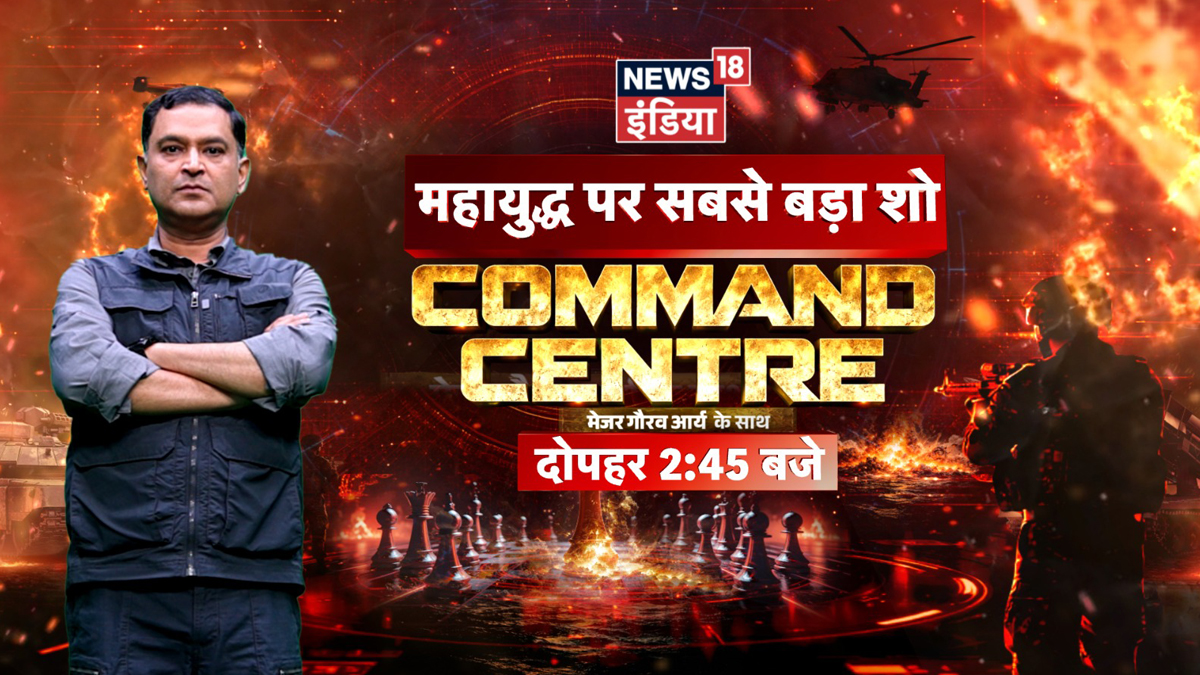
MUMBAI: News18 India has rolled out a new war-focused programme, Command Centre, featuring Gaurav Arya, as it looks to offer viewers a sharper, more grounded take on global conflicts amid rising tensions in West Asia.
Positioned as an “insider war room”, the show moves away from conventional panel debates and instead focuses on explaining military developments, decoding strategy and connecting global events to their everyday impact, from fuel prices to economic shifts.
The format leans heavily on visuals and data. The studio has been designed like a command hub, complete with large LED war maps, real-time graphics and an alert system to track developments as they unfold.
At the centre of it all is Arya, who brings his military background to simplify complex war strategies for viewers. His signature line, “Seedhi baat samjhiye”, anchors the show’s promise of clarity over noise.
News18 India managing editor Jyoti Kamal said, “Command Centre, featuring Major Gaurav Arya is designed to deliver accurate insights and a clear perspective on how evolving conflicts impact everyday life, from household budgets to national security. With expert voices analysing every development in real time, the show goes beyond headlines to decode what’s happening now, what it means, and what could come next.”
Echoing the intent, Gaurav Arya added, “In times of war, confusion is the biggest threat. With News18 India’s Command Centre, we are bringing viewers inside the war room, decoding strategies, tracking every escalation, and explaining, in the simplest terms, what it means for India and for every household. Seedhi baat samjhiye, this is where you understand not just what is happening, but what happens next.”
The weekday show will air in the afternoon slot and will also feature Gaurav Shukla, adding to its editorial depth.
With its mix of analysis, visuals and a clear focus on impact, the show reflects a broader shift in news consumption. Viewers are no longer just watching events unfold, they are looking to understand what those events mean for them.







