News Broadcasting
TV channels can still seek downlink OK: Govt

NEW DELHI: Television channels that have not yet applied for registration under downlink norms in India need not loose heart, though the deadline expired on 11 May 2006.
The government said that a channel can apply for registration in India for re-distribution clearance even after the expiry of the deadline.
However, there is a rider. Those applying for landing rights after 11 May 2006 would not be carried by cable networks legally till the time the government gives it a clearance.
“There’s no bar on TV channels applying for registration still. The only difference being that such channels can only be seen in Indian cable homes once the government clears them, which may take longer time compared to those who applied within the deadline,” an official of the information and broadcasting ministry told Indiantelevision.com today.

Last week, the government had clarified that from 11 May, all TV channels uplinking from outside India and having applied for registration with the government by that date could be carried on cable networks for the next six months or till the time government decides on their applications.
The official explained that a channel applying for registration after the deadline would be given less priority compared to those who made an attempt to adhere to norms within the stipulated time.
The registration process is two-fold. First a TV channel will be registered with the government, which will make it easier for the authorities to monitor errant ones on various counts, including breach of the programming code.
Second, an authorized company, responsible for the actions of a channel beaming into India, will be registered. This entity can either be an authorized distributor of a channel in India or the channel-owning company’s Indian subsidiary.
Now that the deadline for adhering to downlink norms is over, the government will compile the information, including shareholding patterns, provided by various channels and companies and scrutinize their authenticity.
“This task will take some time and that’s why we have indicated a six-month period. The work can be completed earlier also,” the ministry official pointed out.
Conspicuous by their absence are Pakistan TV family of channels, including PTV, Geo TV, the ARY channels and Q TV.
“If they haven’t applied for registration, then their carriage on any (Indian) cable network or a DTH platform (beaming to Indian consumers) would be termed illegal,” the I&B ministry categorically said.
The ministry is also in the process of issuing a notification in this regard, which will amend the Cable TV Act of 1995 and the DTH guidelines to incorporate the features of downlink norms.
“The notification in this regard should be out in a day or two,” the official said. The downlink norms, announced in November 2005, have been termed stringent by many a broadcaster and industry lobbying bodies.
Those TV channels that have got permission to uplink from India will be deemed as registered after furnishing some additional details.
Meanwhile, according to the I&B ministry’s website, a total of 65 TV channels have applied for registration till 11 May.
The channels are Star Utsav, Star Plus, Star World, Star Gold, Star One, Star Movies, Channel V, Deutsche Welle TV, Angel TV, Hallmark Channel, Disney Channel, Toon Disney, Star Vijay, Sony TV, Set Max, Animax, SET Pix, SAB(Sony), AXN, National Geographic Channel (NGC), History Channel, MTV, Nick, Vh 1, MTV2, Ten Sports, Channel News Asia, B4U Music, B4U Movies, Discovery Channel, Discovery Travel & Living, Animal Planet, Zee Studio, Zee Café, Zee Trendz, CNN International, HBO, POGO, Turner Classic Movies, Cartoon Network, Boomerang, TV5 Monde, ESPN Sports, Star Sports, BBC World, Fashion TV, Voyages Television, Miracle Net TV, God TV, Reality TV, ABC Asia Pacific, Zee Arabia, Goal TV-1, Goal TV-2, Zee MGM, Day Star Television, DAN Tamil Ozhi, DAN Cinema, DAN Music, Trace TV, Euro News, Family Entertainment TV, CT Buzz, Raj Musix and Vissa TV.
Indiantelevision.com learns that Essel Shyam, a joint venture between Shyam Electronics and Zee’s parent Essel Group, has applied for registration on behalf of over a dozen of TV channels, most of which are foreign owned.






News Broadcasting
UDF poised to return to power in Kerala, says Manorama-CVoter survey
Massive opinion poll projects shift in Kerala politics ahead of 2026 Assembly elections.
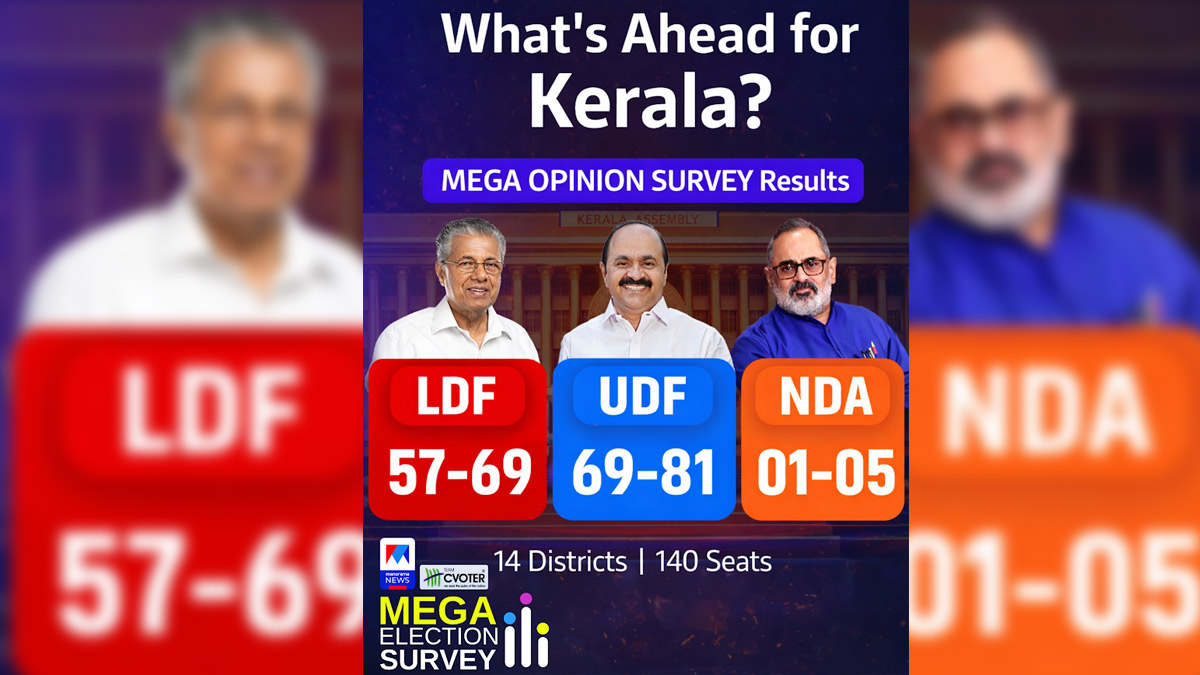
MUMBAI: The winds of change appear to be blowing through Kerala’s political landscape and this time, they seem to favour the United Democratic Front. A comprehensive mega opinion survey conducted by Manorama News in partnership with CVoter projects a potential comeback for the UDF in the upcoming Kerala Legislative Assembly Elections 2026. The survey, covering all 140 constituencies with a massive sample size of nearly 90,000 respondents, predicts the UDF could win between 69 and 81 seats.
The ruling Left Democratic Front (LDF) is expected to secure 57 to 69 seats, a significant drop from the 99 seats it won in the 2021 elections. This would mean the LDF losing 30 to 42 of its sitting seats. Meanwhile, the National Democratic Alliance (NDA), which drew a blank in 2021, is projected to open its account with 1 to 5 seats.
Region-wise, the UDF is expected to make strong gains in Malabar, winning 25 to 34 out of 48 seats, and in Central Kerala, where it could bag 29 to 33 out of 53 seats. In South Kerala, the LDF is likely to retain an edge with 21 to 25 seats, while the UDF may improve to 12 to 16 seats. The NDA could pick up 1 to 3 seats in the southern region.
The survey was conducted between 14 and 26 March 2026, with additional tracker and snap polls carried out from December 2025 to March 2026. A total of 89,693 respondents participated, ensuring representation across all demographics and social segments.
Manorama News has a strong track record of accuracy, with its previous projections closely matching the actual results of the 2019 and 2024 Lok Sabha elections as well as the 2021 Kerala Assembly polls.
In Kerala’s famously fierce political battles, this survey suggests the pendulum may be swinging back. Whether the final verdict matches these numbers or throws up another surprise, one thing is clear, the 2026 Assembly elections are shaping up to be one of the most keenly watched contests in the state’s history.






