Cable TV
Trinity’s tryst with cable biz ends

NEW DELHI: Former Star India distribution head Arun Mohan, who had started a cable TV distribution business in 2003, has shuttered it citing unviable business model.
At the same time, Mohan’s company, AM Trinity Platco Pvt Ltd, is exploring other business options in the television and cable space, including digital delivery of content.
Confirming to Indiantelevision.com that the cable business has been shut down, Mohan said, “We had to get out of the cable business as our initial premises did not work out. CAS, which was a probability in 2003, did not happen.”

Mohan’s company, AM Trinity Platco Pvt. Ltd had stitched a 10-year lease management deal with Delhi’s Punj family-controlled Spectranet, a multi-system operator (MSO) that has also laid fiber optics in certain parts of the city with plans to offer broadband services. The deal was done in 2003.
Pointing out that the company slowly realized the payout to pay broadcasters was more than the earnings through household subscriptions, he admitted, “This made the business unviable.”
Mohan was attempting to build a multi-system operator (MSO) company, starting off with Delhi, in this fragmented and cut-throat Rs. 15,0000 million cable industry.
Trinity’s tryst with distribution came to an end with Mohan formally announcing the decision to the company’s cable-franchisees few days back, subsequent to which the cable ops hitched up with other MSOs and bigger independents.
The MSO that has gained the maximum in the Delhi region is the Hinduja-controlled INCablenet, which is said to have cornered most of the 25,000-odd households and franchisees being serviced by Trinity.
The deal signed with Spectranet entailed Trinity paying a flat monthly fee for usage of former’s infrastructure. Over a period of time, Trinity had acquired about 23 franchisee cable operators, mostly in the up market South and Central Delhi areas.
Spectranet, which started off at a time when the dotcom boom was on and talks of broadband services were being bandied around, has never been a dominant player in Delhi’s cable TV scenario.
Meanwhile, according to Mohan, his company is testing waters in Delhi, Rajasthan and another state with a new business model.
Trinity supplies cable ops in these three states with a free compact disc containing five-hour entertainment mish-mash, including movies.
The cable ops air these programmes on their home video network, while Trinity is trying to convince advertisers to be part of the entertainment package through commercial deals.
“It’s a concept that needs to be marketed aggressively and presently the advertising is just a trickle. But we are hopeful it would pick up,” Mohan admitted.
Trinity has bought the rights of some movies, while snapping up, albeit cheaply, telecast rights of some serials too that were made by a joint venture company promoted by an Indian and Australian media tycoon Kerry Packer.
“Some of these serials have never been aired and we feel they could be marketed,” Mohan said, keeping his faith in the television industry still intact.

Cable TV
Hathway Cable appoints Gurjeev Singh Kapoor as CEO
Leadership change comes as cable TV faces shrinking subscriber base and modest earnings pressure
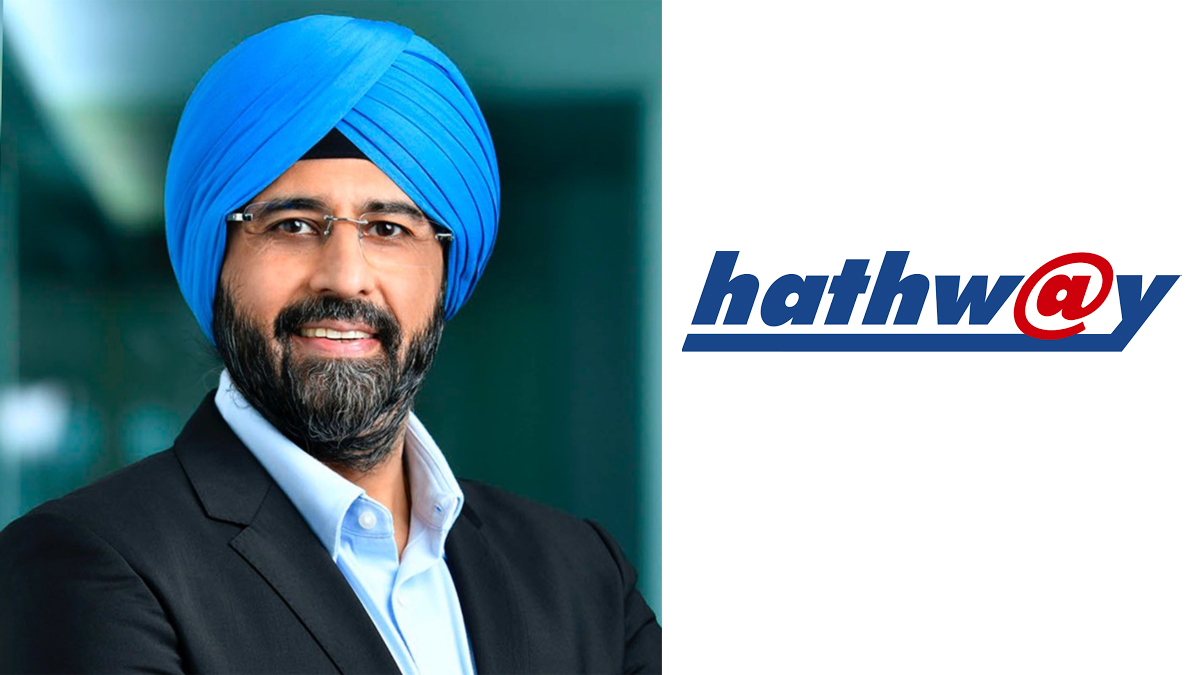
MUMBAI: Hathway Cable and Datacom has tapped industry veteran Gurjeev Singh Kapoor as chief executive officer, marking a leadership pivot at a time when India’s cable television business is under mounting strain.
Kapoor will take over from Tavinderjit Singh Panesar, who is set to retire in August after a long innings with the company. Panesar, chief executive since 2023, has held multiple leadership roles at Hathway, including his latest stint beginning in 2022.
Kapoor brings more than three decades of experience in media and entertainment. He most recently led distribution at The Walt Disney Company’s Star India business, now part of JioStar. His career spans television distribution and affiliate partnerships, with stints at Sony Pictures Networks India, Discovery Communications and Zee Entertainment.
Panesar, with over three decades in the industry, has worked across strategic planning, distribution and business development in media, broadcasting and manufacturing. His past associations include ESPN Star Sports, Star India, Apollo Tyres and JK Industries.
The transition lands as the cable sector grapples with structural disruption. Traditional operators are losing ground to streaming platforms, while telecom and broadband players tighten the squeeze with bundled offerings.
An EY report estimates India’s pay-TV base could shrink by a further 30 to 40 million households by 2030, taking the total down to 71 to 81 million. The slide follows a loss of nearly 40 million homes between 2018 and 2024, a contraction that has already wiped out more than 37,000 jobs in the local cable operator ecosystem.
Hathway’s numbers reflect the strain. The company reported a consolidated net profit of Rs 93 crore for FY25, down from Rs 99 crore a year earlier. Revenue inched up to Rs 2,040 crore from Rs 1,981 crore. As of December 2025, it had about 4.7 million cable TV subscribers and roughly 1.02 million broadband users.
Kapoor steps in with a familiar brief but a shrinking playbook. In a market where viewers are cutting cords faster than companies can reinvent them, the new chief executive inherits a business fighting to stay plugged in.






