News Broadcasting
Trai’s DTH paper stresses on QoS, interconnect


NEW DELHI: The Telecom Regulatory Authority of India (TRAI) just released a Consultation Paper on the issues issues arising out of the provision of the direct-to-home television service.
The Trai paper’s focus is on three issues – interconnect agreements, quality of service standards and technical and commercial interoperability for set top boxes.
On the Interconnection issues, Trai is taking up those relating to standardisation of interconnection agreements and use of the reference interconnect offer methodology. Additionally, issues relating to provision of access to broadcasters, must carry obligations and the related issue of carriage fee are also being taken up.

On the tariff question, the Trai paper remains consistent with the line taken earlier as well by the sector regulator that it will not intervene or regulate matters of pricing of DTH services.
On the subject of quality of service standards, the paper has issues of whether QOS standards for DTH should be mandated.
The other two issues on this subject are
Whether the approach suggested by Trai for the telecom sector where it mandates the details of the grievance redressal machinery – maintenance of call centre, appointment of nodal officers for grievance redressal and establishment of appellate body – can be followed in the case of DTH also.
And whether quality of service standards can be voluntarily evolved by the service provider.
Another major issue is whether technical interoperability of STBs should be retained or whether it should be replaced by commercial interoperability. And then again, if commercial interoperability is to be introduced then what is the manner in which this is to be done.
“Interconnection for DTH is already covered on issues relating to “must provide”. However, the reverse obligations regarding “must carry” as well as issues relating to standardisation of agreements have not yet been addressed and these have been raised in the consultation paper.
“On the quality of service standards, the basic issue is whether these should be mandated and if so, in what manner.
“Finally, the regulatory issues regarding set top boxes focus on the need for commercial interoperability and whether this should replace the technical interoperability. The major issues posed for consultation are indicated in the box placed alongside,” the statement concluded.
As regards pricing, it may be mentioned that in relation to the case between Zee Turner versus TataSky, the Telecom Disputes Settlement Appellate Tribunal had asked a few weeks ago, whether Trai would be looking into this. Trai had later responded that the process is on, and this paper now comes in part as a result of that exercise.
“At present, apart from Doordarshan, which provides free to air channels, there are two other DTH service providers for pay channels and two more have obtained license to commence operation, a statement from Trai said today.
The statement says that there are a number of issues relating to tariffs, both at the wholesale and at the retail level.
“The foremost issue is whether there is need for any regulation of DTH tariffs since the DTH service is in fact providing some competition to cable television. Competition provides an excellent method for ensuring the consumer’s interests are protected.
“Accordingly, regulation has a rationale when the market does not function or the level of competition is inadequate. It has been seen in the recent past that there has been some competition between the two DTH service providers as well as between DTH and cable.
“Competitive packages and offers have been made by all the service providers as against the situation just one year back when the consumer had virtually no choice and options.
“Considering all these developments, it has been decided that these issues should be looked at after some time when the impact of the competition in general, and impact of roll out of the CAS in cable TV in particular can be assessed. Accordingly the tariff issues have not been posed for consultation at present,” the statement said.
The major issues posed for consultation related to interconnection, quality of service standards and regulatory issues regarding set top boxes.
The consultation paper can be found on the Trai website, at www.trai.gov.in.


News Broadcasting
Business Today MindRush returns to Mumbai, spotlight on India’s edge in a fractured world
Policymakers and corporate heavyweights gather to map supply chains, energy security and markets
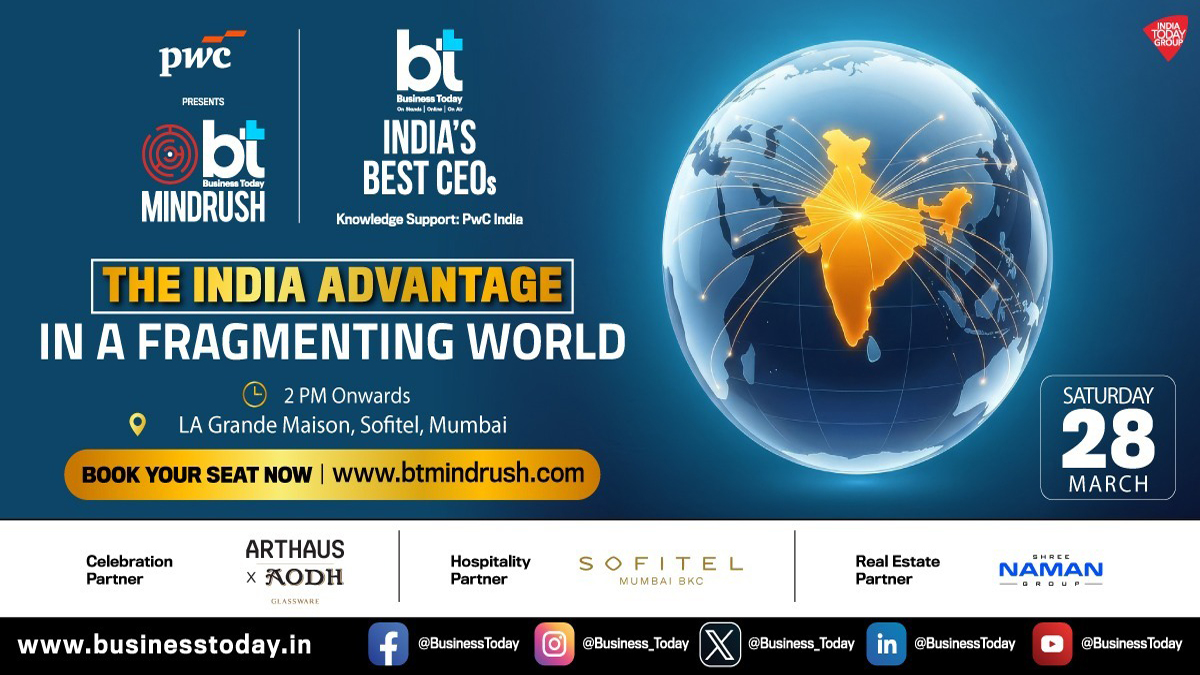
MUMBAI: As fault lines widen across global trade and geopolitics, Business Today is doubling down on India’s moment. The 14th edition of Business Today MindRush & Best CEOs Awards lands in Mumbai on March 28, pitching India’s strategic edge at the centre of a fragmenting world.
The day-long summit, presented by PwC, will bring together a tight mix of policymakers, industry leaders and market voices to decode shifting supply chains, maritime strategy, defence priorities, energy security and capital markets—sectors now deeply entangled with geopolitics.
M Nagaraju, secretary, department of financial services, ministry of finance, will headline the event, setting the tone for discussions that aim to track how India is repositioning itself amid disrupted trade routes and volatile energy dynamics.
The speaker slate reads like a cross-section of India Inc’s command centre. Krishna Swaminathan will zero in on sea lanes and supply chains, while Prashant Ruia is set to push the case for self-reliance in oil and gas. Ashish Chauhan will weigh in on capital markets at a pivotal juncture, as a panel featuring Vibha Padalkar, Sanjiv Mehta, Amish Mehta and Sanjeev Krishan debates navigating economic uncertainty.
Leadership under pressure will be another running theme. Madhavkrishna Singhania, Sharvil Patel, Karan Bhagat and Anurag Choudhary will unpack how businesses are steering through disruption. Arun Alagappan will turn the spotlight on fertilisers, Arundhati Bhattacharya will reflect on leadership transitions, while Anish Shah and S Vellayan will outline blueprints for building future-ready conglomerates.
The event will close with Aroon Purie setting the broader editorial lens, before the Best CEOs Awards recognise standout corporate leadership across sectors.
At a time when the global order looks increasingly splintered, MindRush 2026 is positioning itself as more than a conference—it is a signal that India intends not just to navigate the churn, but to shape it.








