News Headline
TRAI’s Consultation Paper on VoIP can affect mobile TV, IPTV

NEW DELHI: Noting that unified IP based backbone and the benefits associated with the converged telecom access scenario has enabled service providers to launch more and more converged services such as Internet Telephony, IPTV, Mobile TV etc., the Telecom Regulatory Authority of India has sought to know the format of voice over internet telephony (VoIP) in India.
In a Consultation Paper on Internet Telephony, TRAI has also pointed out that use of Internet Protocol (IP)-based networks, including the Internet, continues to grow around the world due to the multitude of applications it supports and particularly due to VoIP. IP-based networks are capable of providing real-time services such as voice and video telephony as well as non real-time services such as email and are driven by faster Internet connections, widespread take-up in broadband and the emergence of new technologies.
The terms ‘IP Telephony’, ‘VoIP’, Internet Telephony and other variants often generates confusion as there are many different definitions used by various organizations. Some use them interchangeably while others give them distinct definitions. Further confusion is caused by using the terms to refer to both the IP-based technologies and the services that are enabled by these technologies.

Convergence is primarily driven by increasing processing power, high capacity memory storage devices, reduced price, lesser power requirement and miniaturization of the devices. High-speed data transfer is now possible which is necessary for delivering innovative and advanced multimedia applications.
Recent trends indicate that Telecom operators are adopting converged platforms to deliver multimedia rich applications containing voice, video and data. The separation of service provisioning and its management from the underlying network infrastructure in packet based networks is further increasing the acceptability of IP based Networks. It is now possible to separate provision of service contents, configuration and modification of service attributes regardless of the network catering such service. There has been enough evidence to suggest that in future IP networks will play much important role and may ultimately encourage migration of conventional networks towards Next Generation Networks or an All IP Network.
In view of this, the Regulator has posed around fifteen questions asking stakeholders to send in their comments by 21 July 2016 and counter-comments by 4 August 2016.
The regulator wants to know what should the additional entry fee, Performance Bank Guarantee (PBG) and Financial Bank Guarantee (FBG) for Internet Service providers be if they are also allowed to provide unrestricted Internet Telephony.
It says the point of Interconnection for Circuit switched Network for various types of calls is well defined, and should the same be continued for Internet Telephony calls or there is need to change Point of Interconnection for Internet Telephony calls.
TRAI has asked whether accessing of telecom services of the TSP by the subscriber through public Internet (internet access of any other TSP) can be construed as extension of fixed line or mobile services of the TSP.
It wants to know whether the present ceiling of transit charge needs to be reviewed or it can be continued at the same level.
The regulation has asked what the termination charge should be when call is terminating into Internet telephony network and whether an Internet telephony subscriber be able to initiate or receive calls from outside the SDCA, or service area, or the country through the public Internet thus providing limited or full mobility to such subscriber.
Should the last mile for an Internet telephony subscriber be the public Internet irrespective of where the subscriber is currently located as long as the PSTN leg abides by all the interconnection rules and regulations concerning NLDO and ILDO, asks TRAI.
It wants to understand the framework if number portability is allowed for Internet Telephony numbers.
In case it is not possible to provide Emergency services through Internet Telephony, will it be enough to inform limitation of Internet Telephony calls in advance to the consumers, asks TRAI.
Since the 1960’s when digital voice communication first emerged, the Public Switched Telephone Network (PSTN) has been supported worldwide as the primary means of voice communication. The PSTN is a connection-oriented, circuit-switched network in which a dedicated channel (or circuit) is established for the duration of a communication. Originally transmitting only analogue signals, the PSTN ultimately switched to digital communication, which offered solutions to the attenuation, noise and interference problems inherent in the analogue system. The modern PSTN uses Pulse Code Modulation (PCM) to convert all analogue signals into digital transmissions at the originating network and reverses the processes in the receiving network.






NEW DELHI: Hamdard Laboratories gathered a cross-section of India’s achievers in New Delhi on Friday, handing out the Hakeem Abdul Hameed Excellence Awards to figures who have left their mark across healthcare, education, sport, public service and the arts.
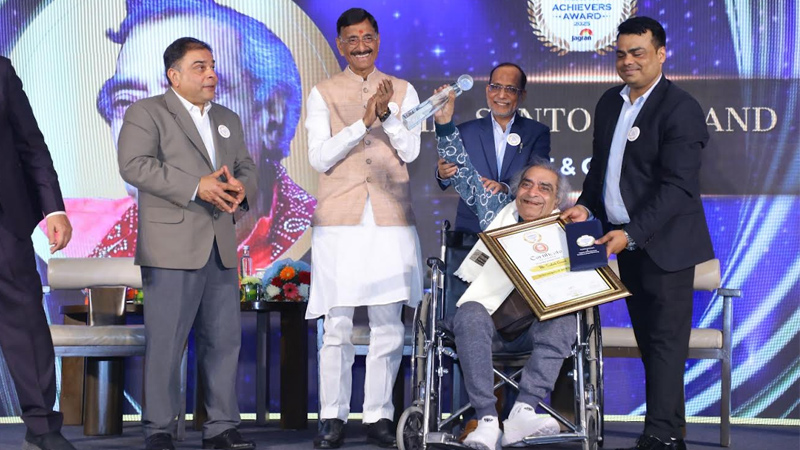
The ceremony, attended by minister of state for defence Sanjay Seth and senior officials from the ministry of Ayush, celebrated individuals whose work blends professional success with a sense of public purpose. It was as much a roll call of achievement as it was a reminder that influence is not measured only in profits or podiums, but in people reached and lives improved.
Among the headline awardees was Alakh Pandey, founder and chief executive of PhysicsWallah, recognised for turning affordable digital learning into a mass movement. On the sporting front, Arjuna Awardee and kabaddi player Sakshi Puniya was honoured for her contribution to the game and for pushing women’s participation onto bigger stages.
The cultural spotlight fell on veteran lyricist and poet Santosh Anand, whose songs have echoed across generations of Hindi cinema. At 97, Anand accepted the honour with characteristic humility, reflecting on a life shaped by perseverance and hope.
Healthcare honours spanned both modern and traditional systems. Manoj N. Nesari was recognised for strengthening Ayurveda’s place in national and global health frameworks. Padma shri Mohammed Abdul Waheed was honoured for his research-backed work in Unani medicine, while padma shri Mohsin Wali received recognition for his long-standing contribution to patient-centred care.
Education and social development also featured prominently. Padma shri Zahir Ishaq Kazi was honoured for decades of work in education, while former Meghalaya superintendent of Police T. C. Chacko was recognised for public service. Goonj founder Anshu Gupta received an award for his dignity-centred rural development initiatives, and the Hunar Shakti Foundation was honoured for empowering women and young girls through skill development.
The Lifetime Achievement Award went to former IAS officer Shailaja Chandra for her long career in public healthcare and governance, particularly in the traditional systems under Ayush.
Speaking at the event, Hamdard chairman Abdul Majeed said the awards were a tribute to those who combine excellence with empathy. “These awardees reflect Hakeem Sahib’s belief that healthcare, education and public service must ultimately serve humanity,” he said.
Minister Seth struck a forward-looking note, saying India’s young population gives the country a unique opportunity to become a global destination for learning, health and wellness by 2047.
The ceremony also featured the trailer launch of Unani Ki Kahaani, an upcoming documentary starring actor Jim Sarbh, set to premiere on Discovery on 11 February.
Instituted in memory of Unani scholar and educationist Hakeem Abdul Hameed, the awards have grown into a national platform that celebrates those building a more inclusive and resilient India. For one evening at least, the spotlight was not just on success, but on service with substance.







